


Javier Milei’s administration has been showcasing Patagonia to Silicon Valley executives, culminating in OpenAI’s ‘Stargate Argentina’ announcement. The focus of this piece, Emiliano Kargieman, is the man actually developing OpenAI’s Argentine project and boasts significant ties to United States’ military and intelligence, NASA, Palantir and the Silicon Valley stalwarts who helped privatize space.
Patagonia, positioned at the tip of the South American continent, has long been valued for its dramatic landscape, its pristine waters and its unique wildlife. However, for some, the value of Patagonia’s natural treasures has shifted. No longer are its majestic glaciers and temperate rainforests to be protected. Instead, it is now being proposed that Patagonia, with its brisk climate and abundant water resources, become home to a new animal –– the data center.
The proliferation of data centers has become a huge political issue in recent months, particularly in the United States, largely due to concerns about their gargantuan appetite for local resources –– driving up utility prices for everyday consumers and endangering communities where some of those resources were already scarce. Many have been outraged about how their local governments, elected to ostensibly protect their interests, have rolled over for data center developers, promising jobs that rarely manifest and –– if they do –– largely evaporate after the center is built. Meanwhile the technology many of these data centers power, Artificial Intelligence (AI), has also sparked its own set of concerns, nominally focused on AI’s usurpation of human jobs and human creativity while generating generous returns for the ultra-wealthy and dubious benefits for the rest of us.
The predation of Patagonia by data center developers has been greatly facilitated by the policies of Argentina’s president Javier Milei. Milei has made it a point to partner with Silicon Valley, as well as the current U.S. administration –– itself colonized by Silicon Valley to an impressive and unprecedented degree. He has also developed generous tax benefits schemes for foreign U.S. Big Tech firms to operate in the country, while offering those that seek to park their data centers in the country next to no regulation regarding their construction or operation. Earlier this year, Milei wrote an editorial in the Financial Times where he “invite[d] AI to free itself” and proposed allowing AI-run companies with no humans involved to operate in his country. While some pointed out that these statements seemed to value AI activity over human activity, this is not an isolated incident. For instance, one adviser in Milei’s inner circle, Demián Riedel, has controversially argued that humans are, in fact, Argentina’s biggest problem, particularly in Argentine Patagonia, because they present an obstacle to AI infrastructure and development in the region.
Riedel was notably involved in brokering a major deal for what will become a truly massive data center in his country: Stargate Argentina. Stargate Argentina is the newest constellation of OpenAI’s Stargate project, which was initially launched in January 2025 “to invest $500 billion over the next four years building new AI infrastructure for OpenAI in the United States.” A few months later, in May 2025, OpenAI announced with little fanfare that it planned to internationalize its Stargate project via its new “OpenAI for countries” initiative. Not long thereafter, and with the direct involvement of Milei and his top officials, Stargate Argentina was born.
While OpenAI is now a well-known name, virtually unknown was their partner in Stargate Argentina –– a company called Sur Energy. Not only was Sur Energy unknown internationally, it was also unknown within Argentina, despite being billed by OpenAI’s Sam Altman as one of Argentina’s “biggest energy companies.” Lurking behind this company, which appears to have no real assets in the country aside from letters of intent, is a man who may be slightly more familiar, at least in Argentina.
Emiliano Kargieman is the face of Sur Energy, but it is only his latest venture in a series of companies that have sought to complement the growing influence of Silicon Valley corporations over the public sector. As will be explored in this article, Kargieman’s previous ventures, particularly the satellite surveillance firm Satellogic, not only boasts close ties to current and former top figures in the Trump administration, but has become an increasingly important part of the AI surveillance grid that the U.S. intelligence contractor Palantir has been amassing. In particular, the company is due to enable –– within the next year –– what was once Palantir’s most implausible ambition –– predictive policing of the entire planet in real time via AI-powered satellite surveillance, i.e. total information awareness.
However, more recently through his efforts alongside Sam Altman to create Stargate Argentina, Kargieman has revealed some hidden truths, not just about the data center he hopes to build, but about the data center build-out at large. As will be detailed in this article, Kargieman has casually admitted that Stargate Argentina is not about bringing jobs to locals (despite what some Argentina politicians have claimed), but about generating dollars. Perhaps more revealing of all, he revealed that it is likely that his partner in Stargate Argentina, OpenAI, will not be ultimate end-user of this massive data center, suggesting that the prominent AI firm will collapse under the inevitable popping of an AI debt bubble. In stating this he notes that, whether OpenAI or not, someone will be using this data center. If so, who will use it and what for? Based on Kargieman’s statements and the available evidence, we have attempted to answer those questions, revealing increasingly likely possibilities that will have implications far beyond Argentina.
Raised in the Palermo district of Buenos Aires, Emiliano Kargieman’s childhood was characterized by his early obsession with computers and a rebellious streak. For instance, he learned how to repair computers at age 10 and was also kicked out of school for filling the principal’s office with toilet paper. At 15, he claims to have created his first software company. By this time, as a teenager, he had also become part of a hacking collective called “Hacked by Owls”, or HBO. According to Matt Travizano, Kargieman’s long-time friend (and later his co-founder at Sur Energy), some of the HBO members used their technological prowess to spy on the conversations and communications of Argentine Congressmen. Though HBO seemed adversarial to State interests, with its members claiming to espouse “anarchist” ideals, many of its members –– including Kargieman –– simultaneously worked for the Argentine government.
For instance, while Kargieman has declined to disclose this in media interviews, one of his old CVs lists him as working for the Argentine government’s Special Information Security Research Group from age 14 to age 17, overlapping with his time at the HBO collective. This group was part of the DGI (Dirección General Impositiva), Argentina’s General Tax Directorate. This is notable given that, while working for this State agency, Kargieman’s hacking collective was also allegedly spying on elected officials.
In 1997, when Kargieman was 20, he and the broader HBO collective began working directly for Argentina’s AFIP (Administración Federal de Ingresos Públicos; in English, Federal Public Income Administration). That year, the DGI, which had employed Kargieman as a teenager via the Special Information Security Research Group, was placed under the AFIP’s authority. Shortly before then, in 1996, Kargieman had created a cybersecurity company that would later become known as Core Security Technologies. He did so with five of his friends, including Gerardo Richarte, Lucio Torre, and Jonathan Altzszul, who had previously worked at the Special Projects Office at Argentina’s AFIP.
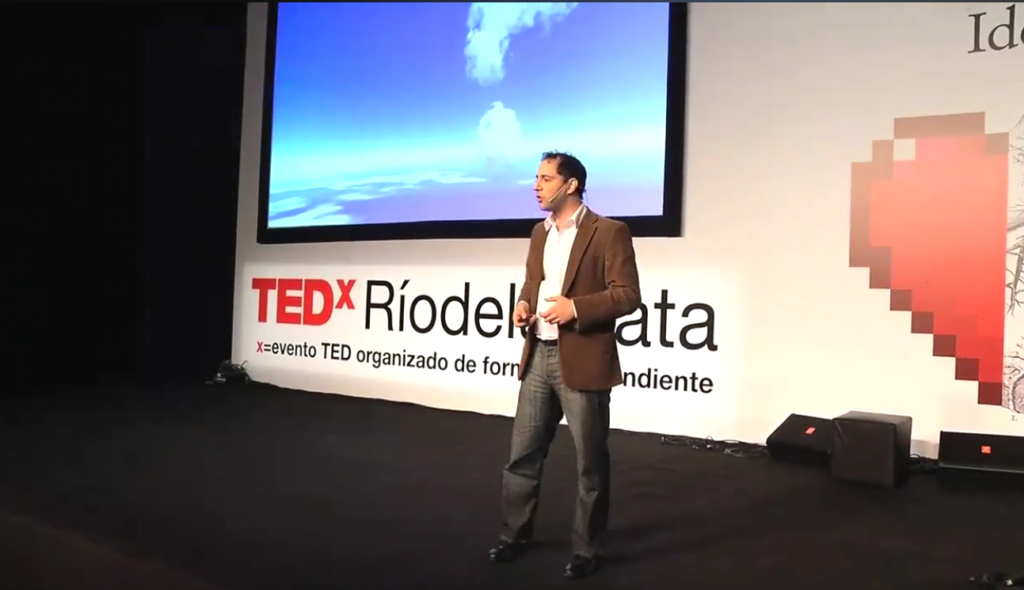
Richarte, Torre, and some long-time employees of Core Security, such as Norberto Kueffner, later followed Kargieman to Satellogic, the satellite surveillance company he would later create. Notably, Kueffner is now Director of IT for Javier Milei’s administration. Another veteran of Core Security, Ariel “Wata” Waissbein, is now the head of Argentina’s Federal Cybersecurity Agency (AFC). Yet another Core Security veteran who also went to work for Satellogic was Aviv Cohen, a former Israeli intelligence officer who was, for a time, Satellogic’s head of “special projects.”
In 1998, a year after becoming entangled with Argentina’s AFIP, Kargieman’s firm Core Security began focusing expressly on the U.S. Market. Shortly thereafter, it attracted significant attention from U.S.-based businesses, such as Apple and Lockheed Martin, and the public sector. Core Security’s main U.S. public sector clients soon included the Department of Homeland Security (DHS), the U.S. military’s DARPA, NASA and the NSA.
The same year, in 1998, Core Security was named an “Endeavor Entrepreneur” by the Endeavor Foundation –– a non-profit organization founded the year prior by two Americans, Linda Rottenberg and Peter Kellner. While much can be said about Endeavor, which features prominently in a previous investigation from Unlimited Hangout, their affinity for a small Argentine software company should be of little surprise given the organization’s intimate relations to the South American country. For starters, Rottenberg and Kellner met while in Argentina. Long before the likes of Edgar Bronfman Jr., Reid Hoffman, and Pierre Omidyar had donated vast sums of money to the entrepreneurial evangelicals, Endeavor’s first success story was Marcos Galperin’s MercadoLibre. Galperin became Argentina’s richest man –– on paper, anyway –– due to his firm’s success, before joining Endeavor’s board when the once-non-profit added a new venture capital component to their organization. Endeavor, now advised by Galperin, eventually funded Kargieman’s later company Satellogic, and Galperin now serves on Satellogic’s board.
By 2001, Kargieman’s Core Security also gained the attention of Pegasus Capital. As noted by iProfessional, Pegasus –– beginning in February 2001 –– began “collaborating” with Core in the development of Core’s business model, growth strategy, organizational design and much more. Pegasus Capital was created by Craig Cogut, a key figure in the “junk bond” financial scandal at the now defunct bank Drexel Burnham Lambert. Drexel’s junk bond department, led by Michael Milken, engaged in blatantly illegal activity and used junk bonds to help fuel the takeovers of major corporations by the era’s infamous “corporate raiders” prior to the bank’s collapse. More specifically, Cogut was the lawyer who advised the Milken-run and scandal-ridden junk bond department on the legality of its transactions, including those that saw Milken become a convicted felon. Following Drexel’s collapse, Cogut teamed up with a group of Drexel alumni led by Leon Black –– now best known for his close association with the deceased sex trafficker and Black’s “financial adviser” Jeffrey Epstein –– to co-found Apollo Advisers (now Apollo Global Management) in 1990. Cogut left Apollo to found Pegasus in 1996. Pegasus has since became a key player in several UN-supported “green” finance initiatives, including some which have directly involved Kargieman’s other company Satellogic.
In 2006, Kargieman created Aconcagua Ventures as a joint venture with Pegasus Capital. This firm ostensibly “focused on investing in high-tech startups in Latin America to develop them as global businesses.” By 2009, it had only invested in Core Security as well as the company Popego, where Kargieman served as both CEO and director in 2007. Popego was described around this time as an artificial intelligence (AI) software company.
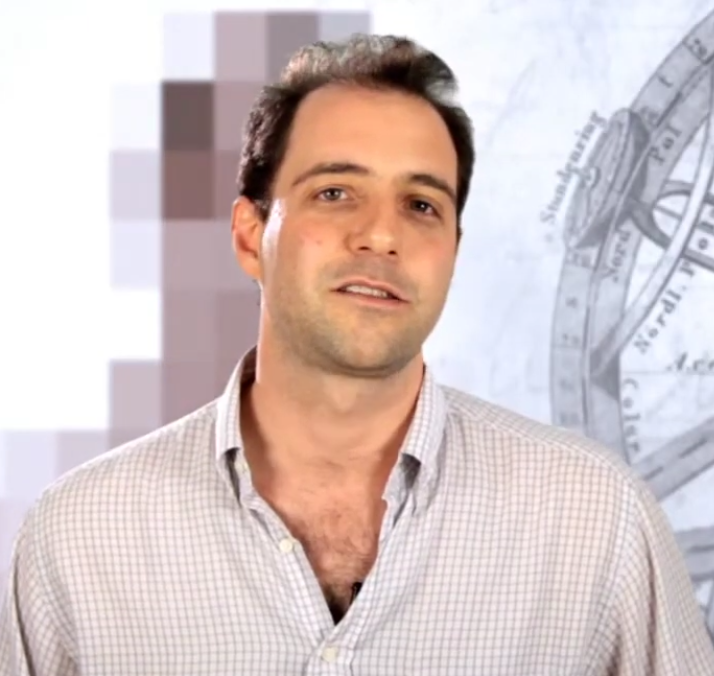
Popego, as well as Aconcagua Ventures, backed a non-profit organization that launched in 2009 with the goal of creating a virtual currency related to one’s online reputation. That organization was called The Whuffie Bank and Emiliano Kargieman is listed as one of its founders. The Whuffie Bank, which launched at a TechCrunch conference in 2009, aimed “to promote change in the web by rewarding users with a positive impact on the web with this karma-like digital currency.” This “non-profit” planned to closely surveil social media users by “monitor[ing] [their] activity across various websites, including things like comments, posts, and more.”
As TechCrunch further explained:
“When you complete positive actions, you gain Whuffies, and you lose them when you do something that the organization deems to be detrimental. [. . . ] The algorithm takes into account ‘public endorsements’, or the number of times a user’s tweets are retweeted, or a Facebook post is Liked. It also takes into account who is making the endorsement, and the content in the messages that are being posted.”
The Whuffie Bank website noted that the goal of the organization was to drive “social change” through its virtual currency, while another Whuffie Bank co-founder, Santiago Siri, has described its goal as “rethink[ing] the future of money.” Siri, while working at the Whuffie Bank, was named a World Economic Forum Global Shaper for his efforts to advance digital, reputation-based money that rewards or punishes users based on their online activity and speech. The Whuffie Bank represents an early effort to link digital currencies to the digital behavior and reputation of its users, efforts which continue today in other forms and have raised concerns about ascendant “social credit systems.”
While the Whuffies went extinct, Kargieman’s next venture Satellogic quickly placed him shoulder to shoulder alongside the very pioneers responsible for digitizing the U.S. financial system, e.g. former U.S. Treasury Secretary Steve Mnuchin and current Commerce Secretary Howard Lutnick (previously the CEO of Cantor Fitzgerald, the largest dealer of government securities in the country). Before his low Earth observation satellite firm took off, former NASA contractor Kargieman found himself in Northern California, at the very Air Force base where Silicon Valley unofficially took hold of the country’s space program –– taking what was once the pride and joy of the US government firmly into the private sector for good.
According to the earliest iterations of its website, Satellogic was founded in 2010 by “two graduates of the NASA Ames-based Singularity University’s Graduate Studies Program” in order to build “shared low earth orbit infrastructure to open real-time satellite data to a new generation of application developers.” Emiliano Kargieman and his co-founder, Andrew Fursman, came up with the “concepts that would become Satellogic” while enrolled in that graduate student program. The program took place at Northern California’s Moffet Federal Airfield –– one of the most prominent locales for NASA’s extensive collaboration with the private sector.
The airport was formerly a US Naval facility. Right up until the year Satellogic was founded, it had housed the Air Force’s 21st Space Operations Squadron. Today, the airport is served by the California Air National Guard, and notably the 7th Psychological Operations Group of the US Army Reserve –– an influential support group for military actions which “involve[s] sharing specific information to foreign audiences to influence the emotions, motives, reasoning, and behavior of governments and citizens” including “cyber warfare and advanced communication techniques across all forms of media.”
NASA’s Ames Center is also known for containing one of the largest free standing buildings in the world –– Hangar One. This building, built in 1933, is over 8 acres large and is known for having fog and other weather-type patterns within its voluminous confines. In addition, it became home to the private jets of past and present Google executives Larry Page, Sergey Brin and Eric Schmidt after a $33 million renovation plan Google offered to NASA in 2011. NASA, the federal Environmental Protection Agency (EPA) and the California Regional Water Quality Control Board eventually came to an agreement in November 2014 which saw Google’s subsidiary Planetary Ventures LLC sign a 60-year lease worth $1.16 billion in rent, which included plans to significantly remodel the famous hangar.
Notably, the first oldest archive version of Satellogic’s website features an image of Hangar One, complete with a five-point star adorning a large bay door and another on top of the building. This is quite likely due to the fact that back in 2009, NASA, Google, and the Ames Center staff collaborated on the founding of the very incubator program that germinated the core ideas of Satellogic.

Unlimited Hangout’s first investigation into Satellogic –– April 2024’s Debt From Above: The Carbon Credit Coup –– focused mainly on the firm’s public-private partnerships related to their enforcement of a blockchain-enabled carbon market scheme via satellite surveillance. To spare repeating information regarding Kargieman’s company that was previously addressed, this article will instead focus on placing Satellogic within the context of the decades-long transmutation of America’s space program from the public sector’s federal budget into the private sector powerhouse. From the evidence, it appears that the main figures and sites responsible for NASA partnerships with the Tech industry, not only produced Elon Musk’s SpaceX –– Satellogic’s “preferred vendor for ride share missions” –– but also Satellogic itself. It seems that Satellogic was essentially created to aid both the privatized U.S. space and mass surveillance programs.
 Mark Goodwin
In September 2008, author and futurist Ray Kurzweil teamed up with space entrepreneur and X PRIZE Foundation chairman Peter Diamandis to found Singularity University (SU). Their decision to partner came after Diamandis read Kurzweil’s 2005 book The Singularity is Near, which argues that machine intelligence will soon surpass human intelligence and that humans and machines should, at that point, merge into a transhumanist collective. Diamandis approached Kurzweil after reading and suggested they partner on what would become Singularity University.
The goal of SU is to educate the “leaders of tomorrow” in emerging technologies that Kurzweil, and presumably Diamandis, believe will allow humanity to accelerate the arrival of this “singularity” event and thus a transhumanist future for humanity. Singularity University’s website boasts that it has consequently developed “a global ecosystem of techno-optimists.” This term appears to be a reference to venture capitalist (and current Pentagon advisor) Marc Andreessen’s “Techno-Optimist Manifesto,” in which Andreessen argues for a full-throated embrace of “transformative” technologies like AI on an accelerated timeline, with complete disregard for whom or for what it could create negative consequences. Kurzweil is notably a “patron saint” of techno-optimism and Andreessen’s manifesto more or less portrays the ideology that Singularity University seeks to instill in its “techno-optimist” graduates.
The “Techno-Optimist” ideology overlaps considerably with Technocracy. This overlap is detailed extensively by Iain Davis in his book The Technocratic Dark State. Davis, in his book, defines Technocracy as a form of governance that claims to maximize efficiency by “scientifically” managing and socially engineering the human population using autocratic sociopolitical and technological behavioral control. In a technocratic system, the management and social engineering of the “human animal” is to be performed by unelected “experts” in science, engineering or technology, also known as the technocrats. This form of governance has been heavily adopted by the wealthiest men in Silicon Valley, including Andreessen as well as others like Elon Musk and Peter Thiel.
A few months after Singularity University was created, the newly-formed university found a home at NASA’s Ames Center after securing “Corporate Founding” funding from Googleand ePlanet Ventures. While Google needs little introduction, ePlanet Ventures is a venture firm associated with Tim Draper’s DFJ (Draper Fisher Jurvetson), whose investment committee once featured all three of DFJ’s partners. One of those partners, Steve Jurvetson –– much like SU founder Diamandis –– is a long-time friend of SpaceX’s Elon Musk, with positions on both the Tesla and SpaceX board. He is also credited with bailing out Musk in 2008 with large investments in both firms. However, Jurvetson hardly deserves singular responsibility for SpaceX’s survival. Two other men who were involved in that rescue also happened to play a prominent role in the founding of SU, where Satellogic was born.
Then-Director of the Ames Center, Simon “Pete” Worden, spoke upon SU’s founding, stating that “The NASA Ames campus has a proud history of supporting ground-breaking innovation, and Singularity University fits into that tradition.” Worden had been selected to run Ames by his long-time friend, Dr. Michael Griffin, who became the Administrator of NASA in 2005. Both Worden and Griffin were alumni of the controversial Strategic Defense Initiative Office (SDIO) –– colloquially known as “Star Wars” due to its early 1980s formalization under President Ronald Reagan –– with Worden having taken over Griffin’s job as Head of Technology in the space-focused missile defense program.

While at SDIO, both Griffin and Worden were responsible for immense strides taken in fields quite relevant to today’s commercialized space industry. For starters, their work helped pioneer the development of Low Earth Observation (LEO) satellite constellations such as those later launched by Satellogic. Their advancement of satellite broadcasting capabilities in general was accomplished via SDIO’s Clementine project –– a “small, low-cost, and rapidly developed satellite used to test sensor and propulsion technology for missile interceptors” and which also “mapped the Moon.” Additionally, Griffin was working at the Virginia-based Orbital Sciences after his time at SDIO, a company which pioneered the use of “a system for collecting data from remote locations using satellites in low-Earth orbit.” Worden is considered a “crucial innovator and promoter of small satellites in the early years of development” while at SDIO.
Worden and Griffin were also both instrumental to the commercially-viable build out of the reusable, vertical take-off and landing of the “DC-X” rocket, which set the stage for SpaceX’s commercially-viable building of reusable, vertical take-off and landing Falcon 1 rockets. In fact, Musk himself told former manager of SDIO Jess Sponable in 2013 that SpaceX was “just continuing the great work of the DC-X project!” While many details remain outside of the scope of this article, Griffin’s stint running a budget-starved NASA while Worden merged the space program with Silicon Valley at Ames led to accusations from Ames employees that the two men were “part of a conspiracy to destroy America’s space program.”

There are few people more responsible for the private sector takeover of the space industry than Griffin, Worden, and Diamandis –– all of whom have their unique ties to Elon Musk and the founding (and eventual success) of SpaceX.
In August 1993, the Falcon 1 predecessor “DC-X” took its first lift off in White Sands, New Mexico during testing by contractor McDonnell Douglas on behalf of the SDIO. Griffin, the Deputy Director of Technology for SDIO at the time, stated that the “DC-X was government R&D at its finest.” The DC-X took its last flight in 1995 before being upgraded to the DC-XA, which was promptly passed back within NASA proper, only to be shuttered after a final flight on July 31, 1996.
In May 1996, the month prior to the shutdown of the DC-X project, Diamandis officially founded the X Prize. The prize offered $10,000,000 to the team that could successfully breach the lower atmosphere. While the winning team would not do so until 2004, the prize kick-started the private, commercial space industry, and was influential in addressing new forms of fundraising and project management for NASA. The original X Prize Foundation Committee, announced in December 1996, featured Worden in addition to astronaut Buzz Aldrin, among others. Due to the nature of the prize being first announced in 1996, the many teams competing had to spend years building their rockets and technology, causing nearly a decade of waiting for the new space industry to blast off.
During this interim period, Diamandis got a call from Bill Gross, the founder of the early tech startup incubator Idealab, in 2000 to come aboard a new company as CEO. That new company, called BlastOff!, was given a $1 billion budget to organize a private moon mission. In a 2008 video for the Google Lunar X Prize, which officially brought together the Griffin-led NASA with SU’s funder Google and Diamandis’ X Prize, Diamandis describes the team at BlastOff! as having eventually decided to use the Russian ICBM “Dnepr” to launch their moon mission. BlastOff!, which operated in stealth, eventually shuttered in January 2001.

Only a few months prior, in October 2000, Musk was replaced by Peter Thiel as CEO of PayPal/X.com, with PayPal also having come out of the Idealab incubator (as Confinity) with an early investment from Gross and Idealab in January 2000. Furthermore, the first board member of PayPal was Idealab VP Scott Bannister, who graduated college with PayPal founder Max Levchin, and who was responsible for introducing Levchin to Peter Thiel. As previous investigations from Unlimited Hangout have aimed to prove, Idealab –– despite being little known today –– is intimately connected to the primordial origins and subsequent immense success of Google, PayPal, Palantir, Tether, PolyMarket and arguably Musk’s SpaceX.
Out of a job and about to be flush with cash from the sale of PayPal to eBay, Musk set his sights on the stars, Mars, and beyond. The year after he was ousted from PayPal, Musk met Griffin at The Mars Society in 2001, which kicked off their lengthy friendship. The Mars Society was previously formed in 1998 and boasted Griffin as a founding Steering Committee member. X Prize Foundation Committee member Aldrin, and a plethora of employees from NASA’s Ames Center soon joined him. Musk made a large donation and subsequently joined the Steering Committee alongside Griffin. Musk has since overtly promoted the idea of establishing a technocracy on Mars. Affinity for technocracy seems to run in Musk’s family, as his maternal grandfather previously led the technocratic movement in Canada.
In 2001 and 2002, Musk and Griffin made multiple flights to Russia in an effort to purchase Dnepr rockets in order to begin experiments in space travel, arguably continuing the work of the Idealab-sponsored BlastOff! On one of their trips to Russia, after finding the purchasing price of the Russian ICBMs too high, Musk typed out a model to manufacture the rockets needed, but at low cost. He reportedly came up with the plans for SpaceX on the flight back alongside Griffin. Griffin was offered a role as Chief Engineer at SpaceX, but decided instead to become the President and COO of the CIA’s investment firm, In-Q-Tel. Musk allegedly named his son Griffin Musk after his friend, and eventually gave Griffin an advisory role at SpaceX-subsidiary Castelion in 2022. Castelion boasts mass-production capabilities of hypersonic missiles, and additionally features fellow In-Q-Tel-alum Lisa Porter on the advisory board.
Griffin left In-Q-Tel to take the reigns at NASA in April 2005 after being selected by President George W. Bush. Only a week after his appointment, Griffin met with Musk at NASA Headquarters. Two key changes to NASA’s status quo occurred at the onset of Griffin’s term –– massive budget cuts to the likes of the Ames Research Center in November 2005, and the authorization of the “Prize Authority.” This novel fundraising and budget concept had been pioneered by Diamandis’ X Prize. Only a few years later, Google, NASA and X Prize collaborated together on the aforementioned Google Lunar X Prize in 2008. Griffin was quoted as being “an advocate for the use of Prize Authority we’ve had at NASA since 2005.”
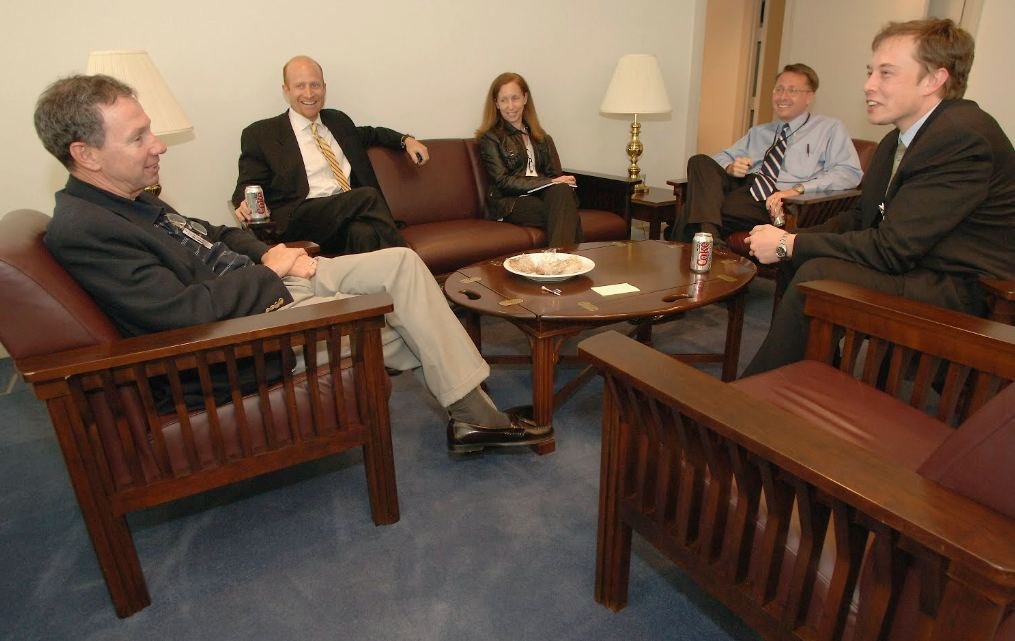
Griffin used his position at NASA to further advocate for the commercial and private space industry, and when Musk’s SpaceX nearly folded after three failed rocket launches, Griffin and his friend Worden came to Musk’s aid. In April 2006, after the explosion of a Falcon 1 on its maiden voyage, the Pentagon selected Worden to lead the inquiry into the mishap, as DARPA had helped fund the launches. The very next month, in May 2006, Worden was selected by Griffin to lead the ever-important Ames Research Center. Two years later, in December 2008, the Griffin-led NASA formally partnered with X Prize and Google, and gave $3.5 billion in contracts to SpaceX and Griffin’s former company Orbital Sciences –– saving Musk’s then-troubled company in addition to the aforementioned private bailout from Jurvetson.
The next month, January 2009, Singularity University was announced by X Prize’s Diamandis with support from the Griffin-led NASA and with funding from Google and the Jurvetson-affiliated ePlanet Ventures –– stationed at the Worden-led Ames Research Center. Early reports of the announcement even listed Worden as an official founding member of SU, although he never appears in later iterations of their founding story. When Worden finally announced his 2015 departure from the NASA Research Center, he specifically referred to “the nine years he spent at Ames” as “the most enjoyable of his 40 years of public service.” Worden furthered:
“In the last nine years we have launched dozens of small, low-cost satellites – and helped ignite a major new industry in this area… Ames has provided entry technology for the emerging commercial space launch sector. We have helped launch small satellites working with a number of nations. And we’ve hosted and inspired thousands of students.”
It is hard to separate Worden’s musings on his time at Ames from Kargieman’s decision to found of Satellogic. Not only did Kargieman become interested in the commercial space launch sector and “small, low-cost satellites” while studying at the Worden-linked, “techno-optimist” graduate program, but the same Ames facility where that program was hosted also apparently became Satellogic’s first home. Thus, more than just sparking the idea for Satellogic, Ames seems to have incubated it as a company. Furthermore, it remains difficult to parse the beginnings of Satellogic from its connections to major players in the privatization of the military and space programs. Many of these companies have been discussed in prior investigations from Unlimited Hangout –– including SpaceX, Tether, and Palantir –– not to mention their willing public partners within the US government. Notably all three of these companies have since become directly and significantly partnered with Satellogic.
In addition, one simply has to look at Satellogic’s board members, both past and present, to understand that Kargieman’s company is hardly a simple tech startup, and operates far more like a cog in a well-designed, multi-headed apparatus developed by the U.S. government but profiteering as a private company.

As previously stated, much was written about the founding and funding of Satellogic in Debt From Above, but the more recent developments deserve reminding for the context of this piece. For starters, in 2022, the current Commerce Secretary Howard Lutnick, who boasts intimate ties to stablecoin issuer (and eventual Satellogic investor) Tether, helped connect Kargieman’s company with former Treasury Secretary Steve Mnuchin, who then funded Satellogic via his firm Liberty Strategic Capital. Both Lutnick and Mnuchin joined the Satellogic board that same year. Another board member who also joined that year has direct connections to the Pentagon –– Liberty Strategic Capital’s Senior Managing Director General Joseph Dunford (Ret.), who was the former Chairman of the Joint Chiefs of Staff under the first Trump administration. In addition, Lutnick’s Cantor Fitzgerald notably helped take Satellogic public, with the ticker $SATL.
In February 2022, Satellogic also officially partnered with Palantir, the privatized versionof the Pentagon’s controversial Total Information Awareness program. Satellogic claimed in a press release that its partnership with Palantir was intended to “leverage Palantir’s Foundry platform” in order to “accelerat[e] business process, rapid image product delivery, AI model training, and enterprise-wide data integration.” The partnership also saw Satellogic become a major provider of space-based surveillance data to the U.S. government via Palantir, which contracts with all 18 U.S. intelligence agencies, the military and many other U.S. federal agencies. According to Satellogic’s press release, as part of the deal, “Satellogic will provide Palantir’s U.S. government customers with ready access to Satellogic’s high-resolution satellite imagery to drive analytical insights across a range of mission-oriented use cases.”

A few months after announcing their partnership, in April 2022, Satellogic and Palantir launched their “first Edge AI-enabled satellite into space” with assistance from SpaceX’s Transporter 4 mission. This trio working together directly lends credibility to the theory described above that the common players behind all three companies were building collaborative infrastructure –– in this case, satellites, AI and rockets. According to their press release, the “new Edge AI-enabled NewSat” is the product of a “six-month project” in which “Satellogic adapted its hosted payload program and edge computing hardware” in order to “run Palantir’s Edge AI platform.” Their “joint project” aims to “deliver[. . .] new capabilities which will have broad applicability across mission sets in both government and the commercial sector.” This technological collaboration allows for quick swapping between different algorithms depending on its location. The press release furthers:
“We are able to hot-swap between models and chain capabilities, depending on mission requirements and terrain. For example, when the satellite passes over a port we can run the cloud detector, image segmentation, and ship detector models, and when passing over a town we can switch to vehicle and building detectors.”
In total, the Satellogic hardware is capable of running 6 additional third party models, including Palantir Omni and Palantir Overcast, in addition to Xailient, Pilot.ai and Mind Foundry. According to Palantir, “the Palantir-Satellogic collaboration represents a significant step in expediting delivery and dramatically improving the quality of data sent back to customers.” Palantir’s blog post on the collaboration concluded that:
“[T]his pioneering application of Edge AI in space aims to serve as the foundation for advanced analytics that can inform timely solutions to address critical global priorities, like combatting climate change, preventing disasters, and improving emergency response.”
One of Satellogic’s more recent announcements relates to the imminent launch of a new constellation of satellites it has named Merlin. Due to launch this October and become active some time in 2027, Merlin will “support persistent monitoring of unlimited locations worldwide” by “enabl[ing the] daily remapping of the entire planet at one-meter resolution.” Presumably, this will also grant its analytic partner, Palantir, the same capability.
In announcing Merlin, Kargieman stated the following:
“Until now, organizations had to choose between global coverage at low resolution or high-resolution monitoring of a limited number of sites. Merlin removes that trade-off and enables persistent monitoring at planetary scale.”
In an interview earlier this year with Forbes Argentina, Kargieman remarked that Merlin will soon “allow us to do things we never imagined. With AI [and Merlin] we can begin to predict the future.” As noted in previous reporting from Unlimited Hangout, a long-time major focus of Palantir is predictive analytics, particularly predictive policing –– often referred to as “pre-crime.”
Merlin exemplifies Satellogic’s efforts to push planetary surveillance into a new paradigm. Kargieman has referred to this new paradigm as “Persistent Global Intelligence,” a departure from the existing Earth Observation paradigm of “episodic imagery.” Its efforts in this regard are meant to empower global intelligence and defense agencies, particularly those of the United States. This is reflected, not only by Satellogic’s existing and new U.S. government contracts, but also through their recent partnerships with U.S. government contractor SynMax (AI surveillance data analytics company backed byPalantir co-founder Joe Lonsdale’s 8VC) and appointing one of the main architects of the U.S. military’s controversial Project Maven (AI-powered weapon targeting software) as a strategic advisor.
While engineering Satellogic’s pivot to AI-powered “Persistent Global Intelligence” satellite surveillance, Kargieman decided to create yet another company –– this one aimed at cashing in on the AI “boom.” He, along with Matt Travizano and Stan Chudovsky, founded Sur Energy in 2025. Travizano was an Argentine who was also the head of Sur Ventures, which invested in Satellogic, and had long-standing business interests in California. He is also credited with connecting the administration of Javier Milei to prominent figures in Silicon Valley. Travizano died last year while scaling California’s Mount Shasta, shortly after founding Sur Energy. Meanwhile, Chudovsky was previouslyVP of Messaging at Meta/Facebook and, prior to that, VP of Growth and Global Strategy at PayPal.
Shortly after launching, and even before having a website presence, Sur Energy announced a massive partnership with OpenAI, the formerly non-profit but now for-profit AI company run by Sam Altman and the developer of ChatGPT. Altman is a protégé of Peter Thiel, the billionaire co-founder of PayPal and Palantir whose recent move to Argentina and meetings with Milei and top government officials earlier this year made international headlines.

The Sur Energy-OpenAI partnership, formalized in October 2025 via a letter of intent, seeks to develop a $25 billion data center in Argentina’s Patagonia region called Stargate Argentina. Oracle, the CIA-linked data infrastructure company helmed by Larry Ellison, will likely operate Stargate Argentina upon its completion, per Kargieman. Oracle is notably OpenAI’s partner in the U.S.-based Stargate project, which –– per OpenAI –– now has global ambitions. Kargieman has also claimed that construction on Stargate Argentina will begin this year and end in 2027, even though the planned location of the site has not been made public. Notably, Milei’s administration was intimately and directly involved in the discussions that led to the signing of the letter of intent between Sur Energy and OpenAI.
In announcing the project, OpenAI’s Sam Altman referred to Sur Energy as one of Argentina’s “leading energy companies,” which it is not. Upon the announcement, even Bloomberg noted that Sur Energy was entirely unknown in the sector and had exactly zero assets in the country. OpenAI later clarified that Sur Energy was instead “the energy and infrastructure developer” of the project, not the provider.
Reports have suggested that the majority state-owned nuclear power firm, Nucleoeléctrica, may play a role in the project. Significantly, Milei’s government announced its efforts to privatize Nucleoeléctrica just weeks before Stargate Argentina was announced. Forbes pointed to the involvement of Nucleoeléctrica’s former president, Demián Reidel, in Stargate Argentina. Reidel, prior to leading Nucleoeléctrica, had been a top advisor to Milei and an architect of his administration’s policies on AI and nuclear power. In that role, he had controversially claimed that Argentina, Patagonia in particular, was ripe for AI development, but that its main problem was that it was too populated with Argentines.
It was later revealed that Sur Energy had signed two memorandums of understanding with two other Argentine power providers prior to announcing the project in October of last year. Those companies are Central Puerto and Genneia. Central Puerto is the formerly state-owned power provider of the Buenos Aires area, which was privatized in the early 1990s and has since expanded to several other areas of the country. The second, Genneia, is an interesting company to explore in this context, as it shows how Milei’s administration has become entangled with the network supporting Milei’s ostensible worst enemies.
Genneia was created in 1991, initially operating as a natural gas distribution company under the name Emgasud. It rebranded to Genneia in 2012 following a pivot to renewable energy. This pivot was driven by the introduction of a new crop of shareholders, namely Argentine businessman Jorge Horacio Brito, his son Jorge Pablo Brito and his long-time business partner and brother-in-law Delfín Jorge Ezequiel Carballo, all of whom joinedthe company’s board a year prior to the rebrand in 2011.
Brito was the long-time head of Argentina’s Grupo Macro, which includes and was built around Banco Macro. Brito’s early banking enterprise was initially launched as a financial company during the 1970s, when Argentina was under dictatorship. His company was closely related to figures who would later become top officials in the government of Raúl Alfonsín, after Argentina transitioned away from dictatorship and toward “democracy.” One such figure was Mario Brodersohn, who was Alfonsín’s Treasury Secretary when Brito and Banco Macro were granted banking licenses in the late 1980s. Brito allegedly used his close ties to the government for privileged access to information. In one notorious example, his bank bought 3 million dollars prior to the Alfonsín government’s disastrous “Spring Plan” (Plan Primavera) that saw the Argentine peso sharply devalued. He was investigated, but never charged.
Under the subsequent government of Carlos Menem and a wave of privatizations, Brito again received preferential treatment. When the province of Salta had its regional bank privatized, Brito’s Banco Macro was the only buyer put forward. Other provincial banks were privatized in a similar fashion, netting Banco Macro millions of taxpayer dollars annually just in payment for its maintenance of provincial bank accounts.
During the Argentine economic crisis of 2001, Brito’s Banco Macro came out on top, buying up collapsing banks and expanding its footprint. Meanwhile, the bank participated in the notorious “corralito,” a government policy whereby depositor funds were essentially frozen for over a year and Argentines could only withdraw $250 a week from domestic banks. During that time, the Argentine peso was, again, sharply devalued, and depositors lost a significant portion of their wealth.
Brito subsequently became extremely close to the political power center of Argentina yet again under the “center-left” Kirchner political dynasty. This coincided with Brito’s appointment to chair ADEBA, the Association of Private Banks of Argentine Capital. Brito was again a major beneficiary of Kirchner-era policies, including the decision to have ADEBA banks manage pension pay-outs. He was also investigated for his apparent role in moving suspect funds in one of the worst corruption scandals of the Kirchner era, the Ciccone Case. He was allegedly involved in several other corruption scandals that plagued the Kirchner presidencies, but was never properly investigated. His coziness with political power even continued under the “right-wing” government of Mauricio Macri, leading some media outlets to call Brito “the banker friend of political power, who never loses.”
However, it seems that Brito’s strategy to be as close to political power as possible was not only about making massive profits, but also about preventing investigations into his apparent criminal dealings. Banco Macro, under Brito, was an avid money laundering enterprise. When Argentine authorities began fining banks for violating anti-money laundering (AML) practices in 2010, Banco Macro was fined for just that five times in less than a year. A few years later, in 2015, Banco Macro had some of its activities temporarily suspended by Argentina’s National Securities Commission (CNV) for continuing to fail to enforce even the most basic AML practices. The bank then issued a short press release (without providing evidence) that it had, in fact, complied and, thanks to Brito’s political connections, the suspension was lifted after just one week.

Brito was eventually forced to step down from Banco Macro following his role in the Ciccone Case, the aforementioned Kirchner-adjacent corruption scandal, as well as money laundering concerns. He returned to lead the bank in 2020, once he and his associates believed the fallout from the scandal had died down, only to die in a bizarre helicopter crash a few months later. After his death, his son Jorge Pablo Brito took the reins of his business interests along with Delfín Jorge Ezequiel Carballo, who was Jorge Brito’s long-time partner and brother-in-law.
When Javier Milei ran for Argentina’s presidency, he ran against what he called a political “caste” that included, not only politicians, but the businessmen who enabled and often benefited from brazen acts of political corruption. Banco Macro, under both Britos, has been a key financial enabler of this political caste, with some former Argentine politicians calling it “the bank of Argentina’s [establishment] politics” because of its long-running and often insidious relationship with national politicians. The Brito family and Banco Macro are arguably a key financial node that has allowed this political “caste” to function and metastasize. Milei has even privately referred to Jorge Pablo Brito, chairman of the board of Genneia, as one of the main financial backers of his party’s opposition.
Nevertheless, under Milei’s government, Brito’s Genneia has been given preferential treatment compared to other domestic energy companies and given million of dollars in government contracts, undermining both Milei’s supposed commitment against the entrenched “caste” of Argentine political corruption as well as his supposed commitment to free market competition. Perhaps Brito’s and Milei’s shared interest in turning Patagonia into an AI “hub” was enough for Milei to look the other way.
However, even the deals with Genneia, as well as Central Puerto and Nucleoeléctrica, may not be enough to power Kargieman’s Stargate Argentina. According to press releases and reports, Stargate Argentina is planned to have a capacity of up to 500 MW “to support advanced artificial intelligence computing.” This means that the data center will use roughly 500,000 kilowatt-hours (kWh) every hour, and thus roughly 4.38 billion kWh annually. As a result, Stargate Argentina, once it is fully operational, would aim to use a supply of electricity roughly equivalent to 3.4% of all electricity currently produced in the entire country annually. In contrast, in the United States, all data centers, AI-related and otherwise, use roughly 4-5% of domestic electricity production annually. Kargieman himself has said that Argentina “generates and consumes approximately 14 gigawatts of energy in terms of capacity”, and that, with his data center alone, “Argentina would go from consuming 14 to 14.5 gigawatts.” Kargieman himself acknowledged this jump is a “significant percentage.”
On top of that, Stargate Argentina has claimed it will only use renewable energy sources, which currently represent slightly under half of Argentina’s total energy production. Some Latin American news outlets have noted that Stargate Argentina’s ambitions will be difficult to achieve given that, in order to have the advertised capacity, all existing renewable energy sources in Argentine Patagonia –– from the flared gas of Vaca Muerta in the Neuquén province to the wind and hydro plants of its southernmost regions –– will not be enough to meet its demands.
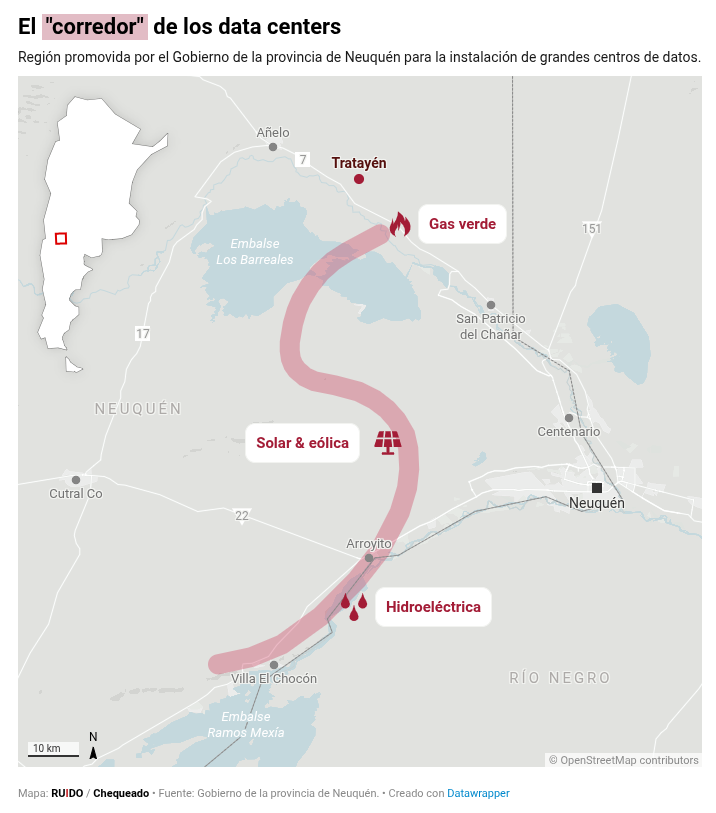
However, that doesn’t necessarily mean the project is infeasible. For instance, the Neuquén province in particular has the promise of generating much more energy over time, though increased energy production would likely have to precede Stargate Argentina’s full build-out, as currently planned. Indeed, in a recent interview, Kargieman has alluded to this, stating that Sur Energy is planning “to build the infrastructure for the generation and distribution of energy to supply the data center,” but that it planned to partially rely on existing power infrastructure. In addition, the Milei government has made it a point to attract AI-related investment, including data centers, through its new tax incentive scheme known as RIGI, which provides tax benefits for large, often foreign investments in the country. Stargate Argentina is a known beneficiary of the RIGI scheme. This, coupled with Milei’s deregulatory bent, could allow data centers to quickly colonize Patagonia, particularly given that data center construction and operation is almost entirely unregulated in Argentina (e.g. they face essentially no legal obstacles related to their potential impact on the environment or local inhabitants).
Like in many other countries, Argentines are wary of AI and, as a consequence, local and federal officials have touted the build-out of data centers, particularly in Patagonia, as projects and investments that will create significant employment opportunities for locals. For instance, the Planning Minister of the Patagonian Neuquén province, Ruben Etcheverry, has claimed that a proposed data center “corridor” in Neuquén will “open new economic opportunities for the local population.” Meanwhile, Argentine president Javier Milei, proclaimed earlier this year that, while “many fear that there will not be enough work in the Argentina of tomorrow,” these new industries –– e.g. energy, mining, critical mineral processing, digital infrastructure and artificial intelligence –– “will more than meet the demand for labor withdrawn by the old industries, and with much better salaries.”

However, the main figure behind Stargate Argentina, Emiliano Kargieman, apparently disagrees. Last December, Kargieman, in an interview with La Nación, claimed that AI data centers, including his own project, “are not a source of jobs in Argentina.” Instead, he posited that they are, in actuality, “a source of dollars.” More specifically, Kargieman stated that:
“For construction, data centers require employing thousands of people. For its subsequent operation, it employs about a hundred people. It is not a direct source of employment. [. . .] That is not the way this investment is going to contribute to the country [. . .] The development of AI infrastructure contributes to the country not only by generating a line of income from exports of computing services, dollars. It also allows us to position ourselves strategically and improve the competitiveness of companies and the efficiency of the State.”
Kargieman’s claims that data centers are not a direct source of employment is supported by local and regional investigations. One such investigation, jointly written by Brazilian and Argentine media outlets, found that data centers in South America “do not create local job openings and much of the investment funds [destined for job creation] instead go to technological teams, which are generally imported.”
Thus, even Kargieman has acknowledged that projects like Stargate Argentina are not about creating jobs for locals. Given this admission, it is worth mentioning again that a key architect of Milei’s AI policy and his alliance with Silicon Valley –– Demián Riedel –– had previously claimed that local Argentine populations were the main obstacle to AI infrastructure development.
Once Stargate Argentina is up and running, who is likely to benefit most of from this massive Patagonian data center? Per Kargieman, it may not be his main partner in Argentina –– OpenAI. In his recent interview with La Nación, Kargieman noted that OpenAI’s Sam Altman has acknowledged to him (and also publicly) what many investors have been warning more feverishly in recent months, that there is an AI market “bubble.” Kargieman says that such a bubble existing is “normal,” adding that “all the major industrial revolutions were accompanied by bubbles.” In the case of those who invested in factories or other infrastructure in past bubbles linked to past industrial revolutions, Kargieman stated that “whoever invested in that building goes bankrupt, but someone ends up using the building.” Thus, he sees it as irrelevant whether Stargate Argentina is ever used by OpenAI or not and, in his words, seems to imply that OpenAI itself may disappear after an inevitable market correction.

From Kargieman’s point of view, it doesn’t matter “whether it is OpenAI or not [using Stargate Argentina’s projected data center], what matters is the long-term demand of the sector.” In response to that statement, his interviewer said: “So, if OpenAI does poorly, there will be others looking to use this type of infrastructure.” Kargieman responded in the affirmative and stated that “the infrastructure is going to be used for something regardless of whether it is OpenAI or not.”
While Kargieman seems to imply that OpenAI may not be the ultimate user of Stargate Argentina, but rather a corporate accelerator of its construction, he does hint at one of the actors he thinks will ultimately be using Stargate Argentina and for what purpose: the Argentine State. Kargieman stated in that same interview that the State would be among the main beneficiaries of Stargate Argentina because, over the next decade, “States will transform to be more efficient using AI.”
Kargieman then added the following:
“This can only be done if citizens’ data is handled in an environment over which the State has jurisdictional control. A data center of this type in Argentina gives the country its initial stepping stone for a profound transformation of the efficiency and transparency of the State’s operation, based on data control. These things are not minor. It is a long-term strategic function.”
Open AI itself has a similar view. For instance, one of OpenAI’s press releases about Stargate Argentina stated that:
“In addition to developing the infrastructure needed to power AI, we are discussing opportunities with the Argentinian government to drive AI adoption across Argentina, as part of our OpenAI for Countries initiative [of which Stargate Argentina is part], starting within the government itself.”
If Argentina’s government is to be one of the likely ultimate users of Stargate Argentina, it is important to examine what its government is already using AI for and how else they plan to use it.
While much has been written about Milei’s laissez faire policies with respect to AI and corporations, including allowing for AI-only companies with no humans involved to operate in the country, it is his government’s use of AI that has been largely overlooked.
One of the Milei-led government’s earliest domestic policies with respect to AI came in 2024, when former Security Minister Patricia Bullrich announced that the government would surveil Argentines’ social media activity with AI in order to “predict future crimes.” To do this, Milei’s government created a new subagency of the Security Ministry called the AI Applied to Security Unit (La Unidad de Inteligencia Artificial Aplicada a la Seguridad). The new Unit works to “patrol open social networks, applications and internet sites,” in order to “detect potential threats, identify movements of criminal groups or predict riots.” The Unit also uses AI to “analyz[e] security camera images in real time in order to detect suspicious activity or identify wanted people using facial recognition” while also “patrol[ling] large areas using drones, provid[ing] aerial surveillance.” This aerial surveillance would also be fed into the AIs used by this new subagency. The Unit also identifies “suspicious financial transactions or anomalous behavior that could indicate illegal activities” through its automated surveillance activities, while also “us[ing] machine learning algorithms to analyze historical crime data and thus predict future crimes.” The program is remarkably similar to a U.S. proposal that was made under the first Trump administration in 2019. That program, known as SAFEHOME, sought to use AI analytics on Americans’ social media posts to identify potential “warning signs” of individuals who may commit acts of violence, allowing those individuals to be “disrupted” by the government before they could commit an illegal act.
Around the same time that the AI Applied to Security Unit was created in Argentina, it was also reported that the Milei-led government planned to replace human government workers and organizations with AI, further underscoring Milei’s commitment to the Argentine State’s “digital transformation.”
More recently, in May of this year, Milei’s government announced a new AI public policy “innovation” – the creation of a “digital twin” for every Argentine based on their online activity, as surveilled by the State. This “twin” would then be cross-referenced with other government databases and then used to create predictions that would then inform public policies. This, notably, is quite similar in some ways to the concept of futarchy, which seeks to use prediction markets to dictate public policy. In announcing the policy on X (formerly Twitter), Milei remarked that “Argentina anticipates the future, because the future does not wait” and treated this new policy “innovation” as a global milestone.
In announcing the policy, the Argentine government stated that: “a State that not only observes reality once the problems have already occurred, but also has the capacity for anticipation, simulation and prevention.” It then described a “digital twin” as “a tool aimed at transforming data into prediction capacity and strategic design of public policies.” The video Milei posted to X when he announced the policy noted that this use of a “social digital twin” would allow the State to “predict the future” from a person’s childhood until “autonomy” (i.e. adulthood) in order to “anticipate the impact at each [life] stage.” One image shown in that video shows Argentina’s Minister of Human Capital, Sandra Pettovello, talking to officials from the United Nations and European Union as part of the project. It also displays the logo of Amazon Web Services (AWS), a CIA contractor, suggesting that they would also be involved in the project. However, the Ministry later clarified that “no external companies” would be involved in the development of the system.

Notably the concept of the “digital twin” was developed in the 1960s by NASA, which –– as previously explained –– played a major role in Kargieman’s past and his decision to launch his company Satellogic. As previously noted, Kargieman’s company is now shifting gears to offer “Persistent Global Intelligence” by remapping the planet daily with satellite surveillance at high resolution for its clients, most of which are intelligence and defense agencies. Notably, NASA has more recently argued that digital twins are important for “predictive maintenance” of complex systems. When applied to Argentine society at large, the proposed digital twin system is likely to synergize with the Security Ministry’s new AI unit, which already focuses on “predictive policing.”
As previously noted, Satellogic’s soon-to-be-launched satellite constellation, Merlin, which will have AI-native capabilities will, per Kargieman, “allow us to do things we never though possible” such as “begin to predict the future” using AI-powered planetary surveillance. Satellogic and Kargieman are not alone in this endeavor, as industry publications have recently noted that “space-based predictive analytics” will be a “gamechanger.” One top executive at a Canadian satellite surveillance company was recently quoted as saying:
“Predictive analysts is going to be more important going forward. Be it in terrorism or nature in terms of wildfires, predictive analytics will aid the earth in a completely new way.”
Thus, Kargieman –– whose Stargate Argentina is slated to serve as an essential data repository for these type of AI predictive programs with national security applications –– is also committed to predictive analytics through his other main venture, Satellogic. Notably, Satellogic and its imminent predictive capabilities are being marketed largely to the U.S. national security apparatus and its web of private contractors. With Argentina a signatory to the U.S.’ new and highly secretive Pax Silica agreement, both Argentina under Milei and Kargieman’s affiliated business interests are seeking to make Argentina a critical node of U.S. power projection with respect to emerging technologies and the often Orwellian applications of those technologies for population control and the suppression of dissent.
As previously reported by Unlimited Hangout, a network of former counterterrorism and surveillance projects once hosted by the U.S. Military’s now shuttered Information Awareness Office (IAO) at DARPA were privatized after garnering significant public controversy due to extreme privacy concerns in the early 2000s. The privatization of this network of programs was largely made possible by one man –– Peter Thiel. One of Thiel’s companies, Palantir –– the privatized version of IAO’s Total Information Awareness program –– is closely partnered with Kargieman’s Satellogic, as previously mentioned. Total Information Awareness was explicitly created to target “terrorism” after the 9/11 attacks, but treated everyone as a suspect. Its goal was to use predictive analytics to stop “terrorists,” or anyone they defined as such, before they could commit any attack.
As noted earlier in this piece, Satellogic appears to be part of another, related nexus of companies born out of the effort to privatize major aspects of the controversial Strategic Defense Initiative Office (SDIO) or “Star Wars” project of the Reagan era, a project which was also closely linked to the architect of DARPA’s IAO, John Poindexter. As noted in previous Unlimited Hangout reporting, Poindexter was also a key figure in Thiel’s efforts to privatize Total Information Awareness as Palantir. Today Palantir offers predictive analytics with applications for national security and law enforcement, with the ultimate goal of preventing crime and terror events before they occur –– just like Total Information Awareness.
Peter Thiel recently made the decision to move to Argentina, largely due to the governance strategies, public policies and ideology of Javier Milei. Shortly before Thiel met with Milei and top government officials, the Argentine government announced its “social digital twin” initiative, leading some international and domestic media outlets to speculate about a connection between Milei’s meeting with Thiel and the project’s announcement. Many of those outlets made note of Thiel’s role as both a co-founder of Palantir and as the current chairman of its board. Palantir, unsurprisingly, offers digital twin functionalities as part of its product suite for both national security and corporate applications.
Thiel is, of course, also well known for his controversial political views. While often publicly posturing as a libertarian, Thiel clearly has no interest in defending the civil liberties of the general public, if his business record is any indication. His political views are better classified as neo-reactionary, as he is now known to be a central figure in the growing nexus of Silicon Valley “techno-optimist” billionaires who are overtly transhumanist and seek to balkanize and privatize the public sector into “smart” city-states. Milei, similarly has publicly postured as a libertarian and freedom maximalist, while his governance decisions –– particularly those related to AI –– show that he is functionally a freedom minimalist with respect to the Argentine public. His “chainsaw” approach to shrinking the government has been heavily applied to those agencies that had provided social benefits, while the size of the government agencies dealing with surveillance and “security” has ballooned.
It is quite clear from the evidence that what is emerging in Argentina under Milei is a beta test for what will likely become a global model for techno-authoritarianism, where AI-powered capitalism (likely with minimal human involvement) enjoys complete freedom while human beings enjoy essentially none. Herein lies the potential for a disturbing return to the data-sharing operations that were used to hunt and murder dissidents during the era of CIA-backed South American dictatorships, such as Operation Condor, in which Argentina’s dictatorship enthusiastically participated. In that context, it is worth pointing out that Argentina’s dictatorship had attempted to create “paper twins” of its citizens by collating its surveillance data (e.g. wiretapped phone recordings, etc.) in order to predict their likely behavior and if they might present a threat to the dictatorship. These primitive data-based dissident elimination programs were closely associated with the disturbing and extensive crimes of those dictatorships against their own citizens.
With the technology of today, Milei’s “digital twin” efforts and other AI-powered programs could rapidly resurrect and improve the infrastructure of atrocity from Argentina’s dictatorial past, allowing them to commit crimes against humanity and against human freedom faster than ever and at much greater scale. In these efforts, Milei has no greater ally domestically than Stargate Argentina’s Emiliano Kargieman, who is building both the planetary surveillance grid and the terrestrial data depository that will make it all possible.