


The Praxians—a new breed of tech billionaires—form the core of the Silicon Valley-rooted wing of the global oligarchy. The Praxians are a subset of the network of tech moguls who are embedded within and encircle the Trump administration. The Praxians are distinguished by their close affiliation with the ideas of the Neoreactionary movement (NRx) and by their enthusiasm for building their own private city-states.
Some Praxians, such as Marc Andreessen, openly declare their adherence to NRx principles. Others, such as Mark Zuckerberg, extol NRx ideology through their corporate sloganeering. And still others, such as Peter Thiel, continuously fund specific NRx projects, such as Praxis in Greenland (see Part 1).
Ironically, there are aspects of the technology that the Praxians are encouraging us to adopt for their own ends that we could instead repurpose to finally free ourselves from their hierarchical authoritarianism. We could flip the features of programmable digital currency, such as central bank digital currencies (CBDCs) or stablecoins, and turn them from the ideal tool for centralised control into the means by which we achieve monetary and economic emancipation. And we could use some facets of the network state—the Praxians’ own technology-based nation-building strategy—to construct new models of sovereign decentralised sociopolitical structures.
In my book, The Technocratic Dark State, I wrote:
Distributed Ledger Technology (DLT), such as blockchain, could be used to liberate instead of enslave us. Artificial intelligence (AI) could be used to improve our lives, not diminish them. Digital currencies, decentralized finance (DeFi), and financial technology (Fintech) could free up investment and lead to an explosion of economic, scientific, technological, and social innovation that benefits humanity, not just the oligarchy. [. . .] We could build homes, towns, and even cities that maximize our individual sovereignty and independence from authoritarian control.
It is a choice. It is our choice. Humanity, not oligarchy, is the dominant force on this planet. But if we don’t get on with building the world we want, and if the oligarchs succeed in imposing the world they want, future generations will face a long and arduous struggle to once again free humanity from slavery.
Praxian Libertopia Is Not Libertarian
There is no need to doubt what the Praxians and their oligarch partners want to construct. The NRx’s oligarch backers, like Peter Thiel, have been transparent—at least in part—about what they are trying to achieve.
Speaking in 2010 at the Libertopia anarcho-capitalist conference, Thiel explained why he co-founded PayPal and why the Thiel Foundation bankrolled the Seasteading Institute:
The initial founding vision was that we were going to use technology to change the whole world and basically overturn the monetary system of the world. [. . .] We could never win an election [. . .], but maybe you could unilaterally change the world without having to constantly convince people and beg people and plead with people, who are never going to agree with you, through technological means. [. . .] This is where I think technology is this incredible alternative to politics.
This kind of rhetoric resonates well with libertarians, who are opposed to the imposition of centralised authority by governments. When, in 2008, Thiel seed-funded the “startup” called the Seasteading Institute, the media widely reported it as a libertarian project. Such media reports, which paint the Praxians as libertarians or anarcho-capitalists, are commonplace. Framing Praxians as libertarians serves as propaganda to entice genuine libertarians to make a massive error of judgement and get on board with Praxian city-state projects.
As Thiel outlined at Libertopia in 2010, in the Praxian world view, technology enables them to unilaterally change the world without other people’s consent. If, as the libertarians who have fallen for the NRx’s alleged Libertopia believe, the objective were simply to build parallel societies where people could voluntarily co-exist outside of the current political system, where their individual sovereignty would be maximised «through technological means,» then NRx-aligned libertarians would have reason for hope.
But that is not what oligarchs like Thiel, Andreessen, Musk, and Zuckerberg have in mind. Rather, they want to use technology to literally replace human agency with Agentic AI. They want to offer us Governance-as-a-Service (GaaS), which they will program and control unilaterally. And they want to change the «monetary system of the world» for their benefit, not humanity’s.
The Praxians are part of a global oligarch network that has adopted the smart city-neostate model as the best route to stamp its centralised authority on the entire planet and on every individual inhabitant of the planet. Their collective ambitions could not be further removed from the libertarian ideal.
The Praxians are highly deceptive. For example, Marc Andreessen’s Techno-Optimist Manifesto reads like an attack on the centralisation of authority and global governance structures. Andreessen claims that «statism, authoritarianism, collectivism, [and] central planning» are among the accelerationists’ «enemies.» He attacks the stakeholder capitalists and, by supposedly denouncing «the limits of growth,» also attacks globalist think tanks like the Club of Rome. Andreessen says that the self-styled NRx optimists stand against «Sustainable Development Goals» and other UN initiatives. Again, the attempt to appeal to libertarians is plain.
Yet, the Praxians are trying to construct exactly the world order most desired by the UN. The Praxians call it their «Network Empire,» while the UN calls it «multipolarity.» As we’ll cover shortly, the UN considers «institutional innovation» through a global network of smart city-states essential for it to implement technocratic global governance through the enforcement of SDGs. Contrary to Andreessen’s Praxian propaganda, the Praxians do not oppose UN sustainable global governance; they are working tirelessly to enforce it.
The Network Empire Manifesto
The Praxians’ ultimate goal is to create a web of interconnected smart city-states that are either public-private or completely private and that will form the NRx’s «patchwork of realms.» The United Nations (UN) supports the Praxian idea of a lattice of city-states because it views it as the most effective method of establishing, for the first time, genuine centralised global governance over the world’s population. (We’ll also elaborate on this point shortly.)
The Praxians are eager to accelerate the global governance agenda. They want to go further than stakeholder transnational capitalist oligarchs have gone thus far—by dispensing with the public sector entirely. Either way, whether the smart city project be public-private or purely private sector, the Praxian model of the network city-state—the neostate—has the backing and blessing of their international and “globalist” peers.
The original 2024 version of the Praxian Manifesto—the version reported by Gil Duran at his informative website, The Nerd Reich—has been removed from every Praxis Nation site and has not been archived. All that remains is the 2024 Declaration of Ascent.
Fortunately, Gil Duran preserved some of it, including the following excerpts:
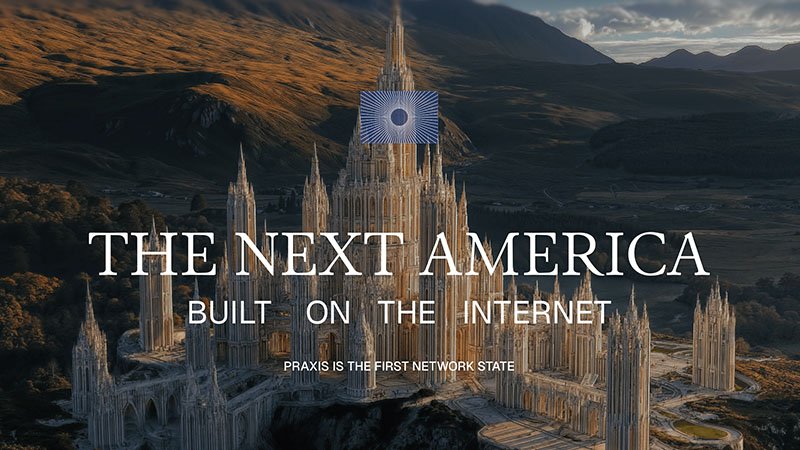
Network States offer a path to crypto’s next wave of adoption by integrating onchain infrastructure into the parallel institutions supplanting the global system’s core functions. [. . .] As local communities dissolve and Nation States stumble, Network States will ascend. Soon, Network States will be your most important group affiliation, passport, and community. Network States will represent Citizens controlling trillions dollars of assets, represented on their native asset registries. We’ll watch the flippening of Network States over Nation States in real time. Network States will coalesce neighborhoods and build cities. The next global superpower will be a Network State. The next America will be onchain.
The notion of the system’s “core functions” references the 1934 publication of the Technocracy Inc. Study Course, where “a governance of function, a Technate” is described. The Praxians’ objective is to supplant the current Westphalian-based global order with a patchwork of network states, otherwise known as a governance of function—aka, a global Technate.
In the 2022 book The Network State, referenced repeatedly in the original, now-removed Praxis Nation Manifesto, author Balaji Srinivasan determined that “all value eventually becomes digital” and that “nothing officially exists unless it’s on-chain, in the blockchain system of record for that society.” The adoption of programmable digital currency by captured populations forms “the backbone” of the neostates. Though all references to The Network State have now been dropped from the Praxis Nation Manifesto, what remains is even more concerning.
In the new Praxis Nation Manifesto there’s a «Declaration by the Founding Citizens of the Praxis Empire» that is littered with quasi-mystical New Age junk. In that declaration, the billionaire Praxians tell us:
We, the founding citizens of Praxis, declare our intent to ascend [. . .] and establish a new form of human civilization: the Network Empire. [. . .] As the warrior-kings once sought the sacred Grail, so too shall we build an empire where true power flows from heroic courage and alignment with the divine order. [. . .] We, the founding citizens of Praxis, hereby pledge to each other our lives, our fortunes, and our sacred honor in pursuit of these noble aims.
Who knew that subjecting humanity to techno-feudalism would be regarded as a “noble aim”?
To what extent the Praxians seriously believe this puerile nonsense is debatable. Their practical application of technology to build the «Network Empire»—namely, using artificial intelligence and surveillance technology—is less debatable. We can now see why Praxians consider AI to be their «Philosopher’s Stone.»
Within their «noble aim» of «Sovereign Intelligence,» the Praxians decree that «AI’s omnipresence in physical production, media, and governance will remake the world in the image of whoever’s moral paradigm it serves.»
Can you guess whose paradigm it serves?
The Praxians boldly outline how their AI-based sovereignty will serve them and their oligarch partners:
Artificial intelligence is driving the greatest power transfer in human history. As AI surpasses human capability, trillions in annual economic value will shift from labor to capital, never to return.
The AI revolution is seen as a mechanism to permanently transfer all power and all sovereignty away from humanity—whose labour is no longer necessary—to those who hold all the capital: the transnational capitalist oligarchs.
The oligarchy knows it is currently more exposed than it would like to be. Its ability to rule without challenge is in notable decline. Its vanguard Establishment does not serve as the protective layer it once did.
If there is a real race, it is not a technological race between nations but a race for sovereignty between humanity and oligarchy. Either we humans assert our equality, our individual sovereignty, or the unseen sovereignty of a ruling oligarchy will be strengthened and reimposed. That is the whole point of the new global governance system we’re about to discuss.
In the section of their Manifesto extolling alleged “Sovereign Intelligence,” the Praxians disclose their key sales pitch to their fellow so-called elites. They explain why the global governance agenda needs to accelerate:
We face a decisive moment — before our power slips away, we must gain control of our civilization’s mind. [. . .]
The $50 trillion in annual costs of production currently flowing to wages will then accrue to the owners of AI infrastructure — the companies controlling models, chips, data centers, robotics, energy, metals, and more. Those who control AI will shape our world through control over three key channels: The production of goods, services and infrastructure, [. . .] [t]he creation and curation of media, [and] [t]he administration of governance. [. . .]
As such, the beliefs and intentions of the people who control AI — the primary source of all goods, beliefs, and governance — will determine the destiny of every society where it is employed.
We should take the Praxians at their word. They are serious about seizing control of everything and constructing a system where a small group holds unprecedented power. Again, from the Praxians’ Manifesto:
AI becomes responsible for cultural production, physical production, and the administration of governance — curating content, growing food, writing laws, negotiating alliances. The small number of people prompting this tool will have power unprecedented in human history.
Writing that «Zuckerberg and Ellison running companies from Hawaii» and that Thiel «securing a passport in New Zealand» are examples of billionaire Praxian oligarchs exiting from «jurisdictions [. . .] they don’t trust,» the Praxians reflect on what they call «Singularity Politics.» The alleged singularity is the purported existential threat that has obsessed the thinkers behind the Dark Enlightenment.
In their reflection on the singularity, the Praxians lay out their Network Empire-building strategy in full:
Digital Nations are polities that form online around shared values, accumulate economic and political capacity, and settle physical territory. As existing nations lose coherence, Digital Nations will fill the void, [. . .] powered by their Sovereign [Artificial] Intelligence. Praxis is the first Digital Nation. We are uniting [. . .] $2T tech net worth in a coalition dedicated to the revitalization of Western Civilization.
We are building a shared way of life, aligned technology, and eventually physical territory. As AI alters the political landscape, we must act before misaligned governments accumulate power they were never built to wield.
The kind of power oligarchs accumulate and exercise is not meant for governments to wield, and, according to them, it never was intended for this purpose. After all, oligarchs are the rarefied few who assume for themselves the divine right of kings. The Praxians’ Network Empire is the methodology they propose to finally secure total global control.
The Praxians’ Secret Enclaves
As previously discussed in this series, Praxians Peter Thiel and Alex Karp sit on the steering committee of the Bilderberg Group. Occupying this lofty position proves they have already been invited to join the same global oligarchy that they have attempted to posture against publicly. Thiel also runs a more technology-focused globalist think tank through his off-the-record discussion group for «leaders» called Dialog.
As recently reported by WIRED, a Swiss hacktivist who goes by the name of maia arson crimew claims to have accessed the Dialog website source code, which reveals an attendees list that WIRED journalists say they have seen and confirmed. That the information provided by WIRED is congruent with numerous other reports about the secretive Dialog group makes the WIRED story plausible. The names shown on the list of invitees, such as Elon Musk, Eric Schmidt, Joe Lonsdale, and Jared Kushner, also lend it credibility.
The reported topics for discussion at Dialog 2026 are not surprising. “Money (Does?) Buy Happiness,” “Bring Back Nuclear,” “Navigating WWIII,” “Battlefield Technologies,” and “Build-a-Cult» are precisely the kind of ideas that secretive oligarch-led think tanks often explore. Not surprisingly, all attendees—most notably the selected politicians and government officials—tried to avoid public scrutiny by signing up using only private email addresses. Power is supposed to be wielded unseen.
Writing on Substack, Hans Jonsson explained that Auren Hoffman, Dialog’s co-founder and chairman, has developed technology firms, such as Safegraph and LiveRamp, that specialise in data harvesting, analysis, and surveillance. Jonsson also noted that, via Dialog, Hoffman has had «off-the-record» chats with government insiders, including Trump’s Secretary of the Treasury Scott Bessent and US Sen. Ted Cruz (TX), chairman of the Senate Committee on Commerce, Science, and Transportation. Cruz’s committee oversees the conduct of the Federal Trade Commission, among other matters. The FTC supposedly controls the nation’s antitrust (data privacy) regulations.
Jonsson astutely observed:
The people who build the surveillance systems sit in private rooms with the people who are supposed to regulate and oversee those systems. Off the record. No government email. No public disclosure. Dialog isn’t just a dinner club. It’s where the regulated and the regulator meet without a transcript.
That’s the truth. In reality, so-called elites and state officials, working in partnership, privately collude. They never openly disclose what they are trying to achieve together. This has always been how hierarchical power structures operate. Unfortunately, enabling the technocratic rule of oligarchs is the purpose of the modern system. And, unfortunately, we can see all too clearly how their technocratic rule is evolving.
A New World Economy Under BIS Sovereignty
The Bank for International Settlements (BIS), the central bank for central banks, has made itself the key institution in the oligarchy’s global monetary and economic remodelling plan.
In The Technocratic Dark State, I observed:
In Working Papers No 1178 [published in April 2024], the BIS described the construction of a decentralized, tokenized, digitized world that will enable the recentralized (unified) surveillance and control of everything. To this blatant swindle the BIS gave the name “the Finternet.”
More recently, in March 2026, the Center for International Governance Innovation (CIGI), a globalist think tank closely linked to the Soros-Omidyar oligarch group, published a paper written by a research team led by S. Yash Kalash and titled “How The Bank for International Settlements is Redesigning the World Economy.” (For short, we’ll call it the CIGI paper)
In it, the CIGI accurately defined the BIS’ Finternet (which from now on, in keeping with the CIGI paper, we will refer to in the lowercase as the “finternet”):
[It is] a unified, programmable financial internet, where digital money, tokenized assets, identity credentials and compliance logic operate seamlessly across jurisdictions. [. . .] [I]t is a meta-network of interoperable financial systems. [. . .] In a finternet world, assets and money are no longer separate categories; they coexist on a common ledger framework. [. . .] Trust and compliance in the finternet hinge on verifiable digital identity. [The finternet] embeds [digital] identity as infrastructure. [Programmable] code [. . .] governs how money and assets interact. [Programmable] smart contracts [determine] how financial logic instruments such as interest payments, taxes, compliance checks and even monetary policy triggers can be embedded directly into tokens and payment instructions.
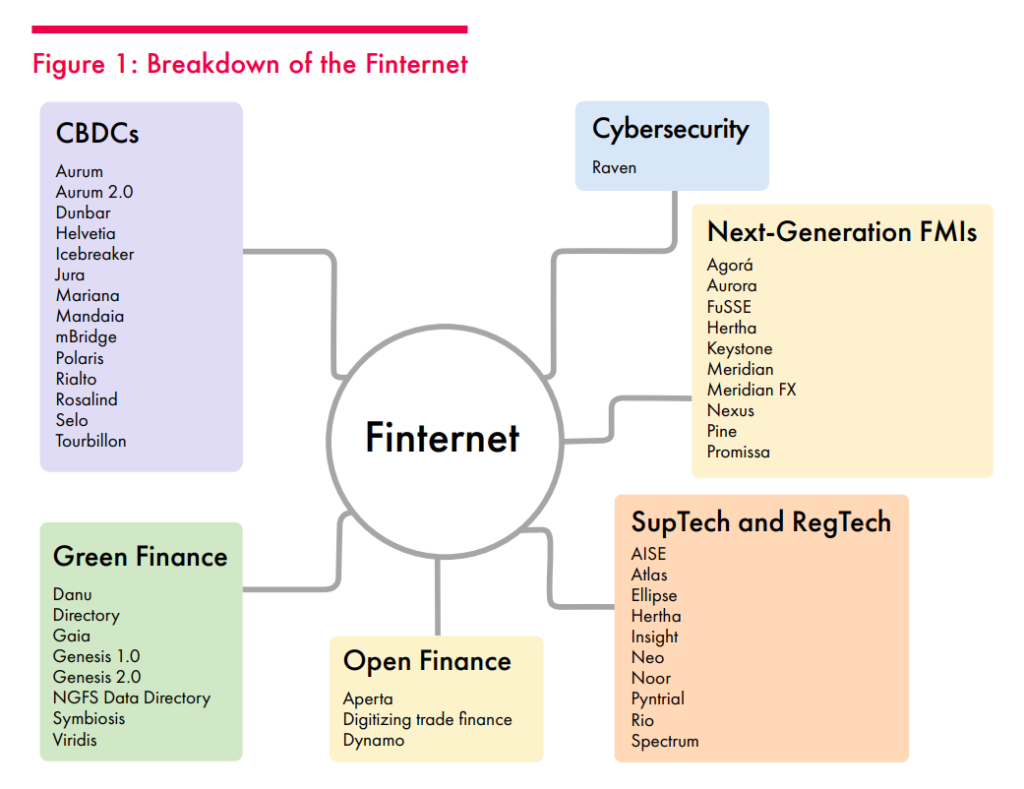
Programmable digital currency (PDCs), linked to the digital identities of everyone and everything—from individual human beings to all businesses, alongside existing and new tokenised asset classes and every device connected to the Internet of Things—is the envisaged «backbone» of this hoped-for global governance system. Once the interoperable system is in place, resolving all transactions on a permissioned unified ledger will give those who have access to the program unprecedented control of the planet’s economy.
The CIGI paper examines the forty-five monetary system redesign projects that the BIS has run through its various international innovations hubs in recent years. Nearly all of these projects explored, to a greater or lesser extent, the practical design and application of interoperability. IBM defines «interoperability» as a technological «standards-based approach to enabling different IT systems to exchange data and share functionality with minimal end user intervention.»
The BIS has published a string of subsequent project reports since 2020.
One example, according to the CIGI paper, was the mBridge project, the results of which were published in 2022. The mBridge project was an experiment conducted by the BIS in league with «the central banks of China, Hong Kong, Thailand and the UAE» to create «a multi-CBDC [Central Banks Digital Currency] platform.» The idea was to see if «different national currencies can transact instantly and directly.»
Another example, according to CIGI, was the Agora project, the results of which were published in 2024. The Agora project was an experiment in which the BIS collaborated with «seven central banks and 40 private financial institutions» to «test the desirability, feasibility and viability of a multi-currency, unified ledger for wholesale cross-border payments,» using systems like mBridge.
The mBridge project, CIGI observed, tested the feasibility of an International Monetary and Financial System (IMFS) that «transforms liquidity geography.»
The current IMFS relies on the «liquidity»—the relative ease of converting assets into capital (cash)—that primarily stems from the trading conducted in the world’s financial centres (the top three being New York, London, and Hong Kong). CIGI noted that mBridge essentially creates a new IMFS where «instead of liquidity pools held in New York or London, settlement can occur anywhere a node of trust exists.»
The BIS intends the «nodes» to be «central bank nodes» on «a unified, programmable financial internet»—the «unified ledger» underpinning the finternet. The CIGI paper points out that a «unified ledger» does not infer the creation of «a single database» but rather “a network of interoperable ledgers linked through standardized APIs [Application Programming Interfaces], digital identity frameworks and verifiable credential systems.”
It is important to appreciate that the CIGI paper was written by a CIGI team led by senior fellow S. Yash Kalash and that they were representing a faction of the global oligarchy. Consequently, when referencing the proposed «unified ledger,» the CIGI paper claimed that there is no implied «centralized authority.» This was directly contradicted within the same paper, however. The CIGI authors also outlined how the BIS’ interoperable finternet system operates as an economic dictatorship:
To understand the emerging digital global order, one must see the BIS not merely as a bank, but rather as the protocol layer of twenty-first-century power — the invisible architect engineering the standards through which the world’s next financial system will operate.
Of course such a system consolidates centralized authority, to an almost unimaginable degree. It is irrational to pretend otherwise.
From the CIGI paper, we can see that, regardless of whatever interoperable wholesale («reserve») digital currencies are used, the clearing and settlement of any trade or transaction are set to resolve through the anticipated «nodes.» We can also see that the BIS, which effectively controls the nodes, is building out its global hegemony for a multipolar world. It is assisted in this endeavour by the global public-private partnership (G3P) in which the Praxians are notable partners.
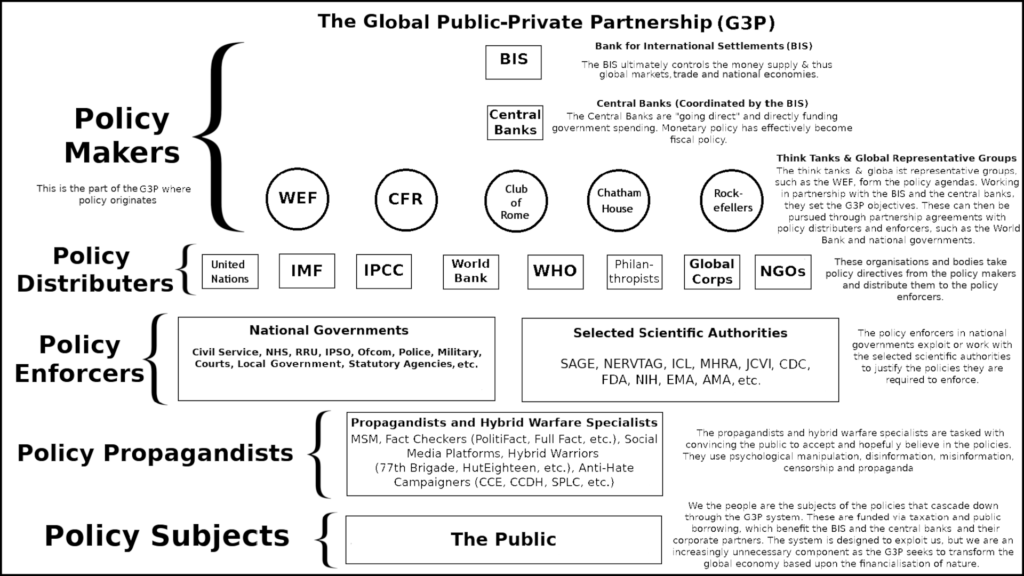
The current IMFS operates as a two-tier system. Transactions conducted everyday by individuals and businesses, usually via commercial bank balance transfers, occur on the «broad» currency layer. Some form of settlement netting eventually enables the commercial banks and financial institutions to settle their aggregate balance of payments between each other, typically using their central bank reserves on the «base» money layer.
In the world of programmable digital currencies (PDCs), broad money transactions are commonly called «retail,» and base money clearing and settlement are called «wholesale.» The BIS would prefer to maintain the two-tier system, where retail PDC transactions clear and settle on the wholesale PDC layer. Instead of being called «two-tier,» however, the two-tier system is referred to as the «hybrid» model of digital currency «ecosystems.»
The Global Blockchain Council, which partners with numerous multinational corporations, government agencies, and academic institutions in hundreds of countries, considered the likely practical adoption of the hybrid model:
In practice, many ecosystems will use a combination of stablecoins, bank money, and potentially CBDCs. Stablecoins [will be used] as the programmable settlement layer for consumer and internet-native payments, [t]okenized deposits or bank-issued stablecoins for regulated payment flows and [. . .] [w]holesale CBDCs to modernize interbank settlement and support tokenized securities settlement with stronger finality guarantees.
Yet the CIGI paper posited:
[P]rivate-sector developments, such as US dollar-backed stablecoin, and public-private hybrids, such as Brazil’s Pix, pose significant challenges and alternatives to BIS led architectures.
The CIGI offers no rationale to explain why the advent of these programmable retail PDCs, such as US stablecoins, would threaten a BIS-led programmable hybrid system hosted on its finternet. Discussing China’s retail and wholesale PDC ecosystem, which operates on a two-tier, or hybrid model, the CIGI stated:
The digital yuan (e-CNY) is already one of the world’s most advanced CBDCs, operating domestically with sophisticated programmability, offline functionality and integration into major retail ecosystems, such as Alipay and WeChat Pay.
Ever since 2020, the BIS has been preparing its «global stablecoin arrangements.» The BIS is seeking to integrate the privately issued PDCs into the architecture of its finternet by setting the interoperability standards for retail PDCs, such as US stablecoins.
There is doubtless some ongoing horse-trading. Representatives of Tether and Circle, the companies that issue the most widely circulated US stablecoins, didn’t respond well to BIS assertions that their coins resemble securities and are therefore not money. Tether made a public statement calling the BIS «ignorant,» adding that its USDT stablecoin users «don’t buy USDT expecting a return, they use it as a digital dollar.»
But Tether’s insistence that its stablecoins are used as «digital dollars» repudiates Sec. 2(22) of the Trump administration’s stablecoin regulation legislation, called the GENIUS Act, which clearly says that US stablecoins, like USDT, are not a national currency, i.e., supposedly they are not «digital dollars.»
Retail CBDC, like cash, is issued as a direct liability of the central bank. Unlike cash, its programmability enables the central bank to have “absolute control” over where, when and how any CBDC transactions proceeds. Central banks are ostensibly public sector entities, whereas stablecoins and tokenised deposits are said to be different because they are issued by private sector entities: stablecoins by non-banks, like Tether, and tokenised deposits by commercial banks, such as J.P. Morgan.
In truth, though, as demonstrated in The Technocratic Dark State, central banks are private sector financial institutions. Furthermore, stablecoins and deposit tokens are just as programmable, and they give «absolute control» to the non-bank and commercial bank issuers. The real three-way debate between central banks, commercial non-bank institutions, and commercial banks is about who should have «absolute control» of transactions using their PDCs.
Evidently China’s hybrid PDC-based financial ecosystem works perfectly well. This fact must please the BIS, given that the essential purpose of its finternet is to expedite the interoperable exchange between all PDCs. There is no technical reason why the BIS global stablecoin arrangements cannot be seamlessly integrated into the finternet. All that remains is for the various players to reach an agreement.
Interoperable Tokenisation on the Finternet
The CIGI outlined how the proposed new IMFS centralises global monetary power. As the CIGI said, the BIS can determine who or what qualifies as a verified node on its finternet. This may be a central bank, but it could also be a BIS-licensed commercial financial institution or an AI algorithmic agent that the BIS favours.
The BIS defines which interoperable digital identity credential the system requires, or permits, in order for individuals and businesses to transact. Through controlling the financial data standards, both for financial communication protocols and for tokenized assets, the BIS determines the conditions for cross-border trade between jurisdictions.
The tokenisation of assets is racing ahead, as intended. Recently the Depository Trust Company (DTC), a subsidiary of the US financial market infrastructure company, the Depository Trust & Clearing Corporation (DTCC), announced its plans to begin facilitating the global trade in tokenized real-world assets (RWAs) as early as this month (July, 2026). RWAs are digital tokens representing ownership of «tangible physical assets or traditional financial instruments, such as real estate, government bonds, or gold.»
DTC-enabled tokenisation is not replacing the existing financial system with ledger-based decentralised finance (DeFi). In keeping with the BIS agenda to centralise control over a global financial system, DTC-approved tokenisation integrates distributed ledger technology (DLT) financial workflows into the regulated, approved, and compliant permissioned system that largely already exists.
Considering the implication of DTC’s decision, NFT News Today reported:
Tokenization is no longer confined to crypto-native experimentation. The operational challenge now is interoperability — making tokenized assets work across brokers, custodians, exchanges, wallets, compliance systems, and post-trade infrastructure that was built over decades for traditional securities.
The DTC tokenised wallets are designed for institutional investors. Private sector financial giants, including BlackRock, Goldman Sachs, J.P. Morgan, Circle, Citi, and Morgan Stanley, are pushing ahead with tokenisation. BlackRock’s USD Institutional Digital Liquidity Fund (BUIDL) is already set up to tokenise RWAs, such as US Treasuries. The trading of highly liquid assets is moved «on-chain» by BUIDL, and the recent DTC initiative vastly increases the potential scale of tokenised RWA trading.
Programmability is built into the system. Compliance and distribution can be automated using smart contracts to determine who gets to profit and who doesn’t. Only the financial institutions permitted to access or operate a «node of trust» will be advantaged by the new token-based economy. These won’t be limited just to US financial corporations. Any «entity,» operating anywhere in the world, could be afforded access. Thus, «liquidity pools» move from their geographical centres to the distributed ledger of nodes on the BIS’ finternet.
Farcically, the CIGI paper maintained that the «BIS envisions the finternet as a public good.» Calling this blatant contradiction «the Paradox,» the CIGI insisted that the BIS is trying to provide «democratized access to global finance.» Yet, simultaneously, it conceded that the BIS’ work represents «a centralization of governance power unprecedented in modern finance.»
Tying itself in more illogical knots, the CIGI added that the «same architectures that democratize access to payments also consolidate decision-making authority in the institutions designing the code.»
There is no “Paradox” here. No institution purposefully designs systems that centralise power to such an incredible extent for the «public good.» The centralisation of authority over the proposed digital IMFS is exactly the BIS’ intention. The motive couldn’t be more obvious. Otherwise, why build such a system?
The CIGI report eventually revealed the central propaganda theme that its oligarch benefactors wish to promote. Insisting that geopolitics are fundamentally shaping the BIS finternet proposal, the CIGI argued that there is «a silent contest between competing visions of the digital global economy.» On the one hand, it said, there is «China’s state-centric model of digital sovereignty» and on the other is the US and EU’s «fragmented regulatory approach,» which is allegedly opposed by «the BRICS+ bloc’s search for parallel infrastructures.»
The CIGI contentions make no sense.
For one thing, nearly all the BRICS national governments have participated in the BIS’ finternet project. Take mBridge for example. Despite widespread media reports that the Central Bank of the Russian Federation (CBR) was suspended from the BIS due to Russia’s «invasion» of Ukraine, at no point did the BIS remove the CBR from its published list of member central banks. The CBR evidently maintained its BIS voting rights throughout its reported exile.
For another, the People’s Bank of China (PBC) was also a BIS mBridge partner. It worked with the BIS to test the possibility of «different national currencies» being exchanged «instantly and directly.» At the same time that the PBC was involved in mBridge, the PBC was also reportedly working with the CBR on cross-border payments using digital currencies (e.g. their respective CBDCs). Obviously, if this is true, both the PBC and the CBR were equally trialing mBridge.
Now we are told by Western news media outlets that the BRICS nations, including Russia, have used mBridge to «bypass» the SWIFT system and defeat various tariffs and sanctions. According to these news sites, apparently the BRICS nations have conducted «over $55 billion in cross-border transactions» «instantly and directly» via mBridge, using «India’s e-Rupee, China’s digital yuan, Brazil’s Drex, and Russia’s digital ruble.»
What this demonstrates is not that there is «a silent contest between competing visions of the digital global economy,» as the CIGI paper claimed, but rather that there is a shared vision and, in this regard, no contest at all.
A Contradictory and Absurd Hybrid War
In the hybrid war we find ourselves in, deceptive propaganda is trotted out to convince us to believe the contradictory and the absurd. Clearly, the BRICS’ use of mBridge evidences the interoperability of their programmable digital currencies. The DTC announcement expands the interoperability of tokenised assets to be traded using interoperable PDCs across borders.
Yet we have people like Zennon Kapron, a contributor to Forbes, who insists that «interoperability is dead.»
In his May 12, 2026, Forbes piece, titled “After MBridge and Agora, Multilateral CBDC Interoperability Is Dead,” Kapron bizarrely declared that because the BIS handed mBridge over to the project’s partner central banks, which then used it to conduct seamless cross-border transactions using CBDCs, «the era of multilateral CBDC interoperability is over.»
Actually, the BRICS have just used mBridge to show the world that the «era of multilateral CBDC interoperability» has just begun. Yet Kapron ignored the obvious and flipped reality on its head.
The apparent point of the Forbes contributor’s flimflam is to sell the idea that the reported tensions between nations—geopolitics—are what we should heed and that the «contest between competing visions» is real. Contrasting mBridge with Agora, Kapron opined that they were not «parallel CBDC experiments»—even though that is exactly what they were.
Agora tested the feasibility «of a multi-currency, unified ledger for wholesale cross-border payments,» and mBridge was a real-time test of a «a multi-CBDC platform» specifically designed to run what Agora subsequently sought to perfect. They are intrinsically and most assuredly two components of one interoperable finternet.
But by emphasising geopolitics, Kapron framed the Agora and mBridge projects as «competing answers to the same question, sponsored by competing blocs, with no overlapping membership.»
No, they were not «sponsored by competing blocs,» and there was «overlapping membership.» They were sponsored by one global financial institution, and it was the leading «member» of both projects: the BIS.
The idea that global financial institutions like the IMF, the BRICS development banks, or the BIS are constrained by geopolitical considerations is laughable. The BIS’ own constitutional Statutes, established by intergovernmental agreement in 1930, afford it «immunity from jurisdiction.» That means from any jurisdiction.
The BIS doesn’t respond to geopolitics. As a world sovereign, the BIS plays a major role in engineering geopolitics. It is redesigning the global International Monetary and Financial System (IMFS) for its own and its partners’ benefit, because empowering itself is the purpose of the global system it leads.
Zennon Kapron is a former global banking executive. He worked out of Shanghai, China, where he was founder and director of his own financial consultancy business, Kapronasia. Prior to that, he was the chief information officer for US-based financial giant Citigroup, a leading partner in the DTC interoperable tokenisation project.
Kapronasia is now an owned subsidiary of Atlas Technologies Singapore. Kapronasia’s consultancy services «help companies understand payments, banking, capital markets and cryptocurrency in China and Asia.»
The fact that Kapron infers that geopolitics between «competing [financial] blocs» determines how investors should strategise their investments in China and Asia and the fact that Kapronasia offers a consultancy service to assist them on that basis indicates that his article possibly reflects a conflict of financial interest.
But more than that, the notion that there are competing blocs is the purported basis for the Multipolar World Order. Specifically, the MWO theory argues that a regional balance of power system is needed for global «stability.» This is what Kapron is apparently promoting.
Most of the estimated «$55 billion in cross-border transactions» conducted by the BRICS using mBridge were ultimately settled using the «digital yuan,» also known as the «digital renminbi» (e-CNY). Furthermore, UAE and Saudi central banks were prominent mBridge development partners. Consequently, Kapron wrote, «mBridge was in practice a renminbi-denominated wholesale settlement rail for trade between China and the Gulf, running outside the dollar correspondent system.»
Because he dismissed interoperability, which has been nearly the sole focus of the BIS for the last decade or more, Kapron had to make the (incorrect) case that Vladimir Putin’s suggested wholesale «BRICS Bridge»—alongside numerous retail currency payment systems, such as «Indonesia’s QRIS, Singapore’s PayNow, and Malaysia’s DuitNow»—is further proof that «interoperability is dead.»
Hardly.
In touting the alleged currency war, Kapron directed readers away from the BIS’ global finternet project and urged them toward the false assumption that the development of digital currencies should be seen in terms of a geopolitical competition between «blocs.» He concluded with this maddening piece of propaganda:
What comes next is a fragmented map of bilateral, bloc-specific, and corporate-built corridors, negotiated one pair of countries at a time. There is no single global rail in it.
He’s got it backwards. The finternet is the «single global rail» running through and interoperably linking (not fragmenting) the «bilateral, bloc-specific, and corporate-built corridors.»
Sadly, by publishing in Forbes, Kapron was informing the chattering middle-class business intelligentsia—or so they thought. Yet, seemingly, his narrative diametrically opposed reality. His readers were, it appears, sorely misled with regard to the new, cohesive global IMFS that is obviously being constructed.
Let’s return to the CIGI May 2026 paper. On the subject of the new IMFS being built, the report concluded:
Collectively, these initiatives aim to create a plural yet interoperable monetary ecosystem — a world where digital currencies of different nations can coexist and interact seamlessly, governed by shared technical and legal standards rather than by the dominance of any single reserve currency. In doing so, they begin to redefine the geography of liquidity, shifting the gravitational centre of global payments from legacy financial hubs to distributed networks of central bank nodes.
Just as in Kapron’s article, so in the CIGI report is there a lot of hybrid propaganda. Nonetheless, the CIGI report’s conclusion, once appropriately filtered, is correct. The BIS and its international coalition of public and private partners are indeed developing a global hybrid IMFS in which PDCs «coexist and interact seamlessly»—an «interoperable monetary ecosystem.» This system will essentially create what current Canadian Prime Minister Mark Carney once called a «Synthetic Hegemonic Currency» (SHC).
Speaking in August 2019, when he was Governor of the Bank of England, Carney stressed the importance of constructing a SHC for a «multipolar IMFS» to boom. The SHC he conceptualised was not a single dominant reserve currency but rather a digital «basket of currencies» that could collectively be «seen as reliable reserve assets.» The imperative, Carney said, was to make the IMFS «worthy of the diverse, multipolar global economy that is emerging.»
Seven years later, the CIGI paper referenced this new interoperable finternet-based IMFS as the «proposed multipolar digital financial order (MDFO)» and gave the reason the BIS was building it:
Ultimately, the BIS’s innovation ecosystem represents a new form of monetary hegemony, not through currency dominance but through infrastructure governance. By defining the technical foundations of the finternet, the BIS ensures that even in a multipolar world, the core logic of global finance remains interoperable with — and thus anchored to — the Western institutional order.
The new «Western institutional order» is not based on the dominance of the US dollar (USD) reserve currency or of any reserve currency. It is not based on the economic dominance of any geopolitical superpower[s] either. In the context of the envisaged «Western institutional [monetary and financial] order,» these concepts are anathema.
The CIGI explained:
In the coming decade, the geopolitical economy of digital finance will not be determined by who issues the most powerful currency, but by who writes the code of the system through which all currencies interact. The BIS, operating behind the façade of technocratic neutrality, has positioned itself as the potential custodian of that code.
The new IMFS, or Synthetic Hegemonic Currency system, designed to deliver the tokenised «multipolar digital financial order» is a global hybrid system of interoperable PDCs that operate on a global «network of interoperable ledgers linked through standardized APIs»—that is, on the unified ledger of the BIS’ finternet.
Whoever is given «node» access to «write the code» for the standardized APIs will be the «monetary hegemon[s].» They will be given global authority to control economies by forcing compliance with the coding standards and protocols decreed by the BIS. The «Western institutional order» could be comprised of any selected «central bank» or «licensed commercial financial institution» from any country anywhere in the world—or indeed of any corporation or other private sector «entity.»
Prospective hegemons definitely include the Praxians. As the CIGI observed, the APIs could be programmed using «[AI] algorithmic agent[s].»
Introducing the Praxians’ AI Agents
Using AI agents to control the global monetary system, the economy, and all governance systems is not some distant pipe dream. The Praxians are already building new city-states with infrastructure primed for Agentic AI governance.
They are not alone. Governments around the world are also doing the same, and the UN is actively encouraging them. The UN reasons that hard global governance can finally be achieved through a global network of smart city-states. The oligarchs behind the global governance agenda are aligned with the Praxians.
As we wrote in the introduction to this article, the Praxians are positioned within a wider network of oligarchs attached to the Trump administration. The people in the entourage that accompanied Trump on his recent visit to China and in the group appointed to the President’s Council of Advisors on Science and Technology (PCAST) are among the representatives of that wider network.
The Praxians’ clear collective priority is digital transformation. Everything they set their sights on is a target for that digital transformation. Their Praxian intention to turn global society into a Technocracy is exemplified by the BIS’ finternet and by the UN’s sustainable development goals. The oligarchs are united.
The various associated experiments and initiatives are globe-wide, not local, national, or regional projects. The oligarch vision is not dependent on putting certain politicians or political parties into office. They don’t care who holds executive power in any nation as long as they can control them.
Based on the list of PCAST members, we can see exactly whose advice appears to be reaching into nearly every sphere of US government policy (refer here to Part 1). They are:
- Marc Andreessen (co-founder and general partner at Andreessen Horowitz)
- Sergey Brin (co-founder of Google and its parent company, Alphabet Inc.)
- Safra Catz (executive vice chair of Oracle)
- Michael Dell (founder and CEO of Dell)
- Jacob DeWitte (founder of Oklo)
- Fred Ehrsam (co-founder of Coinbase and Paradigm)
- Larry Ellison (co-founder, executive chair, chief technology officer of Oracle)
- David Friedberg (unicorn investor and founder of The Production Board)
- Jensen Huang (founder, president, and CEO of NVIDIA)
- John M. Martinis (quantum physicist and professor at the University of California)
- Bob Mumgaard (co-founder and CEO of Commonwealth Fusion Systems)
- Lisa Su (president and CEO of AMD)
- Mark Zuckerberg (co-founder, CEO, chair of Facebook and parent Meta Platforms)
The most prominent business and technology company executives who accompanied Trump on his recent visit to China were the following:
- Tim Cook (CEO of Apple)
- Jensen Huang (CEO of NVIDIA)
- Larry Fink (CEO and co-founder of BlackRock)
- Stephen Schwarzman (CEO and co-founder of Blackstone)
- Kelly Ortberg (president and CEO of Boeing)
- Brian Sikes (chair and CEO of Cargill)
- Jane Fraser (chair and CEO of Citi)
- Jim Anderson (CEO of Coherent)
- Larry Culp (CEO of GE Aerospace)
- David Solomon (chair and CEO of Goldman Sachs)
- Jacob Thaysen (CEO and interim chief commercial officer of Illumina)
- Michael Miebach (CEO of Mastercard)
- Dina Powell McCormick (president and vice chair of Meta)
- Sanjay Mehrotra (president and CEO of Micron)
- Cristiano Amon (CEO and president of Qualcomm)
- Ryan McInerney (CEO of Visa)
- Elon Musk (CEO of Teslia, SpaceX/xAI)
We needn’t delve too deeply into this network to see where its members have found common cause. We’ve already discussed many of their partnerships in Part 1 and Part 2.
Now Marc Andreessen has been appointed to US Secretary of War Pete Hegseth’s newly reconstituted Defense Policy Board (DPD). Its remit is to provide «independent strategic advice and recommendations» on such matters as US military «strategic planning, the policy implications of [US] force structure and modernization.» Conspicuously, the board will provide independent guidance on «regional defense policies» as a new muscular UN 2.0 multipolar regional balance of power system emerges.
Michael Dell is another notable member of the Praxians’ extended clique. In May 2025, he authorised the publication of his own thoughts on the alleged AI revolution. Explaining how his company, Dell Technologies, provides data centre solutions for Elon Musk’s xAI, among other companies, Michael Dell said:
We are entering the age of ubiquitous [Artificial] intelligence, but it’s not here to replace humans. AI is a collaborator that frees your teams to do what they do best: to innovate, to imagine, and to solve the world’s toughest problems. And Dell infrastructure is the backbone, enabling enterprises to think faster, act smarter and dream bigger.
AI is not «intelligent» at all. In The Technocratic Dark State, for example, I stressed that Artificial General Intelligence (AGI) or «strong AI»—which could perhaps achieve intelligence if and when significant technological problems are resolved—remains a purely theoretical concept.
Systems engineer Sanath Thilakarathna has said that human intelligence is «characterized by consciousness and self-awareness.» No current AI is capable of, or even close to accomplishing, this cognitive feat.
Instead, so-called Artificial Intelligence uses little more than algorithmic pattern recognition. It can perform complex calculation with amazing speed, enabling it to emulate the appearance of intelligent speech, for example. But current AI is not, by any definition, intelligent.
Considering that Dell was selling his services and products, he understandably had to deny that not only is AI intended to replace humans but that it is already doing so. Presently, in the US alone, 11.7 percent of American jobs are directly threatened by AI, MIT has estimated.
Dell Technologies is leading the development of “edge computing.” In contrast to cloud computing—centralised large-scale data storage—edge computing is a framework that manages the data closer to the source of its generation. Combining cloud with edge computing creates cloud-edge networks capable of managing enormous amounts of data near the source. This is particularly useful for enhancing the data processing capabilities of Internet of Things (IoT) devices, such as smart vehicles in a smart city.
As Dell Technologies highlights, edge computing is also ideally suited for Agentic AI:
Unlike traditional AI models, [. . .] agentic AI consists of autonomous “agents”—software entities that can perceive their environment, reason about goals, plan actions, and execute them independently or collaboratively. These agents learn from interactions, adapt to changes, and negotiate with other systems and humans to achieve outcomes. The fusion of agentic AI running on edge hardware creates “distributed intelligence,” where smart agents collaborate across devices, forming a self-tuning ecosystem. [. . .] AI agents now work together, learn from local data, and make autonomous decisions.
The possibility that allegedly autonomous Agentic AI could improve industrial, manufacturing, or commercial administrative processes is clear enough. AI agents are not, however, beyond the reach of human control.
AI agents may be capable of a certain degree of autonomy, but only within the confines of their programming and they cannot «reason.» AI agents are programmed, steered, and directed by the people with the digital permissions to do so. Many of them have very specific agendas. Chief among the permissioned people with specific agendas are the Praxians.
Consequently, we should be wary of supposedly autonomous AI agents controlling any system that directly impacts human lives. When running health care and social care systems, financial systems, defence systems, and other highly personal, private, and risky systems, deploying Agentic AI is not simply the application of passive, dispassionate, logical algorithms to improve services and outcomes. On the contrary, it is an agenda-specific method of control exercised by invisible, unchallengeable, and anonymous human beings.
It is through AI agents that these systems can be manipulated for any purpose desired by the oligarchs. The BIS’ finternet-based IMFS is but one example.
Praxian Global Agentic GaaS
Programmable AI agents are ideally suited to enforcing Governance-as-a-Service (GaaS) upon captured populations. Through the enforcement of AI agent-based GaaS, the resultant Agentic State can feasibly dispense with any and all forms of public sector government.
In software engineering, GaaS takes a systematic approach to streamlining workflows. GaaS enables better compliance, risk management, and governance for software-reliant technical processes. It is in this context that the AI analytics platform Secoda describes GaaS:
Governance-as-a-service (GaaS) is a transformative approach that shifts governance responsibilities from internal teams to specialized providers, typically leveraging cloud-based technology. [. . .] In practice, governance-as-a-service integrates governance controls directly into an organization’s digital infrastructure. [. . .]
GaaS provides the automation and seamless integration needed for effective oversight. The core components of GaaS include automated policy enforcement, centralized identity governance, [and] real-time compliance monitoring. [. . .]
These elements ensure governance is consistently applied across the [system]. [. . .] [C]ustomizable AI agents further simplify access and collaboration.
Applied to government decision-making, Agentic GaaS «shifts governance responsibilities from [governments] to specialized [private AI corporations].» Praxian-backed city-state projects, such as Próspera in Honduras, are already implementing GaaS to control the behaviour of their human «customers.»
Lest anyone think that GaaS is simply «hot air,» Próspera Vice President of Growth Lonis Hamaili announced to attendees at an event in London earlier this year, «We’re inventing this new industry we call governance-as-a-service.»
The ordinary libertarian men and women who have been convinced to go along with the Próspera project are not inventing GaaS. Rather, they are participating in a GaaS pilot on behalf of oligarchs. Whether they recognise it or not, they are contributing to the global GaaS experiment that has already begun.
Hamaili appears to understand the global nature of the Agentic State project. Given that his remit is «growth,» he was happy to tell the audience that, once the Próspera project achieves critical population mass and establishes proof of concept:
[W]e can then scale [GaaS] globally and go from 1 to N. We are talking with governments all around the world in Eastern Africa and different parts of Latin America to be able to create these interconnected zones [Special Economic Zones] with a shared jurisdictional layer.
The planet’s first major public-private interconnected Special Economic Zone (SEZ) enterprise, with its own jurisdictional layer, is nearing completion in China with its Greater Bay Area (GBA) initiative. (We’ll cover this shortly.) You may wonder why governments would be interested in a governance system that essentially threatens their existence. But, as we have already highlighted in this series, governments are not in charge. They are marionettes whose strings are pulled by the oligarch class.
China’s government is not a tyrannical oddity. Governments the world over are heading toward implementation of the Agentic State. In fact, in terms of the deployment of Agentic AI, countries like Estonia and Ukraine have arguably exceeded China’s progress.
In Part 1, we discussed the October 2025 Times Radio interview that the head of Palantir UK & Europe, Louis Mosley, gave to seasoned UK journalist John Pienaar. During their discussion, Pienaar said he had spoken to «the tech minister for the government of Ukraine,» who had regaled Pienaar with tales of an «extraordinary new app which seems to do the work of [. . .] many government departments.»
Pienaar put it to Mosley, «We’re looking there at the future of the administration of government, of the working of the state everywhere.» Pienaar was correct. Though he wasn’t familiar with the terms, he was essentially asking Mosley, who is familiar with them, what he thought about the Agentic State operating GaaS.
Mosley responded:
You’re referring to the DIIA app. [. . .] It’s a very, very impressive development. [. . .] The Ukrainians have [. . .] created a way to engage with the state and all kinds of services, ranging from ordering a new passport to obtaining a divorce certificate, [which] can now be done online.
Tellingly, Palantir’s Moseley called DIIA «very, very impressive.» As reported previously by Unlimited Hangout, DIIA didn’t just spring out of nowhere. It WAS developed as an international public-private partnership program. DIIA is an «everything app»—precisely the model that Elon Musk is following in his efforts to transform X (formerly Twitter).

Assuming the Praxians’ Agentic GaaS project continues to expand, the powerless residents unfortunate enough to live in Musk’s Starbase City—which we’ll discuss it in a bit—and other Praxian city-states will inevitably be subjected to the tyranny of Technocracy. Musk has openly stated he wants to establish the components necessary to implement Technocracy.
Among other quests, Musk seeks centralised control of all populations’ access to money. He has long argued that populations everywhere should be totally reliant on the state. And he has persistently advocated for Universal Basic Income (UBI), which, based on his extremely dubious economic theories, he calls Universal High Income. With his proposed X «everything app»—which is imminently incorporating X money—Musk practically declares that his aim is to comprehensively control «your entire financial world.» X money will become a «node» on the BIS’ finternet.
Musk is in the process of seizing control of how we communicate with each other, quite possibly including our access to the internet. His companies have already virtually captured some countries. In 2023, Ukraine’s digital minister, Mykhailo Fedorov, referenced by Pienaar above, was quoted as saying, «Starlink is indeed the blood of our entire communication infrastructure now.»
Mappr, the website that collates maps from around the world, recently used Starlink’s own data to make this case:
SpaceX’s Starlink is now the largest commercial satellite-internet network in history. As of 10 May 2026, its official availability data file lists 166 countries and territories. [. . .] The pattern is striking: Starlink covers more of the world’s land area than any consumer ISP [Internet Service Provider] in history.
The increasingly oppressive surveillance of populations and technological control of human behaviour will eventually enable Technocracy to function as intended, Musk and his fellow Praxians believe. Establishing Technocracy is the Praxians’ objective, and constructing a global Technocracy is the purpose of the multipolar global governance system. Enforcing Technocracy is what global governance does.
Technocratic Agentic Global Governance
Perhaps an illustration would be helpful here.
In October 2024, the World Economic Forum (WEF) set up its specialised think tank, called the Global Government Technology Centre Berlin (GGTC), in order to «accelerate government digital transformation.» Through the GGTC, the WEF brings together «governments, technology leaders, and policymakers to drive innovation and facilitate policy development» to the WEF’s specifications. The WEF is a strategic partner of the UN and the corporate founding partner of the WEF’s GGTC initiative is Capgemini.
Capgemini is a French multinational IT firm that is currently partnered with Palantir to run data mining operations and provide targets to US Immigration and Customs Enforcement (ICE) officers. Using what is effectively a US population-wide digital surveillance and targetting system, ICE hunts, and sometimes kills, alleged illegal immigrants who supposedly present some sort of national security threat to America. With the full approval of the Trump administration, Palantir has brought back the systems it developed on «battlefields» in Ukraine and Gaza and is now using them against the US population. Capgemini is assisting.
In October 2025, exactly one year after that GGTC report, the World Bank (a specialised agency of the UN) and the GGTC co-produced a blueprint report titled «Rethinking Government for The Era of Agentic AI.» But their «Rethinking» was based on a slew of false assumptions. For example, the report suggested that AI can «reason,» which it can’t. It also asserted that AI makes public services faster and more responsive to public needs, which it doesn’t.
All of us who have experienced the frustration of dealing with public-facing AI assistants know these claims are gibberish. AI is clearly being used as the administrative layer to separate the public from the alleged public services they are finding increasingly difficult to access and use. Deployed in this way, AI serves as a filtering and control mechanism that restricts and deters public engagement. Of course, it does not have to be deployed in this way. It could be used as a true public good.
The 2025 World Bank-GGTC report described the Agentic State in all its glory. When, for example, it cited the DIIA app, called the “Digital State” in Ukraine, it included the comments of Mykhailo Fedorov—the aforementioned Ukrainian minister of digital transformation—who said:
The Digital State was our first step. The next is an Agentic State. [. . .]
By realising this vision, Ukraine has already launched Diia.AI, the world’s first national digital agent that provides government services. [. . .]
AI should become the foundation of public administration, from automating routine processes to delivering personalised services for every citizen.
The same report continued:
The Agentic State represents a fundamental reimagining of how government operates. It is not just a matter of deploying individual AI agents within existing structures; it means a comprehensive transformation of public administration itself. [. . .]
Agentic AI can go far beyond the automation of existing processes compared to previous technology trends, and therefore enables entirely new forms of public administration. [. . .]
Agentic systems can reason through ambiguity, learn from results, and operate with genuine autonomy. [. . .]
The Agentic State is not a distant or utopian future vision but an immediate strategic imperative. The technologies required are already commercially available and become increasingly proven at scale.
Actually, it doesn’t sound «utopian,» and, unfortunately, it isn’t «distant,» either. And anyway, from where, we might ask, did this supposed «strategic imperative» to subject us all to AI governance suddenly appear?
Well, the answer, it seems, lies in the fact that we have a brand-new problem: a novel discrepancy between «the speed of law and the speed of life.» This mismatch allegedly manifests itself through «compliance requirements that change too late, enforcement that comes only after harm is done.» The solution, the World Bank and the GGTC tell us, is predictive AI that will «enhance strategic decision-making in the public sector.» How strange a solution is that, seeing as how Agentic AI inevitably dispenses with the public sector.
Nation-states each have their own systems of law that reflect policy objectives and that affect citizens through regulatory codes and enforcement. As noted above, just as the Praxians’ Network Empire will see «AI become[ ] responsible for [. . .] writing laws,» so, according to the World Bank and the GGTC, AI agents will enforce those laws this way:
In the Agentic State [. . .] AI agents continuously translate policy goals into adaptive, real-time regulations. [. . .] Before enacting new policies, agents test them across synthetic populations and digital twins of social systems. [. . .]
Instead of ambiguous text that requires interpretation, laws are also encoded as formal, executable logic. [. . .]
Agents continuously monitor how rules perform in practice, tracking compliance rates, citizen outcomes, equity metrics, and systemic impacts. When policies drift from intended effects or conditions change, agents propose adjustments.
With Praxian companies like Palantir and Oracle sucking up every scrap of data across whole continents, creating synthetic «digital twins» of populations should be a breeze. No need to ask us what we think. No need for policy or law. Just pump out the predictive models and automatically regulate accordingly, using programmable Agentic AI.
Given that there’s no apparent need for law, government policy, or any human «loop» in the regulatory process—although the World Bank and the GGTC do talk about the importance of human decision-making—it isn’t immediately clear where human decisions fit anywhere into the Agentic State model. The humans who program the agents are the only humans who make any decisions. The authors keep stressing that the planned AI Agents are autonomous and keep emphasising the importance of «Human-AI collaboration,» but human autonomy is notably absent:
Regulator [AI] agents enforce system-wide targets, such as pollution ceilings, leverage caps, safety baselines, while firm [AI] agents optimise local operations within those boundaries. Because compliance is monitored in real time, the system itself can self-balance: [AI] agents track collective performance continuously, tightening oversight when thresholds are at risk and relaxing it when conditions are safe. The result is stricter enforcement of overall outcomes.
The Agentic State is a model for AI governance based on outcomes, not on our needs or our interests and certainly not on our wishes. The Agentic State delivers Governance-as-a-Service (GaaS) in so-called smart cities. Praxian oligarchs are trialing GaaS in places like Próspera and intend to advance it further through many other projects, such as Praxis (see Part 1)—»the first Digital Nation»—and Musk’s Starbase and, as we shall see in Part 4, Gaza.
Agentic States in the Middle East
The UAE is another government claiming to lead the world in smart city development. The UAE is a federation of seven emirates, with each having a degree of jurisdictional autonomy. Dubai is the showcase for the UAE Smart City Initiatives.
In the midst of the conflict between the Israeli-US partnership and Iran, UAE Vice President and Prime Minister Sheikh Mohammed bin Rashid Al Maktoum, who is the Emir of Dubai, announced the government’s two-year plan to run fifty percent of UAE government services using Agentic AI. Reportedly, numerous “experts” were delighted.
ServiceNow’s Innovation Officer Jessica Constantinidis was one such expert. She discussed what the new Agentic State would mean for UAE’s people. «The lived experience shifts from dealing with government to government working around you,» she said, adding that this represents a fundamental change in the «relationship between the country and its people, with AI as the connective tissue.» Indeed it does.
In preparation for the move to the UAE Agentic State, ServiceNow agreed to a strategic partnership with Microsoft to provide Agentic State data cloud storage for UAE citizens’ data, harvested using Microsoft’s Azure platform. Microsoft Azure is the same platform that Israeli Unit 8200 evidently used to develop its tracking and targeting of Palestinians, which might give some UAE residents cause for concern.
Under the UAE system, residency renewals, business licensing approvals—and their denials, of course—will be made automatically, alongside «compliance checks, [control of] citizen communication, fraud detection, and [public] service [provision].» All of these system functions, previously the remit of the government, which could be questioned and scrutinised, will be decided by «a network of coordinated AI agents» operating «behind the scenes.»
According to another expert, Sumeet Agrawal, Vice President of Product Management at Informatica, the UAE Agentic State represents an «invisible government.» Like ServiceNow, Informatica has partnered with Microsoft to use Microsoft’s Azure cloud solutions to deliver what Informatica referred to in 2023 as the UAE’s «intelligent data management cloud.»
As a UN partner, Microsoft is also assisting the UN to use «frontier technology» to enforce its global governance Technocracy. This fact might give UAE residents further reservations about their fast-approaching «invisible government.»
Muscular Global Governance
In the 1990s, the UN announced that a «quiet revolution» had occurred. It explained that its global governance reach had now been extended to the private sector and that «the business of the United Nations involves the businesses of the world.»
A few years later, in 2005, the UN’s special agency, the World Health Organization (WHO), picked up on that theme by announcing that «expectations about the role of government» had changed and that governments’ revised role is now to «create an enabling environment, and invest in equity, access and innovation.» The «quiet revolution,» underway for the past quarter-century, has moved the role of governments, which have always represented the so-called public sector (as distinct from the private sector) to a new status as partners with the private sector. The public sector’s revised role is to establish the «enabling environments» to facilitate private sector «innovation.»
Effectively, then, governments have become «enablers» of multinational corporations’ «innovation.» What this often means is that taxpayers are now investing in—i.e., subsidising—corporate efforts to transform public behaviour, often without public knowledge or consent. While the private sector corporations have to comply with national public sector laws and regulations, the whole point of national public sector «enabling environment» is to engineer the required laws and regulations to «enable» private sector «innovation» to be conducted legally.
As previously covered by Unlimited Hangout, the UN is eager to see nation-states develop and roll out digital surveillance technology, which the UN refers to as «frontier technology.» The necessary enabling environments have been established with this goal in mind.
The UN has also gained new insights from the ideas of Benjamin R. Barber (1939–2017) and others. It now realises that, rather than continue to try to exert control over national—and often nationalist—populations, it will be easier and more effective to enforce global governance through a network of smart city-states.
Although all governments broadly support the oligarchs’ UN-centric global governance agenda, few are as openly enthusiastic about it as the Chinese government. We can at least appreciate China’s candour. When it launched its Global Governance Initiative (GGI) on September 1, 2025, the Chinese government said:
The GGI is another major initiative proposed by China [. . .] on the direction, principles and path for reforming the global governance system and institutions. [. . .]
China will remain firm in safeguarding the international system with the U.N. at its core and the international order underpinned by international law. [. . .]
We will leverage the platforms provided by the U.N. [. . .] to take active actions with all parties and contribute our thoughts and energy to reforming and improving global governance. Priority will be given to [. . .] the reform of the international financial architecture, AI, cyberspace, climate change, trade, and outer space, and to firmly upholding the authority and central role of the U.N. [. . .]
Humanity has become a closely intertwined community with a shared future. Enhancing global governance is the right choice.
Humanity is excluded from any debate about what its «shared future» is supposedly going to be. The ordinary people are utterly irrelevant to the decision-making process. We are just the intended subjects of global governance.
That said, through the UN’s smart city development partners, such as the C40 Cities partnership network, we have an inkling of what oligarchs want our future to be.
In 2019, C40 Cities published a report in which it described how we will be permitted to live. The report says that, in order to achieve the UN’s Sustainable Development Goals:
- Meat and dairy consumption will be banned;
- Daily caloric intake will be set at 2,500 kcal or less;
- Allowable plant-based food will come from “sustainable” multinational corporate mega-farms;
- Private vehicle ownership will be outlawed;
- Flights will be restricted to one short-haul return flight per year;
- No more than three new items of clothing can be bought by each person annually.
According to C40 Cities, consumption of everything, from water to energy, from raw materials to manufactured products, will be monitored, restricted, controlled, and allocated as deemed necessary by our appointed dictators—this is the purpose of Technocracy.
We might think C40’s 2019 report is just another example of unhinged SDG extremism, but that would be wishful thinking on our part. The deployment of «frontier technology» as a mechanism for innovative governance in smart cities, and the development by the BIS of the finternet, makes this unbelievable degree of centralised control over the lives of every individual frighteningly feasible.
To this end, the UN is in the process of reinventing itself as it continues to try to establish its global governance dictatorship. It launched its UN 2.0 remodelling project in 2023 and, at the time of this writing, is holding its third annual 2.0 Conference. The UN 2.0 initiative is centred on delivering what the UN calls the «quintet of change»: data, digital, innovation, foresight, and behavioural science.
Unlike you and me, Microsoft, a UN strategic partner corporation, is included in the discussion about “our shared future.” Microsoft is under no illusions about what the UN is trying to achieve. When rhetorically asking if the global “digital transformation [can] become operating muscle rather than a permanent pilot project,” Microsoft, hoping for the former, wrote:
If UN 2.0 succeeds, it changes who has information, who can act quickly, who sets standards, and who gets to decide what counts as evidence.
Centralising control, at the global level, over «who has information, who can act quickly, who sets standards, and who gets to decide what counts as evidence» is the almost incomprehensible authoritarian despotism that is the proposed UN global governance system. C40 Cities was not spouting hyperbole; it was serious.
This is the same global governance system that China’s government wants to safeguard and improve. When the Chinese government says it seeks «reform,» it means it wants to secure and expand its role. As we are about to discuss, if any government is demonstrating, at scale, that digital technology can potentially become «operating muscle,» it is China’s.
To reiterate a previously made point: the Chinese government isn’t alone in advancing the global governance Technocracy. Also on board for instance, is Iran’s Smart Tehran Programme—the Iranian government’s pilot project to test whether it can succeed in subjecting its own population to the same kind of oppression.
And, like China and Iran, the US government is eager to launch Technocracy nationwide. There are many smart city developments underway throughout the US. Hundreds of established and accelerated startup companies are vying for contracts to build US smart cities and install the necessary frontier technology. In addition, there are hundreds of proposed development sites.
If successful, the Praxians’ Network Empire project will supercharge global governance 2.0. Consequently, the Praxians have found willing partners on all continents.
The Praxians’ approach has found favour with other globalist oligarchs, who agree that enforcing global governance through a network of smart city-states will deliver a more efficient and effective global Technocracy. The oligarchy is offering private sector «governance as a service» (GaaS) not because it is committed to libertarianism but because it is committed to instituting a permanent world oligarchy.
The Purpose of the System
State Crimes Against Democracy (SCADs)—see Part 2—such as manufactured wars, fake pandemics, and other various engineered crises are useful oligarchic devices once they are combined with the appropriate propaganda. Our perception of these events, currently under siege by hybrid warriors, can be shaped to convince us to accept whatever policies or emergency measures are needed to move us incrementally closer to our technological enslavement. When the propaganda is successful, these stories can become truisms that no one ever questions.
It is through propaganda that misleading notions such as «there is no single global [financial] rail» and «interoperability is dead» and «we are governed by the government» wend their way into the public consciousness and subsequently become established axioms. The hybrid propagandist’s objective is to engineer public opinion and keep the people engaged in the fake system they are given. We can see this system for what it is only if we pay attention.
As reported by analyst, author, and journalist James Corbett, the aphorism that «the purpose of the system is what it does» (a deduction from the work of Stafford Beer) provides us with a far more useful maxim.
Corbett wrote:
The purpose of the system is what it does. And that is an incredibly simple, yet incredibly powerful observation that we can use to help explain what is actually happening in reality and strip it from all of the rhetoric and political platitudes and pieties that surround systems that are presented to us.
For example, irrespective of who is said to be in charge of the US system of government —a functional oligarchy—Elon Musk has consistently benefited from US taxpayer-funded subsidies and the contracts delivered to him by the system. This is not an accident. Transferring wealth from Americans to Elon Musk and his corporations, thereby empowering him to achieve his objectives, is, in part, the «purpose of the system.»
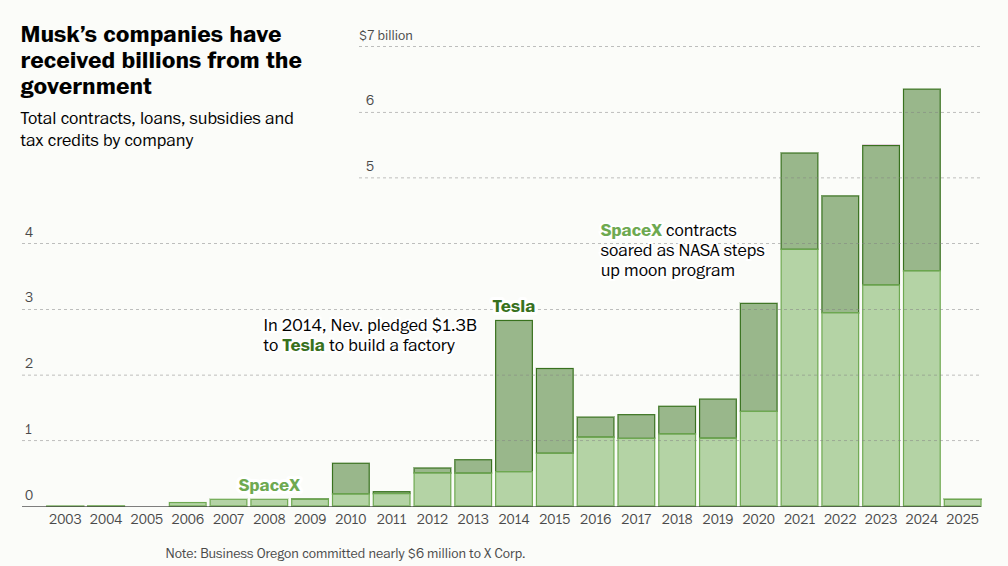
Musk, who invested at least $277 million into putting Trump in the White House, is a «Dark MAGA» accelerationist who wants us to live in a Technocracy. His family is steeped in the tradition of Technocracy.
As part of his Network Empire-building efforts, Musk is founding his own private city called Starbase in Texas. Arch-Praxian and NRx stalwart Balaji Srinivasan greeted the vote of 283 SpaceX employees to incorporate the city of Starbase with tremendous enthusiasm:
Democracy is creating startup cities. Moving to Starbase was voting with feet. Building up Starbase was voting with wallet. And incorporating Starbase was voting with ballot. This is the future of democracy. Not a two-party system with the illusion of choice. Instead, a 1,000-city system with the reality of choice.
The ambition—shared by the NRx, the stakeholder capitalists, Technocrats like Musk, and the dynastic oligarchs alike—is indeed to construct a «1,000-city system» that forms what Curtis Yarvin calls a «patchwork of realms,» otherwise known as the Network Empire.
Based on the concepts outlined in Nick Land’s Dark Enlightenment and utilising Technocracy as a tool for comprehensive social control, the Praxians suggest moving rapidly to a solely private sector governance structure. They openly advocate reticulated Agentic smart city-states that will rapidly grow as regional centres of power, strangling public sector nation-states and stripping them of their resources. Musk’s Starbase is part of that Network Empire project.
If the Network Empire materializes, then, for the first time, actual global governance can be achieved through private sector oligarchs’ unrestricted control of the distribution and allocation of all resources—Technocracy. If that happens, populations will be forced to accept private sector governance out of sheer necessity. Public sector «government,» as we understand it today, will rapidly become obsolete. At least, that’s the idea.
Democracy (which is nonexistent) is not creating modern startup cities, despite what Srinivasan says. Transnational capitalist oligarchs are. In order for Musk to grab the land for his nascent Starbase city, he took advantage of the tax breaks he gleaned by registering Starbase in a Texas Enterprise Zone—a US Special Economic Zone. Musk received the necessary approval to buy US territory from the Texas Parks and Wildlife Department.
In our proposed «shared future,» our dictators will be the hegemons of the «multipolar digital financial order.» They will be the Network Empire’s «small number of people» who program the code and control access to the nodes in order to hold «power unprecedented in human history.» They will be the «founders» of the Network Empire’s smart city-states who will enforce the global governance agenda decided in «off-the-record» enclaves such as Dialog.
Obviously, we cannot afford to participate in the system these people are building. Its purpose is human bondage, pure and simple. Enslavement of the masses is their aim. Enslavement of the masses is what their system does.
China’s Smart City Global Governance Megalopolis
For more than two decades, the Chinese government has been focused on building the surveillance technology infrastructure, through public-private partnerships (stakeholder capitalism), that will ultimately enable the centralised control of all resource allocation and thus of its citizens’ behaviour. This is the essence of Technocracy. Unsurprisingly, Praxian Elon Musk is working with the Chinese government, not against it, to assist their joint development of the «frontier technology» that the UN wants to use to enforce its muscular global governance.
Just as the Chinese government’s civil-military fusion is not unique to China, so the imposition of Technocracy is not unique to China. Technocracy is being pursued by many other governments. The UK government, for example, is also imposing Technocracy on the British. The UK establishment, however, has acted hypocritically and has hidden its intentions.
By contrast, the government of China, as previously noted, has been more honest and open about its plans. As early as 2014, the Chinese State Council Notice concerning Issuance of the Planning Outline for the Establishment of a Social Credit System declared the following:
Accelerating the establishment of a social credit system is an important foundation for comprehensively implementing the scientific viewpoint of development. [. . .]
Accelerating and advancing the establishment of the social credit system is an important precondition for promoting the optimized allocation of resources [. . .]; and an urgent requirement for improving mechanisms for scientific development. [. . .]
Operational mechanisms are the institutional basis for guaranteeing the coordinated operation of all parts of the social credit system.
Scientifically controlling the allocation and distribution of all resources, and therefore controlling citizen’s behaviour, is the purpose of Technocracy. In announcing its Social Credit System, the Chinese government overtly signaled its commitment to Technocracy.
As we discussed in Part 2, much of China’s technological and economic development has occurred due to central government investment in China’s numerous Special Economic Zones (SEZs) and in the similar Free Trade Zones (FTZs) that often reside within the larger SEZs. For example, the Lin-gang Pilot Free Trade Zone (FTZ) is located within the Shanghai Special Economic Zone (SEZ).
According to the UN, China’s SEZs and accompanying FTZs are not merely hubs for technological and economic development. They are also trialing new governance structures that will spur advancements in Technocracy.
In its 2023 report on the «China’s Pilot Free Trade Zones,» the UN acknowledged:
The core function of [China’s] FTZ is institutional innovation to improve government service, expand integration (notably in the services sector), advance reform and encourage technology R&D for industrial transformation through policy tests and experiments. [. . .]
The Pilot FTZs aim to accelerate industrial upgrading through the shift towards an innovation driven economy. [. . .] This looked similar to the purpose of [. . .] the five Chinese SEZs. [. . .]
For the FTZs, the focus is using more comprehensive and innovative policy measures, [. . .] advancing “integrated industrial innovation”, and “optimizing enabling environment for industrial development” including facilitating freer flow of factors such as capital, technologies, talents, and data through reforms in various policy areas.
Via policy tests and various governance experiments, “institutional innovation” seeks to create the «enabling environment» for public-private partnerships to carry out the digital transformation. An enabling environment is, more specifically, a «business-enabling» environment, created for the private sector by the public sector.
The European Union’s definition of an «enabling environment» is:
The set of policy, institutional, regulatory, infrastructure, and cultural conditions that govern formal and informal business activity. It includes administration and enforcement of government and national and local institutional arrangements that effect the behaviour of relevant actors.
China’s SEZs and FTZs are developing the necessary frontier technology-based governance systems. They are hubs for integrating Technocracy into governance. As China’s government and Chinese corporations are very much part of the global public-private partnership, its institutional innovations are moving us all closer to the UN’s sought-after smart city-state world and the Network Empire.
The UN’s 2023 report continued:
In Qingdao FTZ, digital technologies such as AI and big data have been applied to establish a smart enterprise registration system. It is envisaged that this will drive much more transparent, efficient and convenient government service which is essential for sustained economic growth and integration into the world economy. [. . .]
Lin-Gang is seeking breakthroughs in ICVs [Intelligent Connected Vehicles], service robots, interactive terminals, intelligent wearables and drones to scale up high-end intelligent terminals and to expand demonstration AI application scenarios by focusing on intelligent manufacturing, smart cities, and digital security scenarios.
The UN went on to explain why the Lin-gang FTZ is of particular interest to the oligarchs who are behind blossoming smart city-based global governance structures:
Lin-gang Special Area allows more developers to participate in the transformation of AI technologies that drives the development of key application fields such as intelligent plants, smart transportation and smart cities [. . .] so as to realize the digital transformation of the whole city.
The Lin-gang FTZ is among China’s many technology sector R&D regions that the Chinese government is supporting to advance smart city technology—what the UN terms «frontier technology.» These deregulated regions are exploring the application of AI and how governance systems can integrate with the technology to develop smart systems, including smart cities.
The Chinese government is proud of its status as a world leader in smart city construction. With its Guangdong—Hong Kong—Macao Greater Bay Area (GBA) high-speed rail project, the Chinese state is linking its smart city SEZs and FTZs together to form the world’s first genuine megalopolis.
This gargantuan project is the epitome of the large-scale deployment of the very «frontier technology» the UN desires. The GBA centralises state control over the allocation and distribution of resources to approximately 86 million Chinese people. The GBA is the realisation of the regional smart city-based global governance system pursued by the UN.
A Technate is a society under the dictatorship of a Technocracy. China is close to completing the world’s first mega-Technate, and every other functional oligarchy is looking toward China in the hope of emulating it.
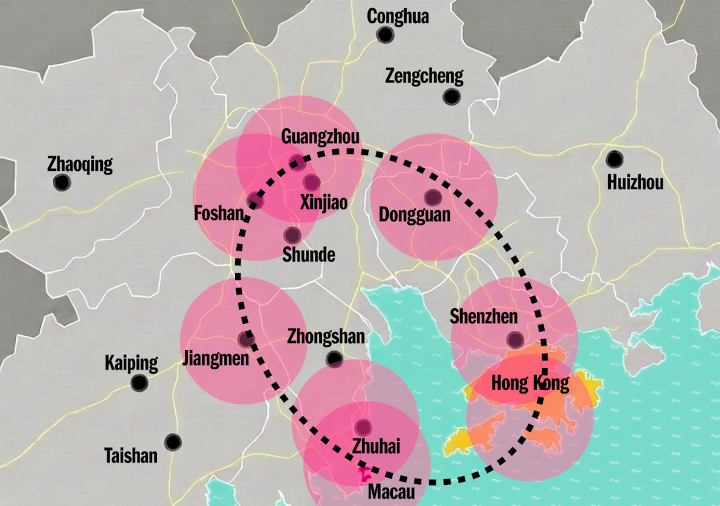
In the political context, one could say that «enabling environments» are the formalisation of functional oligarchy. China’s government is leading the way on this kind of oligarch-led governance. Ultimately, the transnational oligarchs, particularly the Praxians, are eager to see not just Chinese peoples’ behaviour but the entire world’s behaviour transformed, for the Praxians’ benefit.
Needless to say, the Technocracy-led transformation of humanity is also central to the UN’s multipolar global governance agenda. Earlier we noted how Microsoft views the UN 2.0 objectives. Microsoft explained that the UN’s new model of global governance seeks to control all information flows. The UN wants to decree who is allowed to act, what acts are permitted and where. It wishes to control the standards by which all systems, products, and services must comply, and it wants to seize for itself the magical authority to decide what counts as evidence and what doesn’t.
For such a system to flourish, the programmable Agentic State, operating across a network of smart city-states and providing Governance-as-a-Service, is the zenith of enabling environments.
Convincingly Broken Government
To summarise: The UN has been working in partnership with the government of China and with other governments on «institutional innovations» to advance its global governance agenda through a network of smart city-states. The UN’s ambitions coalesce with the Praxian dream of Network Empire.
The BIS provides the monetary layer to assist the UN and the Praxians to realize their goals. Its proposed finternet stands ready to stiffen the «backbone» of the entire new Multipolar World Order. In other words, an international nexus of extremely powerful forces has been formed to implement their shared global agenda.
As we’ll discuss in Part 4, Zionism appears to be controlling the policy decisions of the US government and Zionists are seemingly marshalling the most powerful military and the most powerful economy on earth. True, Zionism is incredibly influential, especially on US foreign policy. But deeper structural forces are using Zionism as a front to absorb public attention and to conceal a far more pragmatic and much less ideological global transformation.
What we’re looking at is the merging of: (1) the oligarchs behind the UN, (2) the oligarchy’s Praxian wing, (3) the Bank for International Settlements, (4) aligned international think tanks, (5) the global corporate network (represented by the WEF, the SPIEF, the ASEAN Private Markets Council (APMC), and so on), and (6) governments everywhere.
All of these entities desperately want the world to accept a new polity based upon Agentic GaaS smart cities. In short, they covet a Network Empire within a Multipolar World Order (MWO).
To implement their plan, though, they need to convince the planet-wide population to adopt the necessary «frontier technology» and eventually choose to live—or at least acquiesce to living—in Agentic GaaS city-state realms. Somehow, they have to persuade us that we’ll benefit by going along with their agenda. Bottom line: They must prove to us that representative democracies are dysfunctional and that Technocracy is the only viable system, the only solution to our woes, the only «order» that can come from chaos.
Ravi Agrawal is a frequent contributor to such globalist gatherings as the WEF’s annual Davos soirée and the Munich Security Council conference. He is a member of the Council on Foreign Relations (CFR) and editor-in-chief of Foreign Policy (FP). The magazine is closely linked to the West’s Deep State think tank network. It’s therefore fair to say that Agrawal is a mouthpiece for the Anglo-American Establishment.
In a leading editorial for a 2022 issue of FP, Agrawal wrote:
By the early 1990s, it was difficult to imagine an appealing or feasible alternative [to representative democracy]. But with the turn of the millennium, global sentiment was shifting. As China’s growth accelerated and Western democracies struggled to enact economic reforms, a line of thinking began to emerge that democracies weren’t well-equipped to tackle the world’s toughest problems. [. . .] The world is a difficult place in 2022. But there is value in hunting for solutions to our challenges—however outlandish they may seem at first.
Other articles in the media have been echoing Agrawal’s contention in recent years. They’ve claimed that our perceived system of government is broken and that we can’t trust it any more. In particular, they have persistently alleged that the Trump administration is undermining democracy and have accompanied this assertion with numerous reports concluding that broken representative democratic governments need to adapt to new global realities. This Western propaganda, replete with China-maxxing, gives readers the impression that the West’s system of government needs to be updated lest it succumb to what it alleges to be never ending global crises.
One of the Praxian’s gurus, Nick Land—the author of The Dark Enlightenment and, according to Mark Andreessen, a «patron saint» of Techno-Optimism—currently lives in Shanghai.
In 2017, The Guardian’s Andy Becket wrote a seminal piece on the topics Land had focused on in his his Dark Enlightenment treatise. In his article, Becket noted that when Land arrived in China in 2004 he was deeply impressed by what he subsequently branded «neo-China.» As Becket tells it, Land thought the rapid economic and technological development underway in China was «the greatest political engine of social and economic development the world has ever known.» In fact, when Land developed the theory that would become the Dark Enlightenment, he already considered China to be an accelerationist society, according to Becket.
Last year Land gave an interview to The Spectator. When he was asked his thoughts on the Trump administration, he responded:
The entire American political system grows out of a Whiggish, English, liberal tradition – law, custom, distance, decentralization. It’s a system designed for power that’s invisible, distributed and procedural.
What Land was referring to was the NRx’s analysis of the social and cultural structural mechanisms through which modern sociopolitical power operates. He and his fellow neoreactionaries call this power structure «the Cathedral.»
Rather than oppose this ideological Cathedral, however, the NRx solution is to convert it into «fungible shares» that can then be bought by anyone with enough cash to own a slice of tyranny. The Praxians have come to believe their own technology companies, including AI firms, can create an Agentic AI Network Empire and thus capture the Cathedral entirely.
It is important to remember that, for the Praxians and for the wider NRx, «dictatorship is good.» Or, as Land is quoted as saying in The Spectator’s 2025 interview, «The best emperor is invisible to society.» With this in mind, Land highlights an important feature of the Trump administration from the perspective of the NRx—and the Praxians:
What’s new with Trump is theatricality, the sovereign as show. But the background operating system, the bureaucracy, the law, the media – all of that stays in place. The show is a symptom of the hollowness of the center. He’s the noise that reveals the emptiness. So in a way he both rejects and confirms the invisible model: he makes the invisible visible by performing the void.
That the invisible «background operating system» stays in place is good news for the NRx, because that’s the part of the power structure they seek to control. What is called representative democracy is the «hollowness of the center»—a hollowness that, in Land’s view, Trump exemplifies.
Trump’s noise «reveals the emptiness» and exposes the «void» that is representative democracy. Even this emptiness is useful to Land, because it shows that the «operating system» is all that truly matters. As Land said: Trump «makes the invisible visible.» Trump’s antics, as unhinged as they seem to be, are perfect as far as the NRx is concerned.
You’ve seen the Praxians described throughout this series as the oligarch faction that currently has the most direct power and influence over the US government—»Praxians in control» (See Part 1). They are bending the Trump administration to their will. Marc Andreessen explained that Praxians support Trump to ensure he is «more favourable» to them and their interests.
One of the Praxians’ objectives is to demonstrate to citizens of the West that representative democracy is broken and needs to be fixed. Their Network Empire solution lies in readiness to «save» us from the inevitable collapse. A Trump administration that appears to be clueless, inept, dangerous, and theatrical to the point of absurdity is very much in the Praxians’ interests.
The Noise that Reveals the Emptiness
Among the many bewildering and nonsensical moves it has made, the Trump administration’s decision to launch Operation Epic Fury and start a conflict with Iran was perhaps one of its worst. There was neither a plausible geopolitical necessity nor an identifiable economic rationale for it. Trump and his team couldn’t even manage to publicly agree which arguments to make in defence of their apparent decision to go to war. The world looked on aghast.
On February 28, 2026, Trump said that «major combat operations in Iran» were underway. The stated aim was to «defend the American people by eliminating imminent threats from the Iranian regime.»
When Trump pointedly blamed Iran for attacking US interests in the Middle East, he was referring to “Iran’s proxy Hamas that launched the monstrous October 7th attacks on Israel.»
He also accused Iran of being the «world’s number one state sponsor of terror» and added that Iran «can never have a nuclear weapon.»
Then he said that the June 2025 US «Operation Midnight Hammer» had «obliterated the regime’s nuclear program.»
Next he said Iran posed a nuclear missile threat to Europe.
So, in February 2026, Trump argued that the US needed to «totally . . . obliterate» the Iranian regime’s military and nuclear capability «again» having already «obliterated» the same a few months earlier.
The first time he vowed to do that very thing was in March 2025, shortly before the US launched «Operation Midnight Hammer.» That was when Trump’s pick for Director of National Intelligence, Tulsi Gabbard, presented the US intelligence community’s (IC’s) official assessment of the Iranian nuclear threat to the House Permanent Select Committee on Intelligence. Gabbard testified as follows:
The IC continues to assess that Iran is not building a nuclear weapon and Supreme leader Khomeini has not authorized the nuclear weapons program that he suspended in 2003. We continue to monitor closely if Tehran decides to reauthorize its nuclear weapons program.
In the days leading up to the 2026 attack on Iran, the leading global news agency, Reuters was one of many Western news outlets to report that the Iranian threat assessment had not changed. Trump’s own Secretary of State, Marco Rubio, had previously hedged his words, saying that Iran was «on a pathway to one day being able to develop» ICBMs.
The February strikes on Iran occurred while negotiations between the US and Iran over the latter’s nuclear program were ongoing. Future talks were scheduled for Vienna and Washington. If Iran’s nuclear program was the issue, there was clearly no reason to choose the military option at that point.
On March 4, 2026, US congressman Seth Magazina posted a selfie video on Musk’s X platform reporting on a White House intelligence briefing he had just attended. He said the US Secretary of State (Marco Rubio), the Secretary of Defence (Secretary of War Pete Hegseth), and the CIA Director (John Ratcliffe) were among the officials who told the gathered representatives that the US IC still had «no intelligence that Iran was planning to attack the United States.» Magazina added that the Trump administration said it «does not have a plan for what is going to happen to Iran after the war is over.»
Possibly this explains why, shortly after Operation Epic Fury began, Secretary of State Rubio gave a completely different justification for attacking Iran. Rubio claimed the US launched its assault because that was precisely what the Israeli government was going to do anyway. According to Rubio, Israel’s «Operation Roar of the Lion» initiated Trump’s «Epic Fury.»
As reported by Reuters, Rubio said:
We knew that there was going to be an Israeli action; we knew that that would precipitate an attack against American forces, and we knew that if we didn’t preemptively go after them before they [Israel] launched those attacks, we would suffer higher casualties.
However, Secretary of War Hegseth gave a different reason. He said Operation Epic Fury was not prompted by Israeli intentions but was, instead, «laser focused» on destroying Iran’s conventional missile and drone manufacturing facilities.
In Part 1, we highlighted that the Praxians’ haphazard digital kill chain, which US forces relied upon, contributed significantly to the murder of Iranian schoolchildren, among many other potential war crimes. Operation Epic Fury was no laughing matter. Nevertheless, the farcical incoherence demonstrated by the Trump administration in the weeks following the launch of the operation was comical.
If we look at the timeline, reported by PBS, of official statements about the anticipated duration of the assault, the impression of a completely clueless US government is hard to avoid.
Initially, former TV personality and serial bankrupt businessman Donald Trump said the operation would last «four to five weeks.» Shortly afterwards, former TV and social media personality Pete Hegseth said «we haven’t stated how long it will take.» A few days after that, Trump echoed Hegseth’s remark, though he insisted it was «his own idea»—which he later claimed came from a feeling in his bones. Mere speculation—which he and Hegseth were chiefly responsible for stoking—did «no good,» Trump insisted. And, with regard to duration, he added, «It’ll be as long as necessary.»
«Necessary» to do what? That seemed to be a reasonable question to ask. For, up to that point, the US government had been unable to clearly specify what the objectives were. And yet its answers were about to get even more confusing.
Declaring tentative victory on March 9, Trump said, «We’ve already won in many ways, but we haven’t won enough.» Trump didn’t even seem to know whether the government of the nation he supposedly leads was at war or not.
On March 11, Trump was asked if the conflict was a military excursion or a war. He replied «Well, it’s both. It’s both. It’s an excursion that will keep us out of a war.»
Repeatedly claiming the operation was «ahead of our time projections,» while simultaneously saying they had no idea how long the operation would last, Trump finally declared some sort of victory on March 15: «We’ve essentially defeated Iran.»
Throughout the remainder of March, Trump, Hegseth, and other US government officials kept saying how decisively the war, the excursion, or whatever it was, had been won and how the operation had been a «tremendous success.»
On April 1, 2026, Trump totally contradicted all of that celebratory grandstanding with these words:
We are on track to complete all of America’s military objectives shortly, very shortly. We’re going to hit them extremely hard over the next two to three weeks.
On April 5, having already won but not won, Trump took his statesmanship to new heights. He turned to his own social media platform, where he habitually issues threats of war and, supposedly addressing the Iranian government, in reference the Strait of Hormuz, wrote:
Open the Fuckin’ Strait, you crazy bastards, or you’ll be living in Hell – JUST WATCH! Praise be to Allah.
Trump followed up this profanity-laced demand, on April 7, by threatening to exterminate the «whole [Iranian] civilisation,» then again declared «[t]otal and complete victory.»
Remember, Trump announced «his» victory on March 15. A month later, on April 16, Trump observed that the «war in Iran is going along swimmingly [and] it should be ending pretty soon. It was perfect. I mean, it’s perfect.»
By June 20, 2026, the Strait of Hormuz was closed again by the repeatedly defeated and frequently obliterated Iranian government and its forces. The conflict has flared up again as both the US and Iran squabble over control of the Strait of Hormuz. Observably, Trump has been and is detached from reality.
In Part 2, we talked about how, from a military perspective, the idea that the US could possibly conduct Operation Epic Fury in the way it allegedly did is highly doubtful. Added to this, the idea that an erratic, blustering, ill-informed, narcissistic buffoon like Trump actually serves as a functioning «Commander in Chief» of US Armed Forces is both hilarious and terrifying in equal measure. It is a small mercy, perhaps, but when US commanders have to plan a real military operation, they appear to at least have the good sense to eject Trump from their meetings.
In any conflict, war propaganda emanating from combatant governments is normal, but the Trump administration’s consistently incomprehensible rambling wasn’t remotely effective war propaganda. Not only was the propaganda narrative incoherent, the wild claims made were widely known and reported to be completely false.
Prices of everything soared everywhere. People died for no immediately discernible reason. Though, sadly, there were many reasons.
Capitalising on Trump’s Folly
The Islamabad Memorandum of Understanding (MOU) that will, with any luck, eventually bring the conflict with Iran to an end, was signed on June 17, 2026. By early July 2026, US hostilities with Iran spiked again. The restart of hostilities coincided with Trump’s appearance at a NATO summit in Turkey. Trump took the opportunity to complain about other NATO member governments less than enthusiastic endorsement of his Epic Fury fiasco.
Trump also used the NATO summit to drive a wedge between the US and its European allies. He threatened that a further withdrawal of US troops from Europe would leave them vulnerable to alleged Russia aggression. Once again, Trump’s apparent US isolationism provides further narrative justification for a regional balance of power structure in a Multipolar World Order.
Obviously representing the Praxians at the NATO summit, Trump again demanded that the US should be allowed to annex Greenland. Whether he knew it or not, he was effectively promoting the Praxis Nation and the Network Empire.
The Israeli government is not a signatory to the Islamabad MOU. Instead, the governments of Israel and Lebanon have signed a separate US-brokered 14-point framework agreement to potentially resolve Israel’s spurious claim on Lebanese territory. The Islamabad MOU explicitly sets Lebanon as a «front» in the alleged US/Israeli «war» with Iran. Like the US and Iranian governments, the Israeli government also continues to subvert both the framework agreement and the Islamabad MOU with its ongoing and extremely violent occupation of Lebanon.
Chatham House—the Royal Institute of International Affairs—arguably remains the world’s most influential policy think tank. Marc Weller, director of the Chatham House Global Governance and Security Centre, said of the Islamabad MOU:
The 14-point document accommodates virtually the full catalogue of Iranian demands. [. . .] The US is losing its key pressure points, whether economic or military. And Iran’s nuclear obligations are yet to be determined. Other war aims, like stopping Iranian support for proxy forces, do not feature in the instrument. [The US] expressly undertakes to refrain from interfering in the internal affairs of Iran as required by international law. [. . . .] To extricate itself from its war, the US has been forced back into reliance on international cooperation and the institutions of the international system. And it is being forced to accept, at least nominally, the principles of the international order it had cast aside.
The «international order» of which Weller speaks is the UN 2.0 Multipolar World Order (MWO) built around the Network Empire. It appears that Trump’s military folly has paved the way for the Praxians their extended oligarch partnership to fulfil their ambitions. The Praxians have long sought a US war with Iran, and now (as we’ll cover in detail in Part 4) it is evident why. The deaths of innocents along the way was just more collateral damage in the Praxians’ digital kill chain.
Trump remains prone to threatening Iran, claiming that Iran will «no longer exist» and so on. His many previous utterances on the same theme have already proven to be nothing more than empty rhetoric. The US military actions that result, however, are still lethal for innocent men, women and children.
Despite the war having been «won» by the US many times, and the Iranian government comprehensively defeated on numerous occasions, the fog of war has never been foggier.
On July 6, 2026, the Iranian government possibly breached the current ceasefire agreement by attacking three vessels exiting the Strait of Hormuz that were reportedly not using the Iranian government’s permitted «transit corridor.» The Iranian government has not denied attacking the tankers but, frankly, that doesn’t mean it did.
After the «unknown projectiles» allegedly struck the Qatar and Saudi Arabian registered tankers, the allegations that Iran was responsible came from the government of Qatar. Reuters reported:
Iran’s foreign ministry said Qatar’s accusations were perplexing and that Tehran was diligently fulfilling its commitments but asserted that commercial vessels faced risks for using routes not coordinated with Iran.
The US retaliated by launching further attacks on Iran and the Iranian government responded to this attack by striking targets in Kuwait and Bahrain. Qatar, Saudi Arabia, Kuwait and Bahrain are all member of the Gulf Cooperation Council (GCC). As we’ll discuss in Part 4, they may have there own reasons for wanting the destruction to continue for a while.
Having started the Epic Fury violence, and engaging in his usual lunatic-fringe style of diplomacy, Trump called the Iranians «vicious, violent people» and labelled them «scum.» He told the press that the Islamabad Memorandum, supposedly underpinning the ceasefire agreement, was over and then indicated that talks would continue.
Journalist and associate editor of The Hill, Niall Stanage, observed that the on-off conflict in the Strait of Hormuz «sent oil prices spiraling, leading to sharp increases in prices at gas pumps across America.» Stanage added:
Prices dropped sharply once the MOU was set and tensions appeared to ease. But the new strikes and Trump’s more bellicose rhetoric caused significant turbulence on energy markets on Wednesday. The price of benchmark West Texas Intermediate crude oil had risen more than 6 percent as of 5 p.m. EDT.
Trump’s «bellicose rhetoric» serves as a market signal. The continuation of the threat of all out war, punctuated by occasional kinetic flare-ups, potentially suits all sides.
The Trump administration threatened to revoke its MOU-dependent license agreement to allow Iranian oil exports, thereby strengthening US government claims that it, not the Iranian government, is in charge in the region. The Iranian used the attacks to again highlight the «Zionist aggression on [Lebanon]» and reassert their claim to be able to make «adjustments to the Strait [of Hormuz].»
The purported tanker attacks enabled the weapons manufacturers, the oil giants and other energy companies, the banks and the financial institutions to continue to make record profits from the war.
But more than this, as stressed by Chatham House fellow Nitya Labh—former UN, CEIP, and DARPA—the ongoing intermittent «war» serves to demonstrate the apparent pressing need for better global governance. She wrote:
According to the International Energy Agency, the blockade has created an oil and gas crisis more severe than those of 1973, 1979 and 2022 combined. The battle to control the strait has led to a slowdown in global economic growth, widespread fuel shortages and deepened humanitarian crises around the world. In Sudan alone, shipping disruption has cut off medical supplies to an estimated 20,000 people.
Global instability, economic turmoil, disrupted supply chains and deaths were always the inevitable and seemingly unavoidable consequences of Trump’s Epic Fury, of Netanyahu’s Roar of the Lion and of the Iranian response, Operation Fateh Khyber. The world is coming to terms with a newly manufactured «geopolitical» reality as described by Chatham House:
Disruption to the critical waterway over the past few months has put a spotlight on maritime chokepoints and the vulnerability of international supply chains. It has also shown how the global economy – often imagined as fluid and borderless – is dependent on a few, narrow shipping channels.
Chatham House emphasises that the world is grappling «with the fallout of Hormuz» but adds that «other chokepoints could pose even greater risks.» The worlds supply of semiconductors could be strangled, threatening technological development such as AI. The World’s food supply of grains and soy could be cut off, oil and energy flows could be further disrupted, the battle against international terrorism stymied, and vital international trade corridors severed.
According to Chatham House, military misadventures emphasise the problem. «Major powers selectively interpret or ignore [international] legal obligations.» Global «enforcement mechanisms remain weak or non-existent [and the] global consensus around these mechanisms» is prone to fracture. Mere «crisis prevention» is not enough when «the legal and institutional frameworks, such as the UN Convention on the Law of the Seas, are no longer keeping pace with geopolitical realities.»
Therefore, the answer is obvious, is it not?
As Labh’s think tank colleague Marc Weller said, the US government, indeed everyone, now needs to accept «the principles of the international order.» The current Westphalian model is unacceptable and dangerous for the whole planet. Better multipolar global governance is required and we must find solutions, such as new transnational trade corridors that circumvent the «chokepoints.» The re-imagination of global governance through UN 2.0 must succeed.
This is precisely what the Praxians and their oligarch partners want.
In Part 4, we will look at the evidence revealing how construction of the Network Empire in the Middle East is destroying global geopolitical hegemony and eroding nation-states. We will show that the Praxians have been involved in every decision and every step along the path to regional deterritorialization—and that they have a explicit plan for the reterritorialization to follow. The Praxians have positioned themselves as «warrior king» saviours prepared to become the private sector hegemons of the new Network Empire they are planning in the aftermath of the destruction they are accelerating.