

In Part 1, we defined the Praxians, considered their openly stated control of the Trump administration, and examined their extensive partnerships with the Israeli defence technology sector. In Part 2, we looked at State Crimes Against Democracy (SCADs) and Military-Civil Fusion within hybrid war. In Part 3, we examined how global forces have aligned behind the Praxian vision of a Network Empire as we move towards a UN 2.0 multipolar world. Now, in the concluding Part 4, we will see how all of this is coalescing in events playing out in the Middle East, how it is shaping global governance, and how, in microcosm, it is being applied to New Gaza.
Across this entire series, we have explored the dawning of a new kind of global governance structure. We are heading toward a multipolar, regional balance of geopolitical power, where financial and economic power is wielded by those who program the nodes on the finternet—those who set the unified regulatory and financial architecture, irrespective of their geographical location.
Populations will be controlled through the managed distribution and allocation of all resources—Technocracy. The United Nations (UN) believes global governance will be most effective when it is exerted extraneously of nation-states through a network of city-states. The global governance ambitions of the UN dovetail with the “Network Empire” objectives of the Praxians and the affiliated neoreactionary movement (NRx) accelerationists.
The Praxians and the NRx accelerationists want to deliver Governance as a Service (GaaS)—via Agentic AI—to captive populations of “customers.” They aim to achieve “the flippening of Network States over Nation States in real time” and ultimately to “establish a new form of human civilization: the Network Empire.”
Simultaneously, the UN wants to roll out “frontier technology”—a broad range of surveillance technologies including digital ID linked to programmable digital currencies—across a growing network of city-states. As we’ll see, the plan is to enforce Digital Nation Stacks on populations living in countries subsumed into their respective regional “poles” within a fragmented geopolitical world of bilateral partnerships between nations, which is the proposed basis of the multipolar world order (MWO).
The multipolar regionalization of global supply chains is giving rise to new types of international economic partnerships, such as Pax Silica. Thus, the MWO pole or unionwon’t necessarily be a geographically contingent region or global subregion, but rather a transnational partnership between geographically dispersed nations and subregions.
Just as access to the programmable nodes on the finternet will create new financial and monetary hegemons, commanding a city-state or Network State—as a node in a global“patchwork of [Network Empire] realms”—will create new geopolitical hegemons. The Network Empire is intended to institute a global partnership of hegemons (oligarchs) exerting global governance influence across the borders of the MWO.
In Part 3, we discussed a research paper published by the Soros-Omidyar network-backed policy think tank, the Center for International Governance Innovation (CIGI). The CIGI explored the Bank for International Settlements (BIS) and its construction of “the finternet.” The finternet is described as “a unified, programmable financial internet, where digital money, tokenized assets, identity credentials, and compliance logic operate seamlessly across jurisdictions.”
Through its finternet, the BIS is seeking to command “the protocol layer of twenty-first-century power.” The CIGI recognized that the finternet represents “a new form of monetary hegemony,” which the CIGI called the “multipolar digital financial order (MDFO).”
Daniel Araya is a senior fellow of the CIGI. He explained how the MWO, with its integral MDFO, emerges through erosion of the existing global order:
In a multipolar world order, power is no longer concentrated in the hands of a single hegemon but diffused among a constellation of regional actors. [. . .] While the decline of unipolarity poses enormous challenges, it also offers an opportunity to build a resilient global order. [ . . .]
Decentralizing UN operations is essential to developing faster and more flexible crisis-response frameworks. [. . .] This means expanding cooperation with regional organizations such as the European Union, the Association of Southeast Asian Nations, the African Union, and Mercosur.
In my book The Technocratic Dark State, I called this apparent fragmentation of authority the “decentralization-to-recentralization trick.” While the system of international relations appears to be decentralized, it is then recentralized through the use of an overarching compliance management system. The Praxians, their oligarch partners, the UN, and various national governments want to use Agentic AI for this task.
Araya described what such a recentralized MWO system would look like:
Building on the efficiencies of artificial intelligence and robotics, UN administrative processes can be automated. [. . .] Real-time data analytics can [. . .] track humanitarian crises and monitor compliance. [. . .]
Most importantly, digital platforms can amplify the voices of smaller nations [and city-states], democratizing participation beyond the elite corridors of New York and Geneva.
The proposed global order, currently under construction, is unlike any form of government or intergovernmental governance system that we have ever encountered before. The so-called multipolar world order (MWO) is genuinely a new world order.
Despite the reported “wars,” the supposed “technological race,” the claimed “intense geopolitical competition,” and the alleged “economic chaos,” the movement towards regional supply chains, new international partnerships, digital transformation, and the increasing power of the private sector is relentless.
Nowhere is this unrelenting march towards the MWO more evident than in the Middle East. The reported “war” with Iran is leading to the construction of regional supply chains; Gaza is set to be an Agentic GaaS city-state, and Trump’s Epic Fury is leading to the disaggregation of hegemony in readiness for the multipolar world.
The Praxian and global governance goals are aligned. The Praxians had the means, motive, and opportunity to disrupt the Middle East. Evidently, they took it.
Glaring Deterritorialization
The United Nations wants to create a network of city-states within and spanning across the multipolar regions. To get to this point, the existing international rules-based order—often called unipolarity—has to be deterritorialized before being reterritorialized as the MWO.
To function as envisaged, there can be no global military or economic superpowers in the MWO. To form the multipolar regions, supply chains and energy corridors also need to be deterritorialized prior to being reterritorialized as more independent regional networks comprising both physical infrastructure and, crucially, programmable digital control mechanisms.
Global governance of all regions will be achieved by using the network of smart city-states and the global finternet to control the distribution and allocation of all resources to populations—Technocracy. Resource restrictions, enabled by surveillance technology that links individuals’ digital identities to all economic and social activities, will allow those who “write the code” to exert behavioral control over everyone.
With this proposed new system in mind, consider the amazingly prescient press conference address UN Secretary General António Gutteres delivered in late January 2026, just weeks before the US and Israel launched their joint attack on Iran and Lebanon.
These are early days, but 2026 is already shaping up to be a year of constant surprises and chaos. [. . .] We are living in a world where actions – especially reckless ones – are provoking dangerous reactions. [. . .] When perilous actions do not meet the adequate reaction, the system destabilizes. Impunity is driving today’s conflicts—fueling escalation, widening mistrust, and kicking the doors open for powerful spoilers to enter from every direction.
About a month later, the US and Israeli governments would demonstrate the “reckless actions” that would provoke the “dangerous reaction” to destabilize the global system. But contrary to Gutteres’ words, as we have already discussed in this series, the chaos was definitely no “surprise.” We can see that causing global economic chaos was the purpose of the so-called war.
We have also discussed how the UN views the populations’ adoption of frontier technology, through a network of smart city-states, as the most efficient means for it to enforce its new muscular model of UN 2.0 global governance. The UN has done everything it possibly can to support and encourage the global construction of the necessary smart cities. It has found common ground with the Praxians who seek to establish an Agentic GaaS Network Empire (see Part 3).
Turning his attention indirectly to the Network Empire, Gutteres said:
We are witnessing perhaps the greatest transfer of power of our times—not from governments to people, but from governments to private technology companies. When technologies that shape behavior, elections, markets, and even conflicts operate without guardrails, the reaction is not innovation; it is instability.
Gutteres’ solution, of course, is not to try to strengthen the sovereignty of national governments to tackle the instability. The UN 2.0 remodelling project is based upon the “transfer of power [. . .] from governments to private technology companies.” The UN’s remedy, therefore, is for the UN 2.0 MWO to ensure the allegedly necessary “guardrails” are erected to save the world from the “instability” the UN is helping to create.
Highlighting the instability “opportunity,” Guterres concluded that the UN’s own public-private partnership system has been engineered to address these challenges:
Our [global governance] structures and institutions must reflect the complexity—and the opportunity—of these new times and realities. One power alone cannot solve global problems. Nor will they be solved by two powers carving the world into rival spheres of influence. It is important to accelerate, deliberately and with determination, multipolarity—one that is networked, inclusive by design, and capable of creating balance through partnerships.
The MWO will be “networked” by embedding the Network Empire within it, spreading like mycelium across its regional and national borders.
Subsequently capitalizing on the so-called war with Iran, the UN has set up its Safeguards Accelerator to purportedly ensure that the “Digital Public Infrastructure (DPI)”—the term that the UN assigns to the frontier technology being simultaneously installed by governments everywhere—is “inclusive” and delivers “meaningful and equitable economic change.” The UN’s sought-after “economic change” is the new “multipolar digital financial order (MDFO)” running on the BIS’ interoperable finternet.
The UN’s use of the term “Accelerator” should not be overlooked. In 2005, the Praxians’ Y Combinator launched the world’s first seed accelerator program. Since then, accelerationism has come to dominate the thinking of governments and intergovernmental organizations the world over.
“Accelerator” is not just some in-vogue label stuck on national and global initiatives for PR purposes. It has a very specific ideological significance. It shows a commitment to using “creative destruction” to deterritorialize sociopolitical and socioeconomic structures only to then reterritorialize them anew.
The UN offers its global Safeguard Accelerator as a “non-negotiable structural requirement.” This argument is also a common Praxian ploy: the “technological singularity” is inevitable, AI Agentic GaaS neostates are the only solution, and humanity must evolve to become “technoplastic beings.” All of these claims constitute risible hybrid warfare propaganda. None of the supposedly unavoidable responses are ineluctable or even necessary, and none are desirable from humanity’s perspective. It’s all just baseless assertion and propagandist bilge.
Bearing in mind the objectives of establishing the Network Empire, the MWO, and its requisite MDFO, the UN’s enthusiasm for accelerationism could not be more overt. Announcing its Safeguards Accelerator to create the “guardrails” to supposedly keep us safe, the UN insists there is a “crucial window for action” and that the UN is consequently “actively shaping country-level execution and delivering impact.”
The UN proclaims:
As the basic layers of Digital Public Infrastructure (DPI) develop, they change into systems that allow different countries to work together and create AI-powered services for both public and private use. [. . .] The Accelerator is the engine that drives local execution. [. . .] With implementations transitioning from pilots to population-scale rollouts, partners must embed practical safeguards into live code, design, deployment, governance, operations, and national policy now, or risk legacy institutional failure as these systems scale. [. . .] Where a country is rolling out or advancing an identity system, payments, data exchange layer, or sectoral DPI system, safeguards often need steady support. [. . .] The Accelerator is designed to help build this local capacity.
In a similar vein to the BIS’ finternet, the UN is adding “practical safeguards into live code” to make sure that those who write the Agentic governance code prioritize the UN goals in all of their programming. Equally, all programmable transactions must comply with global governance diktats.
The Multipolar Pax Silica Template
Though, according to the Council on Foreign Relations (CFR), the EU is “a template that other regional organizations are following” to hopefully form a successful “bloc” or MWO “pole,” as yet it isn’t quite the perfect pole from the Praxians perspective. But that is all about to change.
The EU Commission has officially taken a dim view of Special Economic Zones (SEZs). This presents a slight problem for Praxians who want to construct European private SEZ charter cities—a new city granted a special jurisdiction to create a new governance system—as Elon Musk has in Texas for example.
Since the 2007 EU-wide SEZ ban, the EU mood-music on SEZs has been gradually shifting. In 2017, zone regulation amendments granted leeway enabling EU member states like Italy to expand their SEZ networks. Currently, the EU permits exemptions for its Export Processing Zones (EPZs), Economic Revitalisation Projects, the French “Zones Franches Urbaines,” and numerous other development zones, especially in Eastern Europe.
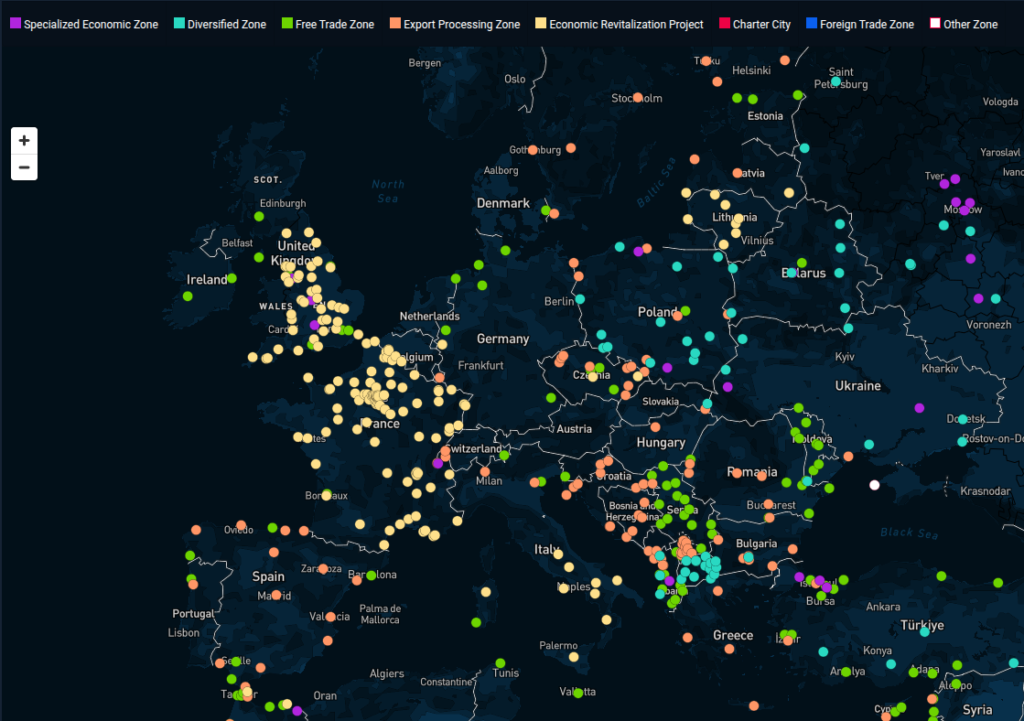
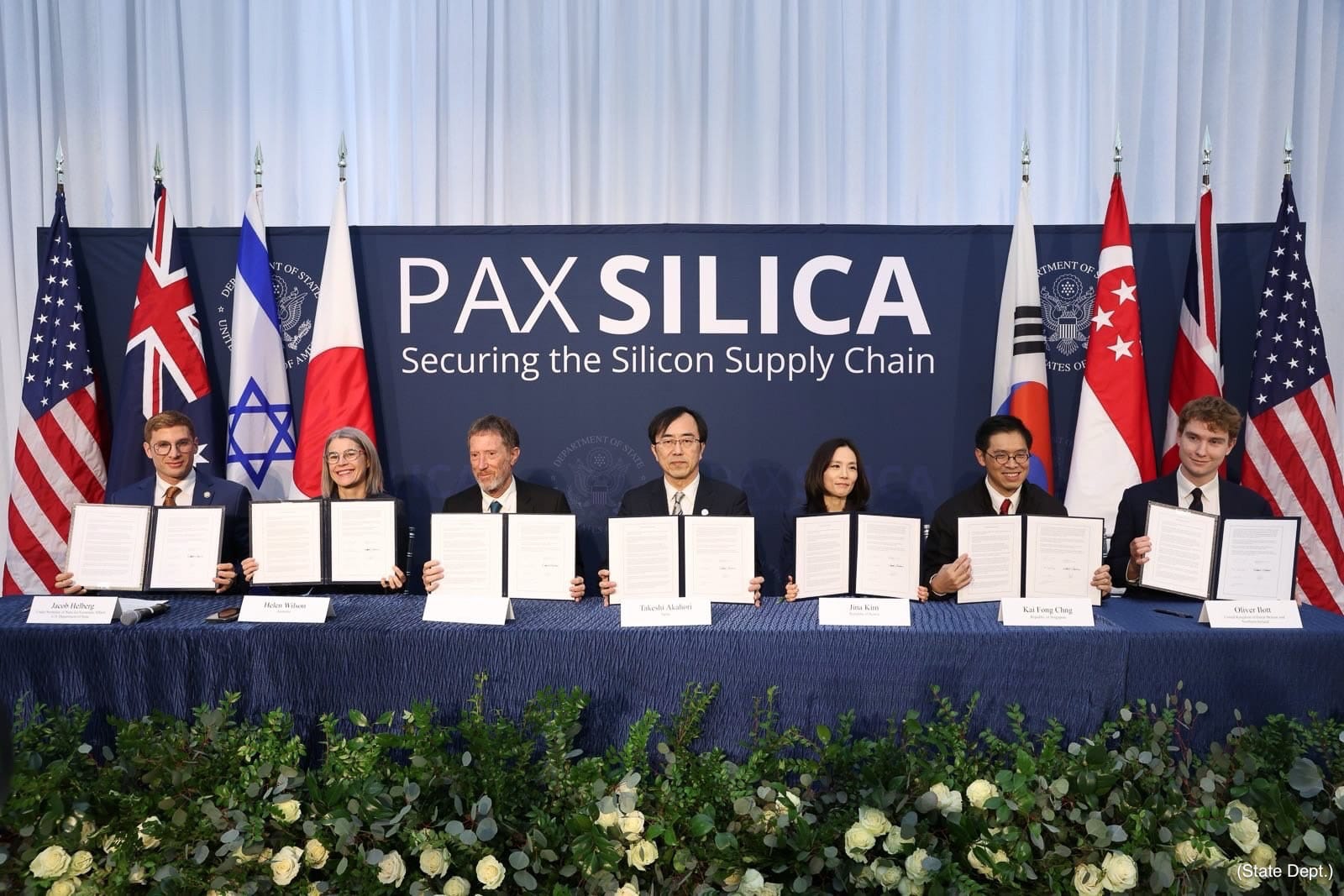
On June 23, 2026, the EU Commission signed the Pax Silica declaration. The Commission has committed the EU to work with “global partners to advance AI and supply chain security.” The stated purpose is to “create new opportunities for European business” but this will supposedly be achieved through “technological progress.” Tellingly, “economic security” is the goal—we’ll see why it is telling shortly. A significant expansion of the EU’s SEZ network is now very likely.
Back in 2024, the Draghi Report on the future of EU competitiveness was published. The research team, led by Mario Draghi, stated that the EU had an “innovation gap” and was lagging behind the US and China. Hence, the resultant Horizon EIC’s adoption of the DARPA model, for example.
Draghi is a former Goldman Sachs managing director; he was an executive director of the World Bank and, next, chairman of the Financial Stability Board (FSB)—a BIS cutout—before becoming governor of the Banca d’Italia. He then served as the president of the European Central Bank (ECB) and, finally, if relatively briefly, as Italian prime minister. Draghi is a prominent Bilderberger, a regular WEF delegate, and a member of the even more exclusive Group of 30 (G30). Draghi is a prominent member of the Deep State that exists to serve the oligarchy.
Draghi advised that to achieve economic security “[a]ccelerating innovation and technological progress” would be essential. The EU would need to maintain “low trade barriers in digital goods, services and infrastructures with the US [. . .] to guarantee access to the latest AI models and processors.” To this end, Draghi continued, it would be important to secure “preferential trade agreements with key partners and guaranteeing critical supplies [. . .] and direct investment in production facilities.” Draghi outlined how this could be achieved:
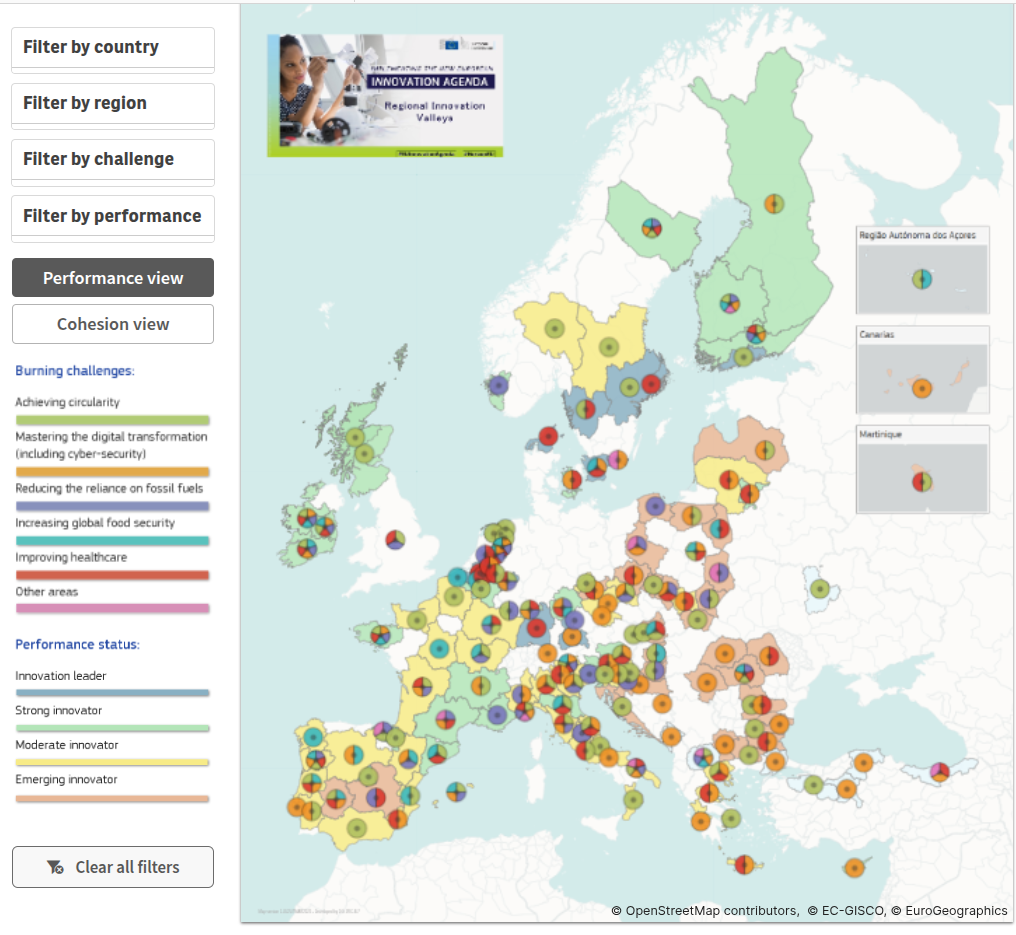
The EU must ensure that more cities and regions can participate in the sectors that will drive future growth, building on existing initiatives such as Innovation Valleys [and] Net-Zero Acceleration Valleys. [. . . ] This will require new types of investments in cohesion and reforms at the subnational level in many Member States. Specifically, cohesion policies will need to be refocused on areas such as education, transport, housing, digital connectivity and planning, which can increase the attractiveness of a range of different cities and regions.
As the EU is supposed to be antagonistic to state-subsidised SEZs, it instead calls SEZs “valleys.” Net-Zero Acceleration Valleys are a European network of SEZs where member states provide incentives for “private investment in energy, digital [transformation] and transport infrastructure.” Regional Innovation Valleys (RIVs) are larger SEZs—incorporating some Net-Zero Acceleration Valleys—that focus on “mastering the digital transformation” of, for instance, energy and food supply chains. The RIVs form a transcontinental network of EU regions which “address[ ] social challenges through cutting-edge technology.”
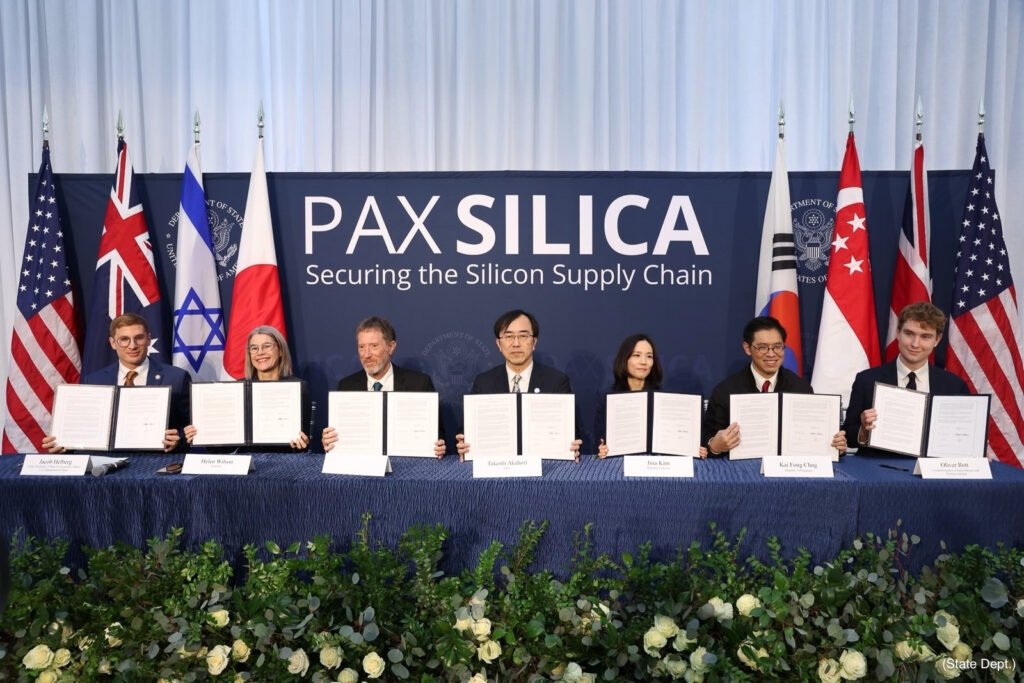
Consequently, with the EU’s Pax Silica signature imminent, ardent NRx accelerationists Jacob Helberg and Joe Lonsdale had good reason for optimism when they spoke in May 2026. You may recall from Part 1 that Helberg’s husband Keith Rabois—an accelerationist investor at PayPal and Palantir and a general partner at Peter Thiel’s Founders Fund—was a campaign fundraiser for both Trump and Vice President J.D. Vance. It was Vance who subsequently appointed Helberg as US undersecretary of state for economic growth, energy, and the environment.
Palantir co-founder Joe Lonsdale interviewed Helberg on his American Optimist podcast—Marc Andreessen’s misleading Techno-Optimist Manifesto (see Part 3) builds on the optimist theme. Lonsdale and Helberg spoke about the Pax Silica declaration and other matters. Apparently, Helberg wrote Pax Silica in consultation with US Secretary of State Marco Rubio, though that probably isn’t true.
The purpose of Pax Silica is to form transnational partnerships that will secure “strategic stacks of the global technology supply chain, including, but not limited to, software applications and platforms; frontier foundation models; information connectivity and network infrastructure; compute and semiconductors; advanced manufacturing; transportation logistics; mineral refining and processing; and energy.”
Pax Silica is a US private sector-led operation which will seize the strategic digital supply chain stacks through “mobilizing the immense creative and financial power of private industry and entrepreneurship.”
The declaration says that “true economic security requires reducing excessive dependencies and forging new connections with reliable partners and suppliers.” Therefore, “to protect private investment from the market distortions” an isolationist and protectionist Pax Silica pole will be formed through international “cooperation on the enforcement of our respective policies to protect sensitive technologies and critical infrastructure from undue access, influence, or control.” Pax Silica is fundamentally multipolar.
It is somewhat ironic, but as Americans are increasingly questioning Zionist influenceover their government, the Praxians—and supranational and intergovernmental organisations, like the EU and the UN, along with notable national partners, such as the Israeli government—are getting on with the business of building a global multipolar Technocracy. In this regard, Lonsdale’s interview with Helberg was remarkable for its frank disclosure.
Helberg claimed that the US needs to “win the race for innovation, and we need to win the race to secure our supply chains.” As we’ve already discussed in this series, the alleged “race” is marked more by collaboration than competition. The “race” narrative is purely a propagandist justification, in this instance, for the regionalisation of supply chains.
As covered in Part 3, Trump’s Epic Fury “war” with Iran has caused global economic chaos, not least by strangling the energy and commodity supply lines through the Strait of Hormuz. Jumping on this manufactured opportunity, Helberg stressed how vital it was to “de-risk[ ] the choke points that our economy depends on.” Continuing with the regionalisation theme, Helberg claimed the “operation Venezuela was incredibly historic” as its purpose was to regain US “influence in our hemisphere.”
As NRx accelerationists, both Lonsdale and Helberg believe in the Dark Enlightenment and the use of creative destruction to shape the future. They think of themselves as mavericks who, as fellow accelerationist Mark Zuckerberg once said, “move fast and break things.” As a brave pioneer of the Silicon Valley technological frontier, Lonsdale readily agreed with Helberg—and, in his absence, their friend Alex Karp—that there is something special about American business’s risk-taking. Supposedly, American entrepreneurs are “willing to be heretical and contrarian.” Presumably, business people outside of the US aren’t heretical enough. Whatever, for Lonsdale, the “heretical thing is really key.”
People in the US and around the world are increasingly expressing concern about the practices of Praxian mega-corporations like Palantir. This is because many of these organisations appear to be unethical and unprincipled, acting like despots who impose technological surveillance on entire populations while collaborating with genocidal maniacs to slaughter innocent people using advanced weapons technology.
Seemingly oblivious to this reality, rather than recognising the public’s legitimate reasons for concern, Lonsdale apparently thinks there is an underlying PR problem. The problem, he muses, is that people are just “really negative on successful people.” They’re jealousand think, “there’s something wrong with you if you’re too successful.” People and institutions are “anti-growth,” and this is their failing because, in Lonsdale’s bizarre self-serving world view, “freedom” is achieved through nothing but “innovation and manufacturing” in deregulated “free economic zones.”
On planet Lonsdale, concepts like individual sovereign equality, emotional and spiritual self-fulfilment, and freedom from oppression are anathema. All that matters is economic “freedom.” Lonsdale seems unaware of wage exploitation, fails to recognise the unaffordable cost of living, and believes that unemployment is a myth. If you’re not wealthy enough and can’t afford to buy happiness, well, Joe doesn’t understand where you’re “coming from.” He thinks you should work harder for him and his Praxian friends and suggests you may be “mentally retarded” if you don’t.
Like many Praxians and other NRx accelerationists, Joe Lonsdale is a big fan of China’s “free economic zones” and is pleased that US investor oligarchs “partnered with [China’s SEZs] for a generation”—actually, it’s more like two or three generations at this point. Noting the parallels between the modern Chinese and Silicon Valley approach to technological development, with Helberg highlighting the skills exchange between the two, Lonsdale says it’s a shame the US and China can’t work more closely together. Unfortunately they can’t, he ludicrously claimed, because the Chinese are “commies.”
Lonsdale had just outlined how China has embraced venture capitalism; operates a capitalist system of free trade zones—that enable China’s private enterprises to flourish—and has constructed a thriving consumer economy, even if it is stakeholder capitalist. But China also remains “communist,” according to Lonsdale.
Lonsdale contradicted himself by acknowledging the extensive, generational East-West partnership and China’s preferred economic model. These observations were totally at odds with his assertions about the East-West divide. His claim that East and West were irretrievably ideologically opposed was seemingly further propaganda meant to rationalise the ongoing facade of East-West rivalry.
Turning to the Pax Silica agreement with the EU, Jacob Helberg stressed the importance of the Draghi Report, stating that Draghi highlighted deregulation as the path to EU growth. Helberg added that private investment will flow into the EU if it can “secure [its] border, deregulate, lower taxes, and bring down the cost of energy.” He believes that European cultural inertia needs to change because it “disincentivises risk-taking and heterodox thinking.”
To understand the significance of the Lonsdale-Helberg chat, we must consider the broader context. In his interview with Lonsdale, Undersecretary Helberg said:
[Pax Silica] is a fundamentally different grouping than the G7 and the G20 [. . .] which is obviously an artefact of the Cold War; you’re really seeing diverging growth. And because AI is productivity, productivity means growth. [. . .] Pax Silica is an economic security coalition with a group of now fourteen countries that each bring unique industrial capabilities to bear to help secure our supply chains. [W]e want to take a holistic approach, an ecosystem-based approach to supply chain security. And so, one of our first big flagship efforts is the rollout of this economic security zone.
The Central American countries of Costa Rica, El Salvador, and Panama have joined Pax Silica. As have Chile and Argentina in South America. As recently reported at Unlimited Hangout, the governments involved, notably in Argentina, seem content for their populations to be guinea pigs in a large scale “beta test” trialling “what will likely become a global model for techno-authoritarianism, where AI-powered capitalism (likely with minimal human involvement) enjoys complete freedom while human beings enjoy essentially none.”
The fourteen original Pax Silica countries are now fifteen non-EU states plus the twenty-seven EU member states, six of which had already signed prior to the EU Commission adding its own signature. The non-EU Pax Silica countries also include the BRICS founding nation India, Israel, the UK; and GCC members Qatar and the UAE—which aims to install a fifty per cent Agentic AI government by 2030.
In preparation for IMEC-enabled Pax Silica, the UAE government exited the Organization of the Petroleum Exporting Countries (OPEC) in May of this year. Western think tanks such as the Council on Foreign Relations (CFR) suggest this reflects UAE-Saudi tensionsat the heart of OPEC. While it is true that the UAE and Saudi Arabia back opposing sides in the conflict in Yemen and have differing approaches to their relationship with Israel, the UAE clearly has other motivations for its decision.
OPEC sets price and production quotas for its member nations, and the UAE evidently seeks more autonomy. But, for more than two decades, the UAE has sought to diversify its economy away from its overwhelming reliance on energy exports. It has expanded its economic base by investing in digital technology and its financial sector. Its recent comprehensive plan for economic diversification is based upon encouraging private sector growth and attracting foreign direct investment in the UAE’s technological sector, focusing on the development of AI, renewable energy, financial technology (fintech) and digital services.
The comprehensive plan is to expand UAE smart city developments, increase investment in technological innovation hubs, and offer a range of tax, public funding, and deregulation incentives to private sector investors and companies across the UAE’s growing network of Special Economic Zones (SEzs). At the same time the UAE central bank has applied to join the “elite group” of countries that have currency swap arrangements with the US Federal Reserve (the Fed).
The European Central Bank (ECB) defines a currency swap facility as “an agreement between two central banks to exchange currencies. This allows a central bank to obtain foreign currency liquidity from the central bank that issues it.” This is not a loan but a swap at an agreed exchange rate for a fixed period, after which the swap is reversed. The currency swap enables foreign currency exchanges to take place outside of the foreign exchange markets (forex, FX).
The purpose of the swap facility is to shore up access to liquidity during periods of economic turmoil and market disruption. Trump’s Epic Fury has certainly delivered turmoil and disruption. As we shall see, the predictable and expected Iranian military response has included targeting UAE infrastructure, and the on-off switching of the Strait of Hormuz, which adversely impacts UAE oil and gas exports. But the UAE has more than$250 billion of US Treasurys and significant FX reserves and an estimated $1.5 trillion in assets; it has no need of liquidity assistance. Evidently, this move is part of a longer-term strategy to move capital around outside of regulatory oversight.
The UAE government is simultaneously at the centre of Pax Silica while also deepening its strategic relationship with Beijing—we’ll discuss this shortly. As highlighted by analyst Simon Dixon, “the UAE is positioning itself to survive and profit from a shifting world order.” But it is not doing so unilaterally.
The US-Israeli conflict with Iran has been described by the New York Times as a “Whiplash War.” Noting that “seesaws between fighting and calm are common in peace processes,” the NYT observes that “what is happening in this war is another matter.” The seemingly constant “cycling between conflict and negotiation”—at times opening, at others closing “the Strait of Hormuz, a crucial route in the global oil trade”—is obviously causing instability and massive market uncertainty.
As BlackRock CEO Larry Fink said in a 2011 interview with Bloomberg, “markets don’t like uncertainty; markets like, actually, totalitarian governments.” The purported war is shiftingthe world order to persistent instability, which global markets abhor. The UAE government is strategically positioning itself as a result.
Trump’s Epic Fury is clearly engineering a heightened global market desire for stability and the certainty that comes with autocratic order. Thus providing an incentive to move forward with the Pax Silica “pole.” Though the MWO is based on the deterritorialisation of the current global order, it is simultaneously founded upon the reterritorialization of a worldwide finternet, the Network Empire and the UN 2.0 “surveillance state” order. Pax Silica is designed to serve all of these elements.
Therefore, as the digital transformation progresses, no matter where you live, regardless of which pole you reside in, irrespective of your home nation or city, if the oligarch’s plans succeed, everyone is going to be subjected to their respective Digital Nation Stack.
The Digital Nation Stack
The EU already has a plan to construct “100 climate-neutral and smart cities” and a growing network of SEZs, or “valleys,” in which to accelerate their construction alongside the “digital transformation” of existing European cities, such as Paris. Pax Silica is the gateway for the Praxians to spread their Agentic GaaS-based Network Empire into the EU, UK, Israel, Japan, Australia, the GCC countries, and beyond.
As we have just discussed, “economic security” in the EU will be achieved, according to Draghi, by “[a]ccelerating innovation and technological progress.” Pax Silica is an agreement that says the “barriers in digital goods, services, and infrastructures” between the US and the EU must be removed to “guarantee access to the latest [US] AI models and processors.” In his interview with Lonsdale, Helberg added that the “flagship” prototype platform is the “rollout of this economic security zone in the Philippines.”
Precisely: the “economic security zone,” referenced by Helberg, is the “historic deal” Pax Silica signed with the government of the Philippines to construct a “4,000 acre[ ] first of its kind AI-native industrial park” in Subic Bay. This represents a model of the Network States Pax Silica will “connect together” to form the Network Empire within its economic security pole. To understand the Praxians’ plans for the EU and other Pax Silica members, we can look at their actions in the Philippines.
The Bases Conversion and Development Authority (BCDA) is a Filipino public sector “development corporation” that “engages in public-private partnerships to push forward vital public infrastructure such as tollways, airports, seaports, and major real estate developments.” The BCDA aims to attract private investors to “build[ ] great cities” and expand “economic opportunities for Filipinos [. . .] within special economic zones.”
The BCDA has several affiliate organizations, including the Subic Bay Metropolitan Authority (SBMA). The SBMA has a mandate to “develop the Subic Special Economic Zone” (SSEZ). The SSEZ is a “self-sustaining, industrial, commercial, financial, and investment center” specifically designed “to attract and promote productive foreign investment.” The BCDA is the public-private enabling environment for the SEZs, such as the SSEZ, and it is through the SEZs that foreign private investors, such as the Praxians, achieve jurisdictional autonomy.
To illustrate: the SSEZ is offered to foreign investors “as a separate customs territory” where the “movement of goods and capital within, into, and exported out of the Subic Special Economic Zone” is unfettered by virtually any regulation and is “free flowing.” The importation of “raw materials, capital, and equipment”—from wherever—into the SSEZ by the Praxians and other “investors” is “tax and duty free.”
The Philippine government will defend the “zone and [the] security of its perimeters,” but the private-sector owner-operators of the SSEZ are free to establish their “own internal security.” In other words, the Philippine SEZs are a largely autonomous commercial jurisdiction with their own private security forces within Philippine territory. None of which appears to be particularly beneficial for Filipinos.
Recently, when workers in the Laguna Technopark Special Economic Zone peacefully protested to highlight a deadlocked collective bargaining agreement with their employer—Package World Inc.—the SEZ’s private security forces were dispatched to attack them with water cannons and batons. Considered by many Filipinos to be little more than “safe havens for companies that want to avoid accountability,” the Philippines’ SEZs have an appalling history of worker exploitation in deregulated sweatshops.

It is evident that when Filipinos protest against barely subsistence wages and dangerous working conditions in SEZs, the Philippine government “red-tags” identified workers and union organisers. They and their families are then subjected to surveillance, harassment, and violent assaults which occasionally extend to state-sanctioned murder. Filipinos who stand up for their employment, housing and other rights in Filipino SEZs consistently face violence and intimidation. Praxians like Joe Lonsdale describe this situation as “doing well and succeeding.”
The BCDA and the SBMA have partnered with the NRx accelerationists and the Praxians “to make the Port of Subic Bay [. . .] the preferred maritime gateway for the Pax Silica initiative.” It is worth remembering that there are many such Pax Silica gateways, such as the expanded development of the UAE’s “Jebel Ali ecosystem,” which is a key port complex on the proposed India-Middle East-Europe Corridor (IMEC)—we’ll get to this in a moment.
Returning to the Philippines, SBMA Chairman and Administrator Eduardo Jose L. Aliño said:
The designation of the Port of Subic as the preferred port for Pax Silica Operations within the Luzon Economic Corridor is a great honor to the Subic Bay Metropolitan Authority. [. . .] As part of the Luzon Economic Corridor, Subic’s deep-water port and shipyard facilities are designed to quickly transport raw materials like nickel and copper and processed tech goods between the port and the AI-native Economic Security Zone, or ESZ, in New Clark City.
Praxians like Joe Lonsdale and NRx accelerationists like Jacob Helberg have seized an economic free zone in the Philippines where they can do practically whatever they want—regulation and tax free. In the interview with Helberg, Lonsdale said he was part of the negotiating team that brokered the Pax Silica deal with the Philippine government. Now he and his fellow Praxians can “build some stuff” in the Philippines by moving “raw materials, capital and equipment” in and out of the SSEZ as they like.
At the signing ceremony, BCDA Senior Vice President for Legal Services Diana Joyce N. Basco-Galera reportedly said that land and port areas under SBMA jurisdiction would be surveyed and then “strategically leveraged for the Pax Silica initiative.” This will provide infrastructure, utilities, logistics, and port support for Pax Silica. This, in turn, is part of the planned master development of economic zones in the Philippines.
Like the Greater Bay Area infrastructure project in China (see Part 3), the Luzon Economic Corridor links the Filipino SEZs together. The objective of the joint US, Japan and Philippine government project is to “integrate infrastructure development with advanced industries, including electronics manufacturing, data centers, and logistics.”
Consequently, the Praxians can import any raw materials and “processed tech goods” they like—dual use drones, for example—and can funnel whatever undeclared finance they wish into the SSEZ and then use it to rapidly expand construction of “the AI-native Economic Security Zone, or ESZ, in New Clark City.”
New Clark City is supposedly going to be a place where human beings “live, work, and play.” However, as Helberg alluded to in the interview, it is also going to be the site for a “4,000-acre industrial hub to secure inputs vital to American and global supply chains.” New Clark is a new city that will serve as “a new model for AI-native investment acceleration hubs” in the Clark Freeport and Special Economic Zone (CFSEZ). The CFSEZ provides the Praxians exactly the same regulatory and financial freedom they enjoy in the Luzon-interconnected SSEZ.
In my recent book, The Technocratic Dark State, I observed that the Freeport Area of Bataan (FAB), close to Subic Bay, is another SEZ being developed as part of the Luzon Economic Corridor project. By purchasing a FAB Visa (Philippines FIV), foreign investors gain dual Filipino citizenship. Approval takes only five days, and thereafter, the sovereignty they have acquired allows the investor to purchase land and property within the Philippine SEZs overseen by the BCDA. This is contrary to Article XII, Section 7 of the Constitution of the Philippines, which forbids foreigners from owning Filipino land or property unless they can demonstrate a historical material link to the Philippines or its people. Independent SEZ jurisdictions circumvent constitutions.
The Philippines FIV acquisition service is run by Metropolis Global. In keeping with the Network Empire ambition, the tagline for Metropolis Global is “Designing the Nations of Tomorrow.” On its website, the company tells us:
Metropolis builds integrated legal, financial, and technology frameworks that accelerate civic and economic development. [. . .] We help nations activate Special Economic Zones (SEZs) and charter cities. [. . .] We develop digital economic infrastructure that helps jurisdictions access the digital economy and open new channels for participation in global markets.
Metropolis Global’s “Chief Evangelist & Founding Strategic Advisor” is Peter Thiel’s protégé Patri Friedman, who co-founded the Seasteading Institute with the Praxian Thiel in 2008. Three years later, Friedman, again supported by Thiel, switched his apparent focus from building new cities on the water to building them on land. Upon founding Future Cities Development Inc. in 2011, Friedman started a project to build a private charter city in Honduras, today known as Próspera.
Friedman is the founder and a general partner of Pronomos Capital, which specializes in investment in startup societies and charter cities. The Pronomos Capital investment portfolio includes Próspera and Praxis Nation. The Praxis Nation Manifesto openly declares the Praxians’ intention to “establish a new form of human civilization: the Network Empire.” The Praxian methodology to establish the Network Empire is “the flippening of Network States over Nation States in real time. Network States will coalesce neighborhoods and build cities.”

Like Peter Thiel, Joe Lonsdale, Alex Karp, Jacob Helberg, and every other Praxian oligarch and NRx accelerationist, Patri Friedman’s life’s work is to achieve the “flippening.” Independent SEZ jurisdictions provide Praxians and other private investors the regulatory latitude to build their Network Empire city-states.
There are currently more than 7,000 SEZs in over 140 countries worldwide. As previously reported at Unlimited Hangout, SEZs vary in size and benefits, from small areas like export processing zones, that offer some customs and duties perks, to larger charter cities that enjoy major tax breaks and very few regulations to ease the construction of commercial and residential areas—essentially city-states.
In 2022, four years before Helberg published the Pax Silica declaration, the Charter Cities Institute (CCI) had already focused on developing the Philippine SEZs. Noting that the “Subic Special Economic Zone [is] a self-sustaining jurisdiction,” CCI Head of Policy Jeffrey Mason wrote:
[T]he Subic SEZ [is] managed as a separate customs territory with free movement of goods and capital, financial liberalization, no local or national taxes, and no currency controls. [. . .] What I’ve described so far is a very advanced special economic zone regime with a great deal of devolved administrative control. [. . .] But what makes Subic Bay and this enabling law particularly unique is how it addressed the establishment of the SEZ and its relationship with the surrounding communities. When the SBMA was established, each neighboring local government was given the choice of whether or not to join the special jurisdiction.
Jeffrey Mason also wants to digitally transform Gaza into an SEZ city-state. Observing that Gaza’s surviving population is young and destitute, and given that Gaza has been obliterated, Mason sees an enticing opportunity and wrote:
Given the level of physical destruction in Gaza, the scale of reconstruction necessary constitutes the construction of what is essentially an entirely new city. [. . .] Establishing a special economic zone in Gaza, or more ambitiously declaring the entire territory an SEZ, will help leverage a large population of young, working-age people in need of economic opportunities.
Pax Silica has been presented to us as a US bid to secure a distinct semiconductor supply chain, and we are told that this “marks the latest step in the fierce geopolitical competition between China and the US.” In truth, what it really marks is the programmable digital control of regional supply chains, which is a prerequisite for the MWO that both the US and the Chinese governments equally support. With the EU, the UK, the UAE, Israel, India, and many other countries pledging themselves to Pax Silica, a new pole is forming. This pole is not based on geographical proximity but on shared “economic security” and the formation of a patchwork of “special jurisdiction[s].”
We’ve just discussed the UN’s creation of its Safeguards Accelerator, which aims to create the “guardrails” for mature Digital Public Infrastructure (DPI) layers that will be interoperable and stretch “cross-border” to establish an “AI-enabled public and private service interface.” The objective is the “population-scale rollouts” of a public-private network that embeds global governance “safeguards into live code, design, deployment, governance, operations, and national policy.”
The purpose of the system is what it does (see Part 3). The purpose of the UN’s global Safeguards Accelerator system is to bind us all to digital identities tied to programmable digital currencies through which every aspect of our behavior can be engineered and controlled by a global governance agenda.
We have also discussed how Praxian and NRx accelerationist ambitions dovetail with the same global governance agenda, as does Pax Silica, which is a Praxian accelerationist project. Therefore, it is no surprise that Metropolis Global has developed its Digital Nation Stack in preparation for the new programmable regime.
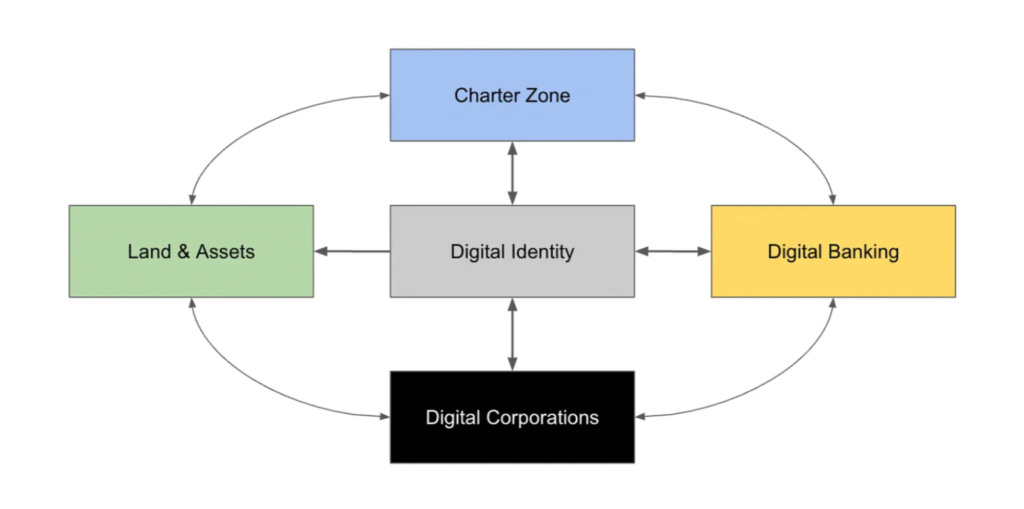
Wading through deceptive NRx propaganda is heavy going at times, and no more so than when reading Metropolis Global’s guff about its Digital Nation Stack. Framing everything as free market choice, privacy-protecting convenience, and some sort of digital ecosystem-based freedom, the Digital Nation Stack is an overt slave system.
Here is the reality of the Digital Nation Stack:
- The Stack does not “allow all global citizens to access essential services”; it restricts, limits, and controls “customers” access to essential services.
- The “new era of competitive governance and of mobility” is the Dark Enlightenment promise of “no voice, free exit,” where “customers,” not citizens, purchase Agentic GaaS, leaving them with no means of redress and a stark choice between obedience or exile.
- The “unique digital identity” is a slave brand, not an emancipating “bridge.” It does not “grant” access to the “digital nation or community” but rather controls access to everything.
- The “digital incorporation system” does not provide “maximum flexibility to global citizens for future [business] entity formation”; it centralizes authority over all business entities. It is compatible “across jurisdictions” because it operates on the worldwide finternet “standards” framework, uniting all special jurisdictions via a unified programmable layer that will surveil and manipulate all “trust in business transactions.”
- Uniting a monetary “world of stablecoins, cryptocurrencies, traditional fiat banking, and everything in between” and then centralizing global control of the “identity credentials” by which every human being on earth is permitted to “access” the new global network of digital “financial services” is not to empower an “ecosystem of partners” who simply want humanity to have more convenience. It is the creation of an authoritarian global programmable monetary and, thus, behavioral control system.
- “[A] simple easy-to-use portal” where only those with established “user identities” can “invest in real estate and other assets” is not a more flexible and egalitarian opportunity for people to purchase “land and assets.” It is a digital finance pipeline through which only the favored and approved will be allowed to own anything, including national territory. The introduction of “fractional ownership” does not ensure “maximum transparency for all”; it is simply the tokenization of all assets from which only the selected “stakeholders” will benefit (Part 3).
- “Special Economic Zones or Charter Zones” that are “tailored to leverage these digital platforms” in order to “leapfrog traditional systems by transparently linking ownership to identity” to establish “digital ownership of real-world assets such as plots of land or residences,” forming “charter zones [that] evolve into charter towns and even charter cities” is how the Network State will proliferate to form the Network Empire and flippen nation states. This is a global empire where only the chosen “stakeholders have a voice.” Everyone else is condemned and damned, excluded and exiled—surveilled, intimidated, beaten, and murdered.
By signing up to Pax Silica, this is the overarching Digital Nations Stack that the EU, the UK, the UAE, India, Israel, and other Pax members have agreed to impose on their populations. The European Centre for Development Policy Management (ECDPM)—a globalist policy think tank specialising in EU-Africa relations—calls the EU’s version of the digital slave grid the Euro Stack:
The global discussion about DPIs has built on the success of India’s Aadhaar digital ID system. [. . .] A global conversation about Digital Public Infrastructure (DPI) has gathered steam. [. . .] Within the European Union (EU), there is growing support for a model of sovereign infrastructure, increasingly referred to as the ‘Euro Stack’, building on a full technology stack approach – everything from hard infrastructure to software solutions and governance. [. . .] the EuroStack emphasises the importance of sovereign solutions.
The EU’s “tech sovereignty package” that promises to realise “Europe’s ambition to become an AI continent, strengthen its digital autonomy and help build a more sustainable digital future” is preposterous propaganda. As a Pax Silica member, the EU has committed itself to an international technology supply chain under a regional balance of power global governance system. Sovereignty is just a code word for multipolar regionalisation and the enforcement of the Digital Nation Stack on every EU “customer.”
Emphasising the absurdity of so-called EU sovereignty, in January 2026, key Pax Silica and IMEC partners, India and the EU, signed an enormous free trade agreement that binds two billion people to the EU and Indian Digital Nation Stacks—the Euro Stack and the Aadhaar-based India Stack. It is sovereignty that is permitted by a transnational public-private partnership that programmes the nodes while leaving billions of ordinary people with no sovereignty at all.
The world is being reterritorialized as the Praxians and their global oligarch partners desire. The necessary digital transformation is being accelerated by the “war” in the Middle East, and that appears to be one of the main reasons behind the Praxians’ apparent decision to instigate it.
Who Sent The US To War?
Previously in this series, we discussed the close working relationship between the Praxians’ technology firms and both US and Israeli intelligence. We considered the reasonable likelihood that the Praxians played a part in manipulating the alleged signals intelligence (SIGINT) failures that supposedly led to the virtually unopposed Hamas October 7th attack. We outlined how the Hamas attack benefited both the Praxians and the Israeli state.
Probably one of the most accurate assessments that followed the Hamas October 7th attack came from Hezbollah leader Hassan Nasrallah—reportedly assassinated in an airstrike in 2024—who said that the Israeli government’s genocidal response to the attack, with Praxian kill chain assistance, was likely to spiral into a regional conflict. Which it has.
Just as the evidence suggests the Praxians contributed to the literally unbelievable string of alleged Israeli errors and mistakes that clearly precipitated the October 7th attack, so there is a suspiciously similar Praxian intelligence influence leading up to the US and Israeli government’s decision to launch an evidently illegal “war” with Iran. To see how the Praxians have potentially manipulated what is supposed to be a political decision-making process, we need to first look at the antecedents.
Back in 2015, the US Obama administration made digital surveillance technology the backbone of the Joint Comprehensive Plan of Action (JCPOA) nuclear agreement with Iran. The JCPOA was dependent upon the International Atomic Energy Agency’s (IAEA’s) Iranian nuclear compliance verification system.
Unsurprisingly, Palantir was selected to provide the surveillance architecture and modified its alleged predictive-policing software to integrate it with the IAEA monitoring processes. The Palantir-IAEA surveillance system was called MOSAIC, which is also the name given to the world’s first graphical interface web browser developed by a team led by arch-Praxian Marc Andreessen.
According to the IAEA, Palantir’s MOSAIC is a suite of software packages. MOSAIC’s Collaborative Analysis Platform (CAP) reportedly enables the IAEA to “search, collect, and integrate multiple data and information sources to enable comprehensive analysis,” including the automated collection and analysis of “open-source, public data,” such as ordinary Iranians’ social media posts. The Electronic Verification Package (EVP) “assembles and processes in-field verification activities” to “link, display, and provide access to all available information associated with a verification activity.”
The first Trump administration withdrew support from the JCPOA in 2018 and reimposed US sanctions on Iran instead. By this time, the Praxian flagship Palantir, embedded within the UN agency the IAEA, seemingly had complete oversight and considerable influence over the Iranian nuclear verification program that continued irrespective of US government involvement.
Palantir entered into their official strategic partnership with the Israeli Ministry of Defense in early 2024. By June 2025, US Director of National Intelligence Tulsi Gabbard, who just a few weeks earlier testified that Iran was “not building a nuclear weapon” (see Part 3), suddenly reversed her assessment completely and said that Iran was “within weeks” of developing a nuclear weapon.
THE TECHNOCRATIC DARK STATE
A powerful group of Silicon Valley oligarchs has captured the government of the United States. Driven by their faith in the Dark Enlightenment and Technocracy. They are accelerating America and the world toward a digital panopticon: The Technocratic Dark State.
 The Unlimited Hangout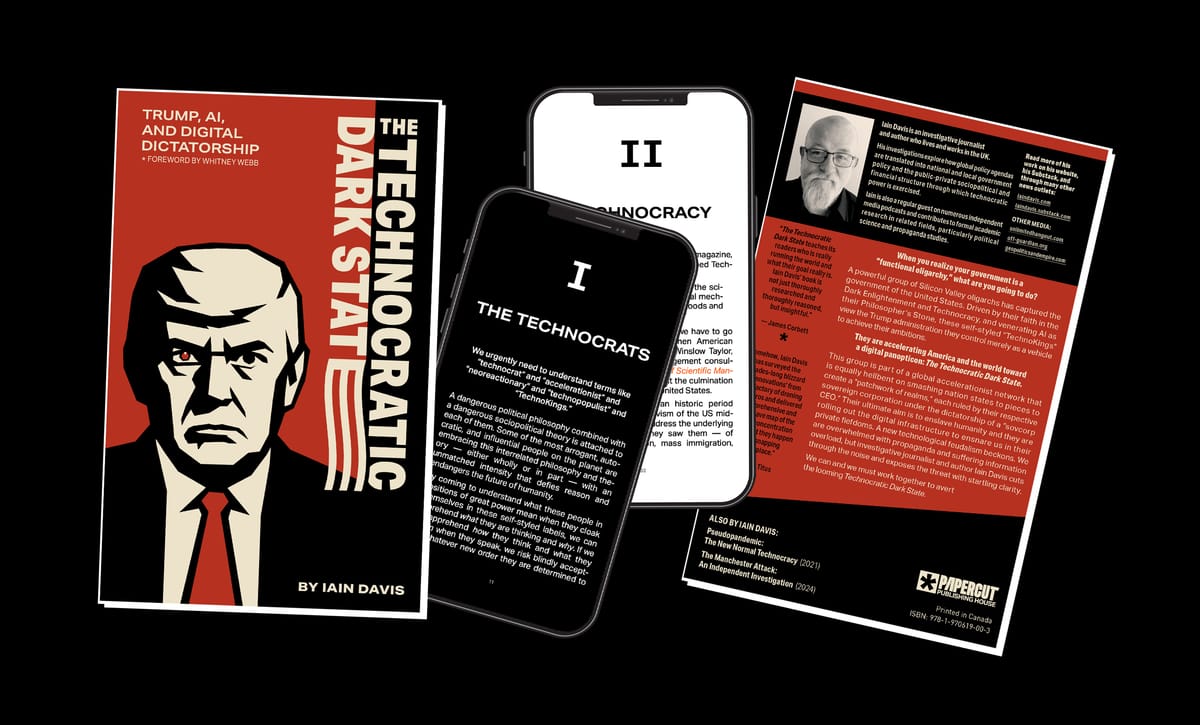
The Praxian Genocidal Kill Chain — Part 3In Part 1, Iain Davis defined the Praxians, considered their openly stated control of the Trump administration, and examined their extensive partnerships with the Israeli defence technology sector. In Part 2, Davis considered global events through the lens of State Crimes Against Democracy (SCADs) and noted how civil-military fusion and hybrid war, combined with SCADs, are socially engineering a proposed new global “equilibrium.” Here in Part 3, he delves into how global forces have aligned behind the Praxian vision of a Network Empire in the march toward a UN 2.0 Multipolar World Order.
This reversal in the intelligence assessment had purportedly come from a secret Israeli spy dossier about which the US intelligence agencies were extremely skeptical. Not only was it contrary to the ten years of IAEA assessments, it was all based on mysterious claims about clandestine groups of Iranian scientists furtively operating off-the-books to build nuclear weapons. The only claimed evidence was the Israeli dossier itself, and no part of it could be verified by anyone, except, supposedly, the Praxians’ strategic Israeli defense and intelligence partners.
Published on May 31, 2025, a new assessment from the MOSAIC-reliant IAEA accompanied the release of the Israeli dossier. In an almost identical fashion, the IAEA alleged that there was an “undeclared structured nuclear programme carried out by Iran” and that Iran possessed “undeclared nuclear material.”
We are told that the Trump administration subsequently took the decision to embark on Operation Midnight Hammer and bomb Iran’s nuclear facilities—throwing the US into the so-called 12-Day War alongside Israel. Yet, as highlighted by investigative journalist Nafeez Ahmed:
Palantir’s dual role – as the analytical engine powering nuclear verification and, simultaneously, a strategic military partner of the US and Israeli governments – represents a fundamental conflict of interest at the heart of the global non-proliferation architecture.
It seems highly likely, if not abundantly clear, that Palantir MOSAIC was instrumental in providing the intelligence that led, within days, to a new and highly questionable Iranian nuclear threat assessment. Israel immediately launched “Operation Rising Lion,” shortly followed by the US’ “Operation Midnight Hammer,” to bomb Iranian nuclear power plants.
Investigative journalist Freddie Ponton observed:
Defenders will claim MOSAIC was merely advisory, that human policymakers retained final authority, and that intelligence failures predate algorithms. Unfortunately, this defense collapses under scrutiny. When the machine generates urgency measured in hours, human deliberation becomes a rubber stamp. Why else did the official US position flip in weeks after years of stable consensus? Why did strikes commence before inspectors regained physical access to challenge the machine’s inferences? The timeline does not suggest consultation. It suggests automation.
Returning to more recent events: in 2026, Trump claimed again that “Iran posed a nuclear missile threat.” Yet, shortly after “Operation Epic Fury” began, the Director General of the IAEA, Rafael Grossi, said “[w]e don’t see a structured programme to manufacture nuclear weapons” in Iran. Grossi conceded that the IAEA had been unable to physically access Iranian nuclear facilities for more than eight months. So from whom, or from what, did the Trump administration get its intelligence to inform its decision to attack Iran again in 2026?
If you recall, in Part 1, we discussed how adoption of Palantir’s Maven Smart System (MSS) and its Artificial Intelligence Platform (AIP) has been accelerated across NATO via its Joint Warfare Centre’s “Task Force Maven.” Similarly, shortly before it attacked Iran, the US Department of War (DOW) published its Artificial Intelligence Strategy.
Supposedly, it was Pete Hegseth who “direct[ed] the Department of War to accelerate America’s Military AI Dominance by becoming an ‘AI-first’ warfighting force across all components, from front to back.” This innovation would be “fueled by the accelerating pace of commercial AI innovation coming out of America’s private sector.”
Outlining its “Acceleration Approach,” the DOW said that funding was available through the “Joint Acceleration Reserve” to “unlock critical foundational [private sector] enablers needed to accelerate war-winning efforts.” Two of the DOW’s acceleration strategy “components” were the “Pace-Setting-Projects” (PSPs) Open Arsenal and Project Grant.
Technological intelligence, or TechINT, is defined as “intelligence derived from the collection, processing, analysis, and exploitation of data and information pertaining to foreign equipment and materiel.” The stated purpose of PSP Open Arsenal was “[a]ccelerating the TechINT-to-capability development pipeline, turning intel into weapons in hours, not years.” In addition, the PSP Project Grant was the DOW commitment to “[e]nabling transformation of deterrence from static postures and speculation to dynamic pressure with interpretable results.”
Combined, Open Arsenal and Project Grant firmly moved US intelligence gathering towards even greater reliance on automated TechINT. The AI-derived TechINT was specifically purposed to turn intel into kinetic force “in hours, not years” and to rapidly move the US government “from static postures and speculation to dynamic pressure.” In the US, Praxian technology corporations almost exclusively control that TechINT.
Since 2017, Palantir’s MSS has been the tool of choice for the DOW and the US intelligence agencies for intelligence gathering and analysis. MSS “aggregates, organizes, and visualizes vast streams of intelligence, surveillance, and reconnaissance (ISR) data” and through Palantir’s AIP, AI performs the “ad hoc analyses” of that vast pool of MSS aggregated data. Also in Part 1, we noted the comments of US Air Force Maj. Gen. Daniel Simpson, who described the Praxians’ targetting systems’ use of MSS as “confidently wrong.”
To date, the Trump administration has not provided any verifiable or documented evidence to explain why it wrongly assumed Iran was actively developing nuclear weapons. We know that Praxian TechINT was almost certainly responsible for the Trump team reaching the same incorrect conclusion in 2025. Added to these findings, the DOW’s own AI strategy clearly outlines the US national security and intelligence reliance on Praxian TechINT.
The Praxians had the means and the opportunity to manipulate the Trump administration into attacking Iran, and they were strongly motivated to do so.
The Praxians’ Iran War Motivation
Pete Hegseth—the supposed US Secretary of War—who is presented as the mastermindbehind the US Artificial Intelligence Strategy, is occasionally wheeled out to make an embarrassing public spectacle of himself for the lapdog press, but that’s about as far as his influence goes. His clowning adds to the impression of a dysfunctional US government, which is an appreciable objective of the Praxians.
As I noted in The Technocratic Dark State, the evidence strongly suggests that Pete Hegseth is a Praxian puppet:
[I]n an interview with CNBC, Joe Lonsdale, co-founder of Palantir and a Thiel protégé who invests heavily in Anduril, said: [. . .] “Pete Hegseth, our Secretary of Defense, was very clear that he wants to have competition, he wants the best ideas to win. [. . .] And that means companies like Anduril and like Palantir are going to keep growing really fast.” [. . .]
Pete Hegseth’s public Venmo profile exposes his close relationship with the Thiel/Musk-linked faction bidding for control of Department of Defense (DOD). [. . .] It seems Lonsdale’s observation that Hegseth is “our Secretary of Defense” is far more specific than most American voters realize.
Nearly all Praxians and most NRx accelerationists either self-identify as Zionists or Christian Zionists. As we discussed in Part 3, the suspicion arises that the Trump administration embarked on its Epic Fury folly at the behest of the Zionist lobby and/or the Israeli government. That said, no matter what they claim to believe, the Praxians and their oligarch partners are not nationalists of any kind; they are not Zionists.
As far as oligarchs like the Praxians are concerned, nation states, including Israel, are geostrategic levers to achieve their collective and personal ambitions. The Praxians are building their Network Empire and are using their strategic partnership with the Israeli state to that end. But it is the Network Empire, not the Zionist project, that matters to Praxians.
Unsurprisingly, Praxian puppet Hegseth self-identifies as a Christian Zionist. In contrast to his Praxian masters, Hegseth may actually believe in Zionism. However, he appears to have the mentality of an emotionally unstable teenager, so his beliefs probably aren’t particularly well formed yet.
When, in March 2026, Hegseth asked Congress for a further $200 billion from US citizens’ pockets to ramp up war in the Middle East, Hegseth said—publicly—“It takes money to kill bad guys.” It is entirely feasible that these words were put in his mouth by one of his Praxian puppetmasters, Joe Lonsdale.
A few months earlier, in December 2025, Lonsdale praised the extrajudicial killings meted out by the Trump-Hegseth DOW, which unilaterally decided to murder people they claimed, without evidence, to be “narco-terrorists.” Via Musk’s X platform, Lonsdale said:
Killing bad guys is DoW [sic] job. [Hegseth] should brag more. Masculine truth: bold, virtuous men deter evil.
Evidently, Hegseth’s role is to be seen to make the announcements, observably sign the orders, and publicly agree to the budgets on the Praxians’ behalf.
All the indications are that the billionaire US Deputy Secretary of Defense Steve Feinberg actually runs the Department of War (DOW). Feinberg is part of a cluster of “important” CEOs who have been gathering in the Washington Business Council since 1933 to give US governments the benefit of their “professional, intellectual, and leadership” prowess. Like Thiel’s Dialog (see Part 3), the Business Council enables the likes of Feinberg and Alex Karp to toss around ideas that they turn into policies before telling politicians to implement them.
War always benefits some, and war with Iran is definitely a boon for Feinberg. He is the founder and former co-CEO of Cerberus Capital Management. In 2024, Cerberus inaugurated its first venture capital fund as a “startup-focused vehicle” targeting “US defense contracts to AI, quantum computing, supply chain, and fusion energy technologies.” Currently holding the DOW purse strings, Feinberg still has a clear conflict of financial interests. He says he intends to divest his Cerberus holdings and has chosen Goldman Sachs to help him figure out how to conduct the very simple business transaction, but he hasn’t quite managed to do it yet.
It is hard to find a policy or decision made by Trump’s government that doesn’t serve the Praxians’ interests. For instance, when Trump was supposedly considering who should actually run his administration’s DOW, apparently there were two names in the hat. Trae Stephens, a partner in Peter Thiel’s Founders Fund and co-founder of Anduril, and Feinberg, a startup venture capitalist who has now awarded a $20 billion “single enterprise contract” to Anduril. Much to the delight of Anduril’s Praxian investors, including Thiel’s and Stephen’s Founders Fund and Marc Andreessen’s Andreessen Horowitz.
Anduril’s software is now embedded within the US defense sector. Meanwhile, Cerberus Capital has consolidated its control of SubCom, the undersea fiber-optic cabling company that is the exclusive cable contractor for the US military-industrial complex. Cerberus Capital is grabbing more of the US military’s hardware infrastructure while its former CEO oversees the department awarding the contracts.
Palantir is now, officially, the cornerstone of the Pentagon’s strategy and, therefore, arguably the single most powerful influence in the US military-industrial-intelligence complex. Less than a month after the US 2026 attack on Iran commenced, Reutersreported:
The Maven artificial intelligence system will become an official program of record, Deputy Secretary of Defense Steve Feinberg said in a letter to Pentagon leaders. [. . .] The memo ordered oversight of Maven. The memo directed the Pentagon’s Chief Digital Artificial Intelligence Office to take over oversight of Maven from the National Geospatial Intelligence Agency. from the National Geospatial-Intelligence Agency to the Pentagon’s Chief Digital Artificial Intelligence Office. [. . .] Feinberg’s order is a significant win for Palantir, which has landed a growing stream of contracts with the U.S. government. [. . .] Those awards have helped double the company’s stock price in the past year, lifting its market value to nearly $360 billion. [. . .] Pentagon official Cameron Stanley [said] Maven platform could be used for weapons targeting in the Middle East.
War is both a preferred strategy and big business for the Praxians. Following the Epic Fury strike on Iran, Palantir’s stock rose sharply. Joe Lonsdale—co-founder of Palantir Technologies and co-founder of his 8VC tech startup investment firm—had long been a vocal advocate for war with Iran. Speaking in June 2025 to CNBC’s “Squawk Box,” Lonsdale claimed that “the Persian people, the Kurds, the others [are] much more natural allies of the Jews; of USA; of the West.”
He added:
I’m really excited to invest in Iran if we can get this country to be some sort of republic and not run by crazy people. [. . .] It’s a lot easier than doing that in Afghanistan or somewhere else. [. . .] It’s very clear that this administration says it’s about eliminating the nuclear threat. That’s their goal. [. . .] Iran’s clearly a really evil regime. So, I’ve been against the Iranian regime. I’ve been for freeing Iran for a long time.
By “freeing” Iran, Lonsdale meant attacking and killing Iranian people. The Trump administration’s determination to eliminate the alleged Iranian nuclear threat—one of the dubious casus belli trotted out—seemingly came directly from Praxian TechINT. In a matter of months, Lonsdale and his fellow Praxians were, once again, given exactly what they want by the Trump administration they put into office.
For Praxians, the opportunity to extend their Network Empire project to Iran is dependent on displacing the current Iranian hierarchy. This explains Lonsdale’s enthusiasm for war with Iran. Notably, Lonsdale is “really excited” about the potential opportunities Iranian regime change could bring for him and his Praxian network.
The Iranian government has already committed to the necessary smartification process and has set up the SEZ jurisdictions to enable Praxians and their oligarch partners to build their private city-states, but, from the Praxian perspective, the situation in Iran isn’t optimal yet. Tehran is putting all the necessary digital surveillance and control infrastructure into place and is zoning Iran as required, but it is also seeking to use that population behavioral control system to consolidate its own political power. This doesn’t quite meet with the UN’s and the Praxian’s shared objective of “flippening [. . .] Network States over Nation States.”
Having bombed Iran, however, the proposed US-backed, privately financed Reconstruction and Development Fund (RDF) appears to be the potential engineered entry point into Iran for Praxians and other oligarchs. Reportedly, the RDF will focus on “securing loans, establishing credit lines, or directly financing the reconstruction” of destroyed Iranian “energy, logistics, manufacturing and transport” infrastructure.
Though there are scant details, Reuters reports that $150 billion of RDF commitments from private investors have already been secured. Aiming to achieve $300 billion in total investment, according to Reuters, the RDF is a “private investment vehicle [. . .] for companies based in the U.S., the Gulf Arab states, Asia, South America and Africa.”
If the Iranian government is amenable, private sector foreign direct investment (FDI) will flow into Iran’s expanding network of SEZs and Free Trade Zones (FTZs). The Iranian government has been moving its SEZs and FTZs toward becoming manufacturing and production hubs to diversify the Iranian economy away from its heavy reliance on energy exports. Prior to Operation Epic Fury, it had attracted significant foreign direct investment (FDI) into its zones. Oligarch FDI will potentially increase markedly as a result of Trump’s Epic Fury.
For example, as reported in early February 2026 by the Tehran Times:
The Chabahar Free Zone holds particular strategic significance, acting as the Iranian terminus of the International North-South Transport Corridor (INSTC), a multimodal network designed to connect India to Central Asia, Russia, and beyond.
A few weeks later, claiming the Chabahar Free Zone was a military target, the US bombedit. As hostilities continued—following the apparent breakdown in negotiations and the Islamabad Memorandum (see Part 3)—for no identifiable military reason, the US once again targetted Chabahar. It was reported that this threatened the Indian government’s investment in the Chabahar Free Zone, but, coincidentally, the Indian government temporarily divested its stake to an Iranian company shortly before Epic Fury began.
If the RDF ultimately proceeds as envisaged, the destruction wrought by the so-called war will potentially encourage, not deter, investment in the Chabahar FTZ and other Iranian SEZs. In turn, this situation could possibly be a boon to the Indian-backed “International North-South Transport Corridor (INSTC).”
That said, India’s strategic interests in the Middle East have changed since it first announced the INSTC project more than twenty-five years ago. Saima Afzal, freelance journalist, analyst, and visiting lecturer and researcher at Germany’s Liebig University, outlined how India’s regional interests have shifted from the INSTC to the India-Middle East-Europe Economic Corridor (IMEC, sometimes also IMEEC), which skirts Iranian territory and crucially provides alternative rail routes through Saudi Arabia to potentially avoid passage through the Strait of Hormuz.
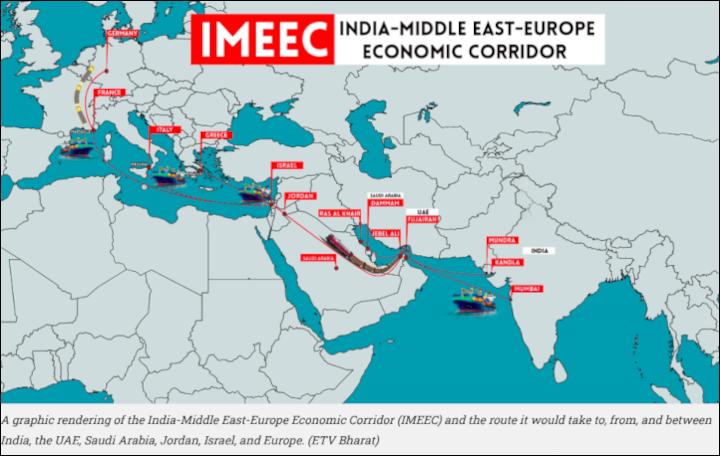
In particular, Afzal observed how the Indian government had moved away from “post-Cold War diplomacy” and was instead focused on its regional “economic interests, connectivity initiatives, [and] defence cooperation [agreements].” She highlighted how “India’s partnerships with Israel, Saudi Arabia and the United Arab Emirates [have] deepened at an unprecedented pace.”
Afzal wrote:
Israel has emerged as one of India’s closest defense and technology partners, supplying advanced military systems, intelligence cooperation, cybersecurity capabilities and expertise in agriculture and water management.
Defense cooperation now extends beyond arms sales into research, innovation and technology transfer. Meanwhile, the Gulf monarchies have become central to India’s economic ambitions. The UAE and Saudi Arabia rank among India’s largest trading partners and are increasingly important sources of investment in infrastructure, logistics, renewable energy and emerging technologies.
The Indian government is building regional partnerships through a network of bilateral agreements. In so doing, it is deepening relationships with Gulf Cooperation Council (GCC) countries and Israel. For example, the India-UAE Comprehensive Economic Partnership Agreement (India-UAE CEPA) is a bilateral agreement that gives the public-private partnerships in both countries considerable advantages.
CEPA excludes UAE exporters from Indian investigations into the practice of subsidising exports to undercut Indian businesses; it opens up UAE public sector procurement to Indian companies while affording UAE companies a ten per cent price advantage for selling to the Indian public sector; it reduces or removes India-UAE trade tariffs, and crucially, it sets globally agreed “standards as a basis for technical regulations.”
Speaking just days before Trump’s Epic Fury caused global supply chain mayhem and after his government had temporarily divested its Iranian holdings, Indian Prime Minister Narendra Modi addressed the Israeli Knesset. He promoted closer ties between the two countries and said both governments were “committed to expanding trade, strengthening investment flows and promoting joint infrastructural development.” Modi added that India and Israel would “work closely [on] the India-Middle East-Europe Economic Corridor and the I2U2 frameworks.”
Gaza is now set to be an important IMEC hub.
I2U2 is a public-private partnership focused on “infrastructure modernisation.” Nominally led by the Indian, Israeli, UAE, and US governments, I2U2 “aims to mobilize private sector capital and expertise to achieve a variety of goals.” Among its goals is to hand control of “water, energy, transportation, technology, space, health, and food security” to the private sectors operating in all four nation states. The overlap with Pax Silica is clear, as is the intention for the private sector to control all resources essential for life.
Pax Silica and IMEC are closely interrelated. Stemming from the 2020 Abraham Accords—that sought to normalise relations between numerous Arab states and Israel—and following the I2U2 framework, the Indian, US, UAE, Saudi Arabian, French, German, and Italian governments, alongside the EU, signed the foundational IMEC MOU. Jordan and Israel were designated as transit territories but were not signatories.
The conflict with Iran has put the spotlight on IMEC’s physical infrastructure shortcomings. The proposed northern rail road—through Saudi Arabia, Jordan and then Israel—relies on the access to UAE ports like Jebel Ali and Khalifa that sit in the Strait of Hormuz. These are obvious Iranian and increasingly Yemeni targets, but you wouldn’t necessarily know it.
For example, we are supposed to believe that the multiple explosions in March 2026 at Jebel Ali—a port that just happens to serve as a US Navy deep-water harbour—were all caused by stray debris from destroyed Iranian drones. Similarly, we were told that the many massive Jebel Ali fires in August 2026—reportedly following seven large explosions in a 20-minute period—were just normal warehouse fires. This situation apparently makes Jebel Ali unusually susceptible to fires, if one chooses to believe the reports.
As reported by Geopolitical Monitor, the conflict hasn’t killed off IMEC hopes, as the UAE port of Fujairah and “Omani ports such as Salalah, Duqm, and Sohar” provide potential alternative ports for prospective IMEC northern rail links. Instead, the war “has exposed a structural limitation in [IMEC] design.”
The focus, however, on the possible physical transport and energy corridors misses a crucial aspect of IMEC’s design. A frequent contributor to the Rothschild-backedinternational public-private think tank the Lowy Institute, Dr Gedaliah Afterman, writing for Geo Horizon, observed:
IMECʼs [. . .] strategic value increasingly sits in the technological, digital and regulatory domain: the systems, standards, and governance frameworks that allow production networks to operate predictably across regions. [. . .] Digital IMEC [. . .] transforms IMEC from a geographically bounded corridor into a framework for cross-regional participation, including by countries such as Japan that are not located along IMECʼs physical route. This initiative includes security frameworks, technical standards, [. . .] interoperable customs platforms, secure data exchange, [and] smart port systems.
In the India-Middle East region, Digital IMEC is practically indistinguishable from Pax Silica. It is also extremely similar to the Chinese-led initiative the Digital Belt and Road, or “Digital Silk Road” (DSR), which proposes a regional “integrated networks for collecting data.” Formally announced by Paramount Leader Xi Jinping in 2017, the DSR is a multipolar regional counterpart to Pax Silica and Digital IMEC.
The DSR is a regional, or multipolar, public-private partnership project, focusing on developing and emerging economies, with leading Chinese firms such as Alibaba and international partners, such as US tech giant Accenture, actively participating. Following Xi’s 2017 announcement, the Chinese State Council for Information reported:
The nation [China] will focus on frontier areas such as digital economy, artificial intelligence, nanotechnology and quantum computing. [. . .] Xi stressed the importance of advancing the development of big data, cloud computing and smart cities.
As we have already discussed, the purpose of the BIS’ finternet is to create the interoperable technological standards architecture upon which the new global fintech economy will operate. Just as Pax Silica stresses the importance of regionally interoperable “software applications and platforms, frontier foundation models, [and] information connectivity,” so the DSR seeks to set its regional connectivity standards for “fifth-generation (5G) mobile networks, the Internet of Things (IoT), artificial intelligence (AI), big data, smart cities, data centres and cloud computing in the digital economy era.”
Returning to the analysis of Geopolitical Monitor: as a result of the widening Middle East conflict that started with the Hamas attack and Israel’s genocidal response—leading to the conflagration with Iran—IMEC currently “functions as a set of bilateral agreements and digital and energy projects. [. . .] This configuration is more resistant to any single conflict, because it does not depend on the simultaneous cooperation of every participant.”
The New Delhi-based Observer Research Foundation (ORF), a global public-private policy think tank backed by, well, everyone, calls the impact of the Middle East conflict on IMEC the Paradox of Resilience:
[W]hen a joint United States (US)-Israel campaign against Iran triggered Tehran’s closure of the Strait of Hormuz, the same sea lines that IMEC was designed to traverse have become the global economy’s most distressed maritime artery. […] [T]he conflict has produced a strategic paradox. It has simultaneously reaffirmed IMEC’s underlying logic of diversification away from concentrated chokepoints; and complicated its implementation, as the corridor’s own physical nodes pass through the current conflict zone. Whether IMEC survives geopolitical fragmentation depends not on whether the conflict ends, but on whether the corridor’s architecture is recalibrated to reflect a more honest assessment of risk.
Again, the alleged paradox assumes the purpose of the Praxians’ Epic Fury was not “geopolitical fragmentation.” It is pretty clear that “geopolitical fragmentation” is precisely what the architects of the Network Empire seek, and it appears to be a strong motivation for the Praxians to start a war.
A fragmented and diversified global geopolitical system of bilateral agreementsestablishes a system of international relations that does not depend on wider international agreements. This creates the structural political conditions for both multipolarity and the Network Empire to prosper.
Writing for Arabian Gulf Business Insight journalist Valentina Pesquali reported that a US State Department spokesperson had informed AGBI that the March 2026 meeting between Emirati and US officials had been the first formal conference under the bilateralUS-UAE AI Acceleration Partnership agreement. As previously reported at Unlimited Hangout:
In May 2025, Trump [. . .] signed a deal to supply US AI-chips, including NVIDIA processors, to the Abu Dhabi AI digital transformation hub. [. . .] Trump called the deal the “U.S.-U.A.E. A.I. Acceleration Partnership.” [. . . ] The UAE-China AI partnership, specifically the Abu Dhabi digital transformation hub, has a Trump administration agreement in place for the supply of the processors and it serves as a “crucial base for Chinese AI firms.”
AGBI went on to report:
Pax Silica and the India-Middle East-Europe Corridor (Imec) have different origins and goals, but broadly aim to shift supply chains for artificial intelligence and other vital industries away from China and its Belt and Road Initiative [BRI]. They also rely heavily on collaboration between the UAE, Qatar, Saudi Arabia and other GCC members, and Israel.
But Pax Silica-related projects, such as the US-UAE AI Acceleration Partnership, are not moving away from China’s interests. Exactly the same connective infrastructure, replete with its financial and digital rails, is being constructed by China and its partners through the DSR and its bilateral partnerships, such as its own UAE-China AI partnership. The Chinese private sector, led by global corporations such as DeepSeek, China Mobile, Huawei, ZTE, and Dahua, is equally committed to the same multipolar global governance system. This emerging new “fragmented” global order is most conspicuous in the Middle East.
GCC countries are forming the new Pax Silica pole while simultaneously strengthening their bilateral trade, economic, and defense partnerships with China. Israel too is seeking greater autonomy by breaking its reliance on US military aid while pursuing deeper bilateral integration with its GCC partners and, by extension, China, India, and other BRICS partners.
Multipolarity, dependent upon the regionalization of supply chains and the disaggregation of hegemony, is a monumental scam. The hybrid propaganda claims that regional protectionism delivers “win-win cooperation.” These assertions are simply attempts to justify a new global governance system based on, as António Guterres said, “the greatest transfer of power of our times – not from governments to people, but from governments to private technology companies.”
Both East and West are collectively contributing to a global effort to construct one allegedly multipolar global governance system founded on the principle of fragmentedinternational relations. Multipolarity is typified by a network of bilateral agreements. The geopolitical deterritorialization is reterritorialized into a centralized Technocracy by the standardization of international trade regulation compliance across all supply chains.
Suzanne M. Richer has thirty years of experience as a leading analyst of global trade compliance and supply chain risk. She notes that Agentic AI is “increasingly being deployed in global trade compliance.” It is being used for “automated customs classification and real-time sanctions screening.”
Richer also observes that using Agentic AI to enforce global trade regulatory compliance introduces “significant legal, operational, and ethical risks.” She assesses that Agentic AI’s “opacity, scalability and decision-making autonomy [amplifies] existing compliance challenges and complicate[s] explainability, auditability and error remediation.” Richer advocates “human-centric oversight [. . .] to preserve accountability, traceability and legal certainty.”
Using our analytical lens of “the purpose of the system is what it does” (Part 3), we might suggest that Richer is missing the point. The centralization of standardized regulatory compliance systems for international trade, using Agentic AI as the enforcement mechanism, gives those who program the nodes immense power and authority. Combined with a finternet that enables the literal programming of all transactions “cross border” “in real time,” a more opaque, less auditable system of international trade appears to be the oligarchs’ purpose for scaling Agenitic AI compliance monitoring globally.
What Battle For World Domination?
Just as the Pax Silica/IMEC corridors and financial rails mirror, and will almost certainly be interoperable with, the DSR/BRI corridors and rails, so the physical infrastructure between IMEC and the BRI connects in multiple locations. Yet we are still expected to accept the absurd hybrid propaganda narrative that “the battle for world domination” is being fought in the Middle East, with Western powers from the US and Europe on one side and China and its partners on the other.
In September 2023, a few short weeks before the Hamas attack on October 7th, Israeli Prime Minister Benjamin Netanyahu presented his plan for a New Middle East (NME) to the UN General Assembly. He suggested an Israeli rapprochement with the UAE, Jordan, Sudan, and Saudi Arabia to form the envisaged NME. Palestine—both Gaza and the West Bank—was conspicuously absent from the map of Israel he showed to depict his geopolitical NME concept.
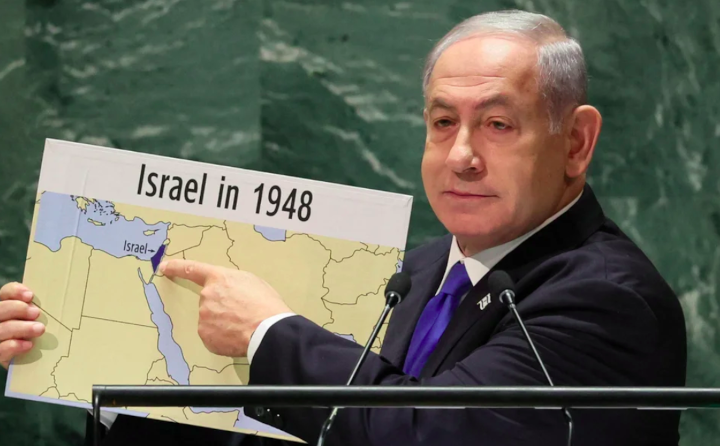
Explaining the “magnitude of the transformation” he had in mind, the expansionist project Netanyahu outlined was not the “Greater Israel” project analysts often highlight, but something else entirely.
Netanyahu said that he envisioned the following:
[A] corridor that will stretch across the Arabian Peninsula and Israel. It will connect India to Europe with maritime links, rail links, energy pipelines, fiber-optic cables. This corridor will bypass maritime chokepoints [the Strait of Hormuz and the Suez Canal]. You see, the Land of Israel is situated on the crossroads between Africa, Asia and Europe. We’ll build a new corridor [. . .] that connects Asia through the UAE, Saudi Arabia, Jordan, Israel, to Europe. This is an extraordinary change, a monumental change, another pivot of history.
Zionism is not the driving force behind the global digital transformation, and it is that which will see populations across the world oppressed under their respective Digital Nation Stacks. Concerns about Zionist control of the American polity, for instance, are well-founded but ultimately serve as a distraction. While the media, politicians, and the enraged public focus on these matters, the real project races ahead behind the scenes. Zionism is the oligarchs’ attention coral to divert public awareness away from what they are really doing.
The frequently forwarded argument that the genocide in Gaza and conflict with Iran are fundamentally about Israeli expansionism misdirects populations. Though people rightly protest against obscene Israeli war crimes and decry the appalling rhetoric of Zionist extremists, the transnational capitalists are exploiting the anger, enabling them to get on with business largely free from any public scrutiny.
Fundamentally, Netanyahu’s proposed NME is not a Zionist project, though it is likely to be applauded by Zionists. It is a transnational infrastructure project intended to make the Middle East the crossroads for a global trade and financial network: a multipolar planetary choke-point of fragmented bilateral agreements running on a unified regulatory and financial architecture.
The port development in Haifa (Israel) is part of the planned IMEC, depicted by Netahyahu. The “war” has supposedly put a strain on Israeli trade relationships in the region, and the proposed joint Turkish- and Saudi-led re-routing of IMEC has led some to suggest that Haifa may be left out.
The geopolitical argument has not deterred the Israeli global logistics giant GADOT Group from increasing its investment in Haifa in support of IMEC. GADOT Group CEO Opher Linchevski reportedly said that the success of IMEC was dependent on the “ability to connect ports, terminals, storage infrastructure, logistics centres, transportation assets and distribution networks into one seamless supply chain.”
Linchevski has good reason to be confident about the GADOT investment in the Haifa complex because it is also a key port for the BRI. The global construction corporation leading the development of Haifa is the Shanghai International Port (Group), which has a twenty-five-year port management contract. As the State Council for the People’s Republic of China reported in 2022:
China and Israel have seen bilateral cooperation develop and expand to their enormous mutual benefit. [. . .] From Belt and Road cooperation to technology and innovation exchanges, China-Israel relations have achieved fruitful cooperation in various fields over the years. [. . .] Supported by the Israeli government, the Haifa new port is a microcosm of win-win cooperation between China and Israel under the Belt and Road Initiative.
The development of the UAE’s Jebel Ali port, part of the Jebel Ali Free Zone (SEZ), sits on both IMEC and the BRI. As does Khalifa Port in Abu Dhabi, which has been co-developed with China’s COSCO SHIPPING Ports Limited. The public-private UAE-China Joint Investment Cooperation Fund is financing the project.
Meanwhile, the Indian government, which sees Khalifa as integral to the Eastern Segment of IMEC, claims that it is fiercely opposed to the BRI. Apparently, this is because of its alleged squeamishness about Chinese debt diplomacy, its potential strategic encirclement, environmental concerns, and, comically, a lack of transparency in China’s “bilateral agreements” with its regional GCC partners. The Indian government has practically identical and equally opaque bilateral agreements with the same regional GCC government partners.
Exemplifying the absurdity of the geopolitical stories we are fed about enmity that evidently does not exist, NATO—represented by its US-dominated Atlantic Council think tank—asserts that IMEC has to happen precisely because of the purported “war” that has caused the global economic turmoil everyone knew it would. NATO now says the situation that the US, its most powerful member state, engineered has to be remedied with a new “network of corridors.”
Stating that Saudi Arabia is the “structural backbone” of IMEC and that rail connectivity remains the corridor’s most “consequential infrastructure gap,” NATO recommends IMEC proceed with the construction of:
The Saudi Landbridge—a 950 km railway linking Riyadh to Jeddah, with extensions to Dammam and major industrial hubs—would transform Saudi Arabia from a road-dependent transit corridor into a fully integrated rail spine connecting the Arabian Gulf to the Red Sea.
Fortunately for NATO—and the US-led Atlantic Council think tank—the Saudi landbridge from Riyadh to Jeddah looks likely to go ahead because it is a major transit corridor along the “Iron Silk Road.” The BRI rail link will indeed “transform” the Saudi Arabian peninsula from a region that is “reliant on shipping lanes to a [region] that replaces them.”
The Iron Silk Road project is led by the “Saudi China Landbridge Consortium (SLCC), a strategic joint venture involving [Saudi Arabian Rail] SAR and the China Civil Engineering Construction Corporation (CCECC).” Riyadh and Jeddah—a center for Saudi-China joint technological innovation—are just two more of the many terminus points and logistic hubs that directly link IMEC to the BRI in the Middle East region.
Shortly, we’ll discuss the proposed redevelopment models for Gaza. In May 2024, just after the Praxians formalized their strategic partnership with the Israeli state, the Israeli government proposed the Gaza-Arish-Sderot Free Trade Zone, or the “Gaza 2035” project.
Gaza 2035 would see Gaza become a smart city and a regional hub for energy production, AI innovation, and regional trade. Via a high-speed rail link, the plan saw the Saudi NEOM SEZ connect to Gaza, thereby affording direct access from NEOM to the Mediterranean, with further routes planned to other ports, including Haifa.
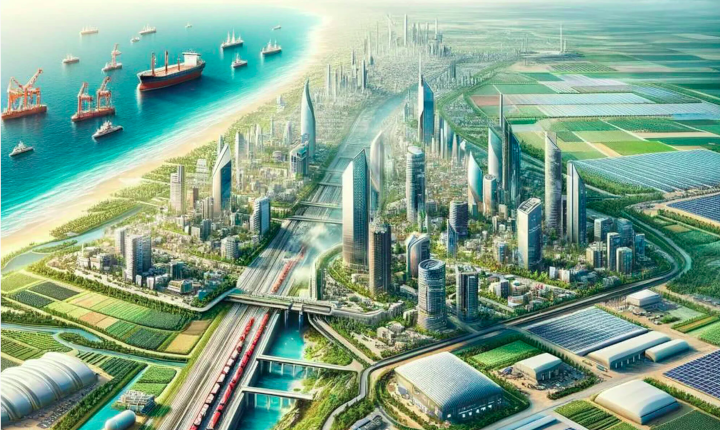
The notion that IMEC and the BRI and other proposed global trade infrastructure projects—such as the Russia-Iran trade corridor—are opposed or designed to “counter” each other is total dross. While everyone becomes increasingly agitated about the influence of Zionism, the system being constructed, incorporating both physical and digital infrastructure, is intended to be interoperable and, therefore, to empower the transnational capitalist oligarchs. Programming the nodes on an envisaged Agentic GaaS network is what they are about, not Zionism.
The system is agreed upon, and it is being built. The rivalry that does exist is between some public but mainly private sector “entities” that are competing for access to the networks’ financial and regulatory programmable infrastructure. War in the Middle East is the SCAD excuse to move the project forward. The resultant geopolitical fragmentation increases regional reliance on bilateral relationships and instigates the disaggregation of hegemony itself.
The Disaggregation of Hegemony
The West’s policy think tank grandee, Chatham House, found that Operation Epic Fury initially resulted in an Islamabad Memorandum (MOU) that “accommodates virtually the full catalogue of Iranian demands” (see Part 3). Though the MOU has supposedly now been abandoned and hostilities have intermittently resumed, the fact that the Trump administration ever agreed to such a MOU in the first place demonstrates that the US has lost “its key pressure points, whether economic or military” in the Gulf region.
On July 21, 2026, from its subjective viewpoint, Chatham House considered the further implications of the US military failure. Dr Aniseh Bassiri Tabrizi, the reporting Chatham House analyst, is a pillar of the Western hierarchy. It is reasonable to suspect that she is paid to produce analysis that is favourable to the furtherance of the Anglo-American oligarchy’s interests.
Calling the US strategy “wishful thinking,” Dr Tabrizi wrote:
Nearly five months after the United States and Israel launched their military campaign against Iran, it is becoming increasingly difficult to escape one conclusion: the central objectives that underpinned Washington’s decision to go to war have not materialized. [. . .] The likely outcome is neither decisive victory nor durable peace, but an increasingly familiar cycle of tit-for-tat, temporary ceasefires, failed negotiations and renewed escalation. [. . .] [T]he war risks becoming self-perpetuating, driven less by achievable political objectives than by the hope that the next round of military pressure will succeed where every previous round has failed.
This is the “whiplash war” we mentioned earlier. Given the global economic disruption the war has caused, the pro-Western establishment stance of Chatham House, and the observable impact on GCC states, three major inferences are apparent.
Firstly, the whiplash war is a flay that functional oligarchies can use either to inflict global economic pain or withhold to relieve it. Secondly, for the foreseeable future, the so-called war is not likely to be won but sustained, thus accustoming us all to grinding financial hardship and inculcating in us a willingness to accept any solution. Finally, the projection of US military superpower in the Middle East has been exposed as a sham.
Condemnation of Trump’s Epic Fury from the Western policy think tanks has been striking. The Council on Foreign Relations (CFR) reported that all the “war” has achieved is the “mauling [of] America’s allies” and the disruption of vital “maritime traffic through critical waterways.”
It is important to appreciate that think tanks like the CFR and Chatham House, and so-called independent analyst outlets, such as Foreign Policy Magazine—that are closely aligned to the Western Deep State—don’t publish anything without purpose. The CFR article was written by senior CFR fellow Ray Takeyh, who said “it is still not entirely clear why President Trump launched the war in Iran in February. The administration’s explanations have shifted and the goalpost has constantly moved.” Though this is an accurate portrayal of events from a narrative perspective, it is also misleading.
The US is a functional oligarchy, and the idea that a blow-hard like Trump commands the nation is farcical. Takeyh’s apparent purpose for alleging that Trump actually leads anything is to maintain the illusion that elected officials make all the important decisions. The ruse is intended to protect the oligarchs, who actually rule, from public scrutiny and to instill false hope for political solutions in the population.
Takeyh continued:
[Iran can] impose costs on the global economy and American taxpayers alike. The question is not who can inflict more pain, but who is prepared to endure more. [. . .] Unpredictability appears to be the defining feature of Trump’s strategy, with military campaigns repeatedly called off and then quickly resumed. [. . .] The longer the war goes on, the more likely that the distinction between civilian and military targets will erode. This is how humanitarian crises unfold—one step at a time.
The CFR is setting Trump up as a patsy. As the conflict kills more and increases the financial pressure on working families around the world, Trump is set to be cast as the incompetent fool who didn’t plan an effective US strategy. For hard-pressed Americans, the offered solution will be to elect another political leader, just as powerless and malleable as Trump.
Takeyh eventually reveals the overarching purpose of the CFR propaganda:
The United States should appeal to the United Nations to authorize a multinational force dedicated to ensuring the safe passage of all ships through the Gulf.
The solution to rogue politicians making calamitous decisions is better global governance—the multipolar world order.
The Western think tank-linked media outlet Foreign Policy Magazine (FP) suggests events in the Middle East have instigated a fundamental geostrategic shift. A new kind of cooperation between Gulf states is likely as a result. FP writers Rabah Arezki, a senior fellow at the Harvard Kennedy School, and Tarik M. Yousef, a senior fellow at the Middle East Council on Global Affairs, wrote:
For 70 years, the U.S.-led order endured because commerce and security moved together. The Middle East is the first major arena where this coherence is dissolving. Economic and security dependence point in different directions, and the result is not a clean handoff from one hegemon to another but a potential disaggregation of hegemony itself.
Emphasising the disaggregation of hegemony, thereby leading to a system of international relations that does not rely on the favour or patronage of superpower partners, Arezki and Yousef stress that a “narrower and more pragmatic” order is emerging in the Middle East. National autonomy that eschews “external mediation” by focusing on regional negotiation is the new imperative, they claim.
The analysts say that regional partners “need not trust one another” if they “codify their disagreements, and create channels capable of surviving crises.” The pair of analysts add that a “fully institutionalized regional order” is no longer necessary.
Noting how China has become an indispensable GCC regional partner, the FP highlights how China’s commercial value to the region as its “largest trading partner” has “ushered in a new era of cooperation centered on energy and infrastructure.” This shift has global ramifications, and the two Western think tank analysts conclude:
The more diffuse the international order becomes, the greater the incentive for Middle Eastern powers to reduce their exposure to great-power rivalry by managing tensions directly with one another. [. . .] The evidence of Middle Eastern states increasingly opting for de-intermediation—engaging one another directly rather than through external patrons—is difficult to ignore. [. . .] Gulf states are coordinating with neighbors on energy infrastructure, transport corridors, and logistics in ways that would have been politically unthinkable a decade ago. Quiet channels between Riyadh and Tehran, Ankara and Cairo, and Abu Dhabi and Doha increasingly substitute for Washington’s good offices.
China is not replacing the US as a superpower. Instead, as the most overt proponent of global governance on the international stage, Chinese foreign policy and trade relationships are the vector through which the disaggregation of hegemony is flowing. Palpably, the Western think tanks are, at the very least, open to this new world order. In truth, a global regional balance of power order has been the Anglo-American oligarchy’s objective for more than a century.
Geopolitically, the “disaggregation of hegemony” is the foundation of multipolarity. The lack of superpower hegemony paves the way for a network of private sector hegemons. The new hegemons will program the financial nodes. They will declare themselves the founders of the Network Empire—a transnational, trans-regional network of smart city-states enforcing frontier technology on hapless customers oppressed under their Digital Nation Stacks.
Gaza is destined to be a prime and sickening example of a Network node.
Introducing The Network State of Gaza
Everything we have discussed, over four articles, in relation to the Praxians—their plans and their progress to date—is currently coalescing and manifesting in the most vile manner imaginable in Gaza. The Praxians and their partners are attempting to construct one of their Network States literally on the crushed bones of the Palestinian families whose murders they aided and abetted.
Nothing is settled, and there are many problems the oligarchs have to overcome before any kind of large-scale reconstruction begins in Gaza. About the only thing that is agreed is the scale of the problem, or more accurately, the opportunity.
In February 2025, the UN specialist agency, the World Bank, working in collaboration with the EU, estimated the cost of reconstruction to be just over $53 billion. Since then, Israel and the Praxians have continued the destruction. Together, since the start of the genocide, they have killed at least 73,000 Palestinians, injured more than 173,000 and forcibly displaced approximately 1.9 million. Estimated reconstruction costs have risen to around $71 billion.
There are also competing visions for Gaza’s reconstruction and redevelopment.
Two of these visions will result in forcing surviving Palestinians to live in a UN 2.0 frontier technology-based smart city under a full Digital Nation Stack. The third will probably result in the same, but it does afford Palestinians more control. The first two proposals we’ll discuss are the Arab League plan for Early Recovery, Reconstruction, and Development of Gaza (ERRDG) and the Trump administration’s plan for Gaza Reconstruction, Economic Acceleration and Transformation (GREAT).
The ERRDG is backed by the Arab League, led by Saudi Arabia, the UAE, and Egypt. As an influential internal grouping within the League, the GCC also formally backs the plan. Consequently, China supports the ERRDG, as does the Russian government. The European governments of France, Germany, Italy, and the UK have also thrown their weight behind the ERRDG.
Sometimes referred to as the Team Gaza Initiative, the EU Commission has taken a slightly different tack and has officially endorsed neither the ERRDG nor the GREAT plans. Instead, it is trying to position itself as a mediator between both proposals, though it leans towards the GREAT plan and seeks more influence for itself.
Hamas—still the de facto government of Gaza—supposedly represents and defends the lives and the interests of Palestinians in Gaza. Hamas has not backed the ERRDG but has opted to approve the US-led GREAT plan. The GREAT plan doesn’t remotely protect and serve the Palestinian people, but neither did attacking southern Israel on October 7, 2023, to initially accelerate the deterritorialization of the whole region.
In truth, Hamas support for either the GREAT or the ERRDG proposals is irrelevant. Both plans represent an ongoing disaster for Palestinians.
The Arab League tells us that the ERRDG “aims to establish the foundations for sustainable and comprehensive development that reshapes the urban landscape [into an] integrated urban environment.” Apparently, this effort “calls for a forward-looking vision based on precise scientific planning [Technocracy] and the use of the latest technologies in reconstruction and smart construction.”
Under the ERRDG, the infrastructure proposals for its version of the future Gaza are as follows:
- Integrating renewable energy, efficient buildings, and smart waste management to reduce the environmental footprint.
- Developing pedestrian-friendly streets and multi-use spaces to enhance social interaction and encourage walking.
- Strengthening public transportation, smart infrastructure, and seamless mobility to improve accessibility.
- Implementing digital governance, smart networks, and AI-powered services to achieve efficiency and flexibility.
- Supporting entrepreneurship, investment, and local industries to create job opportunities and enhance economic growth
That is to say, if the ERRDG plan succeeds, the people of Gaza will have to live in a 15-minute city, subjected to the full gamut of surveillance and behavioral control technology, where Agentic AI delivers GaaS to them as customers within an innovation hub that serves the interests of investors, not them. The GREAT plan is slightly less favorable, but the difference is minimal.
There is, however, a third option the Palestinians living in Gaza could potentially choose called The Phoenix Gaza. Other plans, such as the Palestine Emerging plan (2024) and the UAE Al Habtoor plan (2025), are intended Technocracies that have now largely been incorporated into the ERRDG. The Phoenix Gaza plan stands slightly apart.
Phoenix was designed by “a voluntary, multidisciplinary team of Palestinian professionals and academics from Gaza, the West Bank, and the diaspora.” It focuses on maintaining and building upon Palestinian “property rights.” It is opposed to the “erasure and exploitation” of the people. It seeks to strengthen Palestinian “local governance [and] supports joint planning through [. . .] consistent dialogue with [Palestinian] institutions.” The Phoenix plan purportedly “rejects imposed master plans” in preference to Palestinian “voluntary collaboration.”
Unfortunately, Phoenix is based upon the “Master Plan developed by Dar Al-Omran (DAO),” and, with its commitment to sustainability, resilience, and the circular economy, it is still likely that Phoenix will also result in Gaza becoming another programmable smart city. Nonetheless, Phoenix at least offers the Palestinians some property rights and an active voice in the redevelopment of their homeland. In reality, neither the GREAT nor the ERRDG propositions offer them any. The actual inclusion of Palestinians in the Phoenix planning process probably explains why not a single government, supranational, or intergovernmental “entity” supports it. Hamas certainly doesn’t.
Moving Toward the Network State of Gaza
After it funded, armed, equipped and diplomatically supported the Israeli genocide of the Palestinians, and having greatly assisted in the levelling of Gaza, on September 29, 2025, the Trump administration officially announced its 20-point Gaza peace plan. Point 9 established the “technocratic [. . .] committee”—the Palestinian National Transitional Committee—that would be appointed to facilitate “the day-to-day running of public services and municipalities for the people in Gaza.”
Points 10 – 12 Establish the Network State of Gaza as a Technocracy. In Point 10, the founders of the Gaza Network State Technocracy are defined as the “Board of Peace” that will oversee the “panel of experts”—the technocratic committee—who have “helped birth some of the thriving modern miracle cities in the Middle East.”
According to the Trump administration’s 20-point plan, miracle cities are those that “rebuild” urban environments by attracting “investments that will create jobs, opportunity, and hope.”
By the term “modern miracle cities in the Middle East,” Trump was therefore referencing recent or current urban renewal projects in the Middle East region that have attracted outside investment in order to transform the cityscape. Examples include Masdar City (UAE – Masdar City Free Zone), King Abdullah Economic City and King Salman Energy Park (Saudi Arabia – King Abdullah Economic City SEZ and SPARK SEZ, respectively), Lusail City (Qatar), Beirut Digital District (Lebanon), Smart Muscat (Oman), and Smart Amman (Jordan).
The listed “miracle cities” in the UAE and Saudi Arabia are already in their own dedicated SEZs. Qatar offers a nationwide system of SEZs and other Free Zones to attract foreign direct investment, as do Oman and Jordan. Oman and Jordan actively encourage foreign investors to apply for the establishment of new SEZs. Under the Package Deal Contracts(PDC) system, large-scale foreign direct investors in Lebanon receive ten-year exemptions on income and dividend taxes, full exemption of land registration fees, and half-price residency and construction permit fees. In effect, the whole of Lebanon is a Special Economic Zone.
All of these “modern miracle cities in the Middle East” share clearly identifiable common features. All are smart city projects, and they all use sustainable development as an excuse to enforce frontier technology on their people to surveil, monitor, and control their behaviour. Consequently, they are all designed to comply with muscular UN 2.0 global governance.
As required for a Network Empire special jurisdiction to form—such as New Clark city in the Philippines—Point 11 of the plan, which is allegedly Trump’s, proclaims that a “special economic zone will be established with preferred tariff and access rates to be negotiated with participating countries.” In the pure Dark Enlightenment tradition of “no voice, free exit”—which presumably Trump follows—Point 12 announces that “those who wish to leave will be free to do so and free to return.”
Of course, people with limited means, those who have family commitments, or families who have invested their lives, perhaps over generations, in the land where they live, are not simply “free to leave.” Nor are they likely to want to leave.
This alleged free choice is a Dark Enlightenment feint and a deceitful so-called philosophical concept that is evidently shared by those behind the envisaged miracle city in Gaza. If the Network Empire forms as intended, the vast majority of the world’s urban population, especially Palestinians in Gaza, will have no option but to suffer whatever is heaped upon them by their corporate rulers.
Virtually all Palestinians fled Gaza under duress. They were forced out by Praxian targeting systems and Israel’s weapons. “No voice, free exit” is tyrannical abuse, not a libertarian freedom.
Point 13 names the miracle city in Gaza “New Gaza” and commits Hamas to “not have any role in the governance of Gaza, directly, indirectly, or in any form.” Hamas duly complied, at least verbally.
To form the technocratic committee, Hamas agreed to work with Fatah, its long-time adversary within the Palestinian Authority (PA). The PA is a coalition of Palestinian political parties, which Fatah, led by Mahmoud Abbas, dominates. In 2007, Hamas and Fatah fought a brief Palestinian civil war that resulted in Hamas taking political and military control of Gaza.
Points 14 and 15 deal with the demilitarisation of New Gaza and the creation of a regionalInternational Stabilisation Force (ISF), chiefly formed with the assistance of the Egyptian and Jordanian governments in consultation with the Israeli and Egyptian border forces. The ISF will form the New Gaza police force. The proposal is a virtual facsimile of the Israeli Gaza 2035 initiative—mentioned above—which suggested that Gaza should be administered by the Israeli and Egyptian governments overseeing the Gaza Rehabilitation Authority (GRA). In May 2024, Netanyahu added that the same model could then be “repeated in Yemen, Syria, and Lebanon.”
Point 16 outlines Israel’s apparent agreement that it “will not occupy or annex Gaza.” This would be achieved in phases by the IDF “progressively hand[ing] over the Gaza territory it occupies to the ISF.”
There was no mention of a two-state solution and no guarantee of Palestinian statehood. Instead, Point 20 references “peaceful and prosperous co-existence” between Israelis and Palestinians on some projected “political horizon.”
Calling the 20-point plan the “Comprehensive Plan to End the Gaza Conflict,” on November 17, 2025, UN Security Council Resolution 2803 (Res. 2803) was passed. It formalised adoption of the 20-point plan, and thus the GREAT plan, as the basis for ending hostilities.
Chatham House suggests that the Trump administration cornered the UN—currently the world’s central functional oligarchy—into accepting Res. 2803. After defeating significant Russian draft amendments, with the support of Qatar, Egypt, the UAE, Saudi Arabia, Indonesia, Pakistan, Jordan, and Turkey, the US supposedly “applied a pressure cooker technique.” Allegedly, as the Comprehensive Plan had the support of the “regional states most affected” by the disruption in the Middle East, this cunning US government ploy somehow cajoled the UN Security Council into adopting Res. 2803. This story is abject nonsense. No “entity” wants a Network State technocracy in Gaza more than the UN.
The UN Security Council has five permanent member states—the US, China, Russia, France, and the UK. They each have a veto over security council resolutions. Ten other Council members are selected every two years by recommendation of the Security Council and approval of the General Assembly. Res. 2803 passed by 13 votes for and none against, with two abstentions. Neither China nor Russia used their veto; they abstained.
China’s UN Ambassador Fu Cong said that China didn’t use its veto because what mattered above all else was “a lasting ceasefire,” humanitarian relief operations, and to “launch post-war reconstruction [. . .] for the people in Gaza.” Outlining the Chinese government’s reservations, Fu reportedly said that “the draft resolution does not demonstrate the fundamental principle of Palestinians governing Palestine,” as if the ERRDG plan that China supports does. If that were the Chinese government’s concern, it would have supported the Phoenix plan and vetoed the GREAT plan.
China and Russia did not use their vetos because they are equally committed to a muscular UN 2.0 global governance system based on the rollout of “frontier technology” across an international network of programmable smart city-states. That is precisely what Gaza is now close to becoming by authority of a UN Security Council resolution.
As all governments that voted for the resolution, or abstained, are well aware, Res. 2803 does much more than simply provide the basis for a ceasefire and the reconstruction of Gaza.
Within weeks (January 22, 2026) and with the global authority of the UN behind it, the Trump administration signed the Board of Peace (BoP) Charter, not in New York or Washington, but in Davos, Switzerland, at the World Economic Forum’s annual gathering—the ceremonial home of the global public-private partnership (stakeholder capitalism).
The Charter supposedly empowers the BoP to start building programmable smart city-states in any “areas affected or threatened by conflict.” It can create public and private legal “entities” with international standing that can “enter into contracts, acquire and dispose of immovable and movable property, institute legal proceedings, open bank accounts, [and] receive and disburse private and public funds.”
The BoP is designed to be a private dynasty. Trump is personally—not by virtue of his official public office—the Chairman for life, and only the Chairman has the “authority to create, modify, or dissolve subsidiary [public or private] entities” of the BoP. Before retirement, only the Chairman can appoint his or her successor, and the “Executive Board” can replace the Chairman only if he or she is incapacitated. The BoP is effectively a CEO dictatorship by design.
To buy a slice of Network State Technocarcy in Gaza—or anywhere else, actually—national governments have to pledge $1 billion of their taxpayers’ money the first year. Americans have already pledged £10 billion. Only relatively wealthy nations need apply.
So far, by all accounts, taxpayers have stumped up $17 billion for BoP to run its Network Empire, though frankly, it’s impossible to know what amount of whose funds might be sloshing around in its private bank accounts. As reported by the Financial Times (FT) four months after the BoP Charter was signed:
Rather than use the fund administered by the World Bank, and endorsed by the UN, the board has received donations directly via its JPMorgan account. [. . .] While the World Bank must report on the financial position of the Gaza fund [. . .] no independent transparency requirements are in place for the JPMorgan account.
The FT added that Democrat US Senator Brian Schatz said that Trump referred to the BoP as “sort of a king’s court.” This appears to be a pretty accurate description.
Legal scholars are perplexed. They just can’t understand how the UN ever let such a situation arise.
Writing for Jurist News, Ayesha Naz reported that “[t]he Board’s charter does not mention Gaza once. It frames the Board as a permanent global institution for conflict resolution generally.” She deduced that, via Res. 2803, the UN created “an entity outside the UN system that carries [UN Security] Council-conferred authority without Council-imposed accountability.” Further, the BoP Charter means that nothing “ties the chairmanship to his tenure as president.” Whoever Trump chooses as his successor, be they from the public or the private sector, they will be the king.
Struggling to come to grips with what she had found, though perhaps not recognizing it as the true purpose of Res. 2803, Naz nevertheless fully understood the implications:
If the [Security] Council can confer [. . .] authority on bodies governed outside [UN Charter Articles], the distinction between UN-authorized action and privately controlled action starts to collapse.
This is exactly what Res. 2803 means. It is beyond ridiculous to imagine that the army of legal advisors employed by the fifteen member states of the UN Security Council who voted on Res. 2803, even if they abstained, weren’t aware of it. Of course they knew.
The purpose of Res. 2803 is to collapse the distinction between the UN and the privately controlled “entities” with which it is aligned—such as the WEF. The BoP is a global public-private partnership deal. As the White House said, upon the establishment of the “technocratic committee” to govern Gaza, the actions of the privately controlled and unaccountable BoP “perfectly aligns with United Nations Security Council Resolution 2803.”
Many have posited that the BoP has been created in opposition to the UN. These criticisms completely miss the point that the UN supports the “transfer of power [. . .] from governments to [. . .] private technology companies.” The increasing power and influence of the private sector is the central pillar of the UN plan to, eventually, “flippen” nation-states and thereby firmly establish its multipolar UN 2.0 global governance order.
Whether the BoP succeeds or not, and there are many hurdles in its way, it is precisely the kind of international “entity” the UN wants to see. It is the operating principle established by Res. 2803 that the UN is most eager to promote.
The purpose of the system is what it does.
The purpose of the proposed miracle city in Gaza is equally obvious. The GREAT plan adopts every single technological and structural component of a Praxian Network State. We are seriously expected to accept that this situation is just a coincidence as well. Trump, bought and paid for by the Praxians, is, we are told, the independent-minded POTUS behind the whole project.
The Network State of Gaza
Two years to the day after the Hamas attack, on October 7, 2025, US Military Central Command (CENTCOM) officially announced the opening of the Civil-Military Coordination Center (CMCC) in the city of Kiryat Gat in Israel’s Southern District, close to the Gaza border. The CMCC purportedly brings together “stakeholders who share the goal of successful stabilization in Gaza.” The selected stakeholders include representatives from “partner nations, non-governmental organizations, international institutions, and the private sector.”
Those “private sector” partners include the Praxians. As reported by 972Mag, Palantir’s logo is clearly visible on the Maven Smart System (Palantir MSS) being used by CMCC personnel in released promotional video footage. Perhaps it is worth remembering that, according to Palantir Chief Technology Officer Shyam Sankar, Palantir MSS “optimiz[es] the kill chain.”
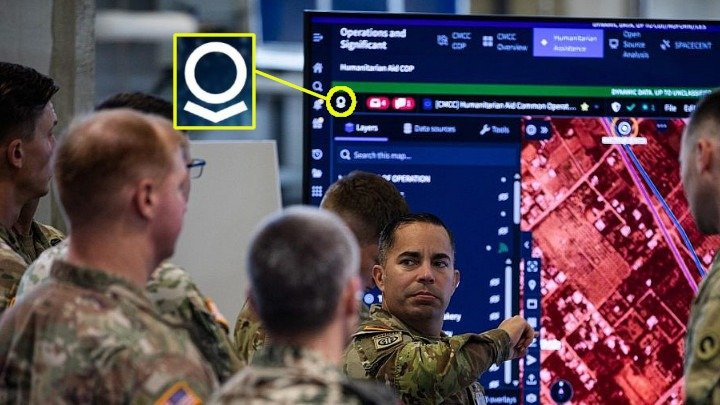
When the Trump administration first mooted the possible GREAT project in October 2024, the promotional video carried the corporate logos of Tesla, Amazon, Constellis—formerly Blackwater—and others. When approached by journalists, most of these companies denied any involvement. Tesla, Amazon, and Constellis declined to comment.
The deployment of Constellis and other similar mercenary outfits in and around Gaza has been a consistent government tactic. The Israeli government has openly conceded that it finances, arms, and equips so-called “counter Hamas” paramilitary groups in Gaza, such as the Popular Forces. When these “allied groups,” alongside IDF troops, have evidently murdered Palestinians desperately trying to obtain hold of food and medical aid, the Israeli government has reportedly called this “open-ended control over Gaza.”
As we noted earlier in our discussion about Pax Silica, the use of “private security” forces in autonomous jurisdictions (SEZs) is a key feature of the Network Empire. The GREAT plan, or “Trust,” refers to this as “Hybrid Security.” Private security contractors (mercenaries) will “distribute aid security and build and operate temporary housing zones.” Once New Gaza is established, the private contractors will “maintain public order.” If BoP plans proceed, the International Stabilisation Force (ISF) in New Gaza will ultimately be a private military contractor (PMC) corporation.
Therefore, it is not surprising that PMCs like Constellis, who claim they specialize in delivering “critical humanitarian services in [. . .] complex and high-risk environments,” are eagerly bidding for the lucrative contracts. Again, in October 2024—coinciding with the first murmurings about the GREAT plan—Israeli-American tycoon Mordechai “Moti” Kahana floated the idea that “well trained private security,” who are “equipped for non-lethal and lethal methods of crowd control” and “trained to use deadly force,” should police “gated communities” in Gaza. Kahana is the founder and CEO of Global Delivery Company (CDC), which he has called an “Uber for war zones.” CDC’s other board members include former US and Israeli intelligence, military, and law enforcement officers.
Described as the formation of “biometric ghettos,” two US PMCs—UG Solutions and Safe Reach Solutions (SRS)—were awarded the contracts to run surveillance checkpoints in Gaza in January 2025. SRS operations were led by former US special forces intelligence officer Phillip F. Reilly. SRS is a registered agent of Two Oceans Trust, LLC.
Two Oceans is a Wyoming-based “independent, partner-owned trust company” that provides “tax advantages, modern trust laws, and privacy protections” to “ultra-high net worth individuals, families, and foundations.” Plainly specializing in providing its services to ultra-wealthy tech oligarchs, Two Oceans says it is the “first US financial institution to offer comprehensive generational management for clients who have substantial digital assets.” Due to investor confidentiality, we cannot identify these tech oligarchs, but we can make an educated guess.
Certainly private capital investment is a core component of the GREAT plan. In December 2025, as reported by the Wall Street Journal (WSJ), Jared Kushner, Trump’s son-in-law and property empire impresario, and Steve Witkoff, the real estate mogul serving as the US special envoy to the Middle East, presented Project Sunrise, a.k.a. the GREAT plan.
Projecting a total $112.1 billion cost over ten years, Kushner presented a plan for transforming Gaza into a “digitally-driven smart city.” Critics immediately pointed out that the plan would fail due to the difficulty in resolving the so-called “conflict.” CFR fellow Steven Cook pointed out that the plan was based on Hamas disarming and that “Hamas will not disarm, so nothing will happen.”
Hamas has recently, however, publicly agreed to disarm itself in the hope of moving the GREAT project forward. This may seem surprising, but Hamas has frequently served as a proxy for the US and Israeli governments, so it shouldn’t shock anyone, least of all CFR fellows.
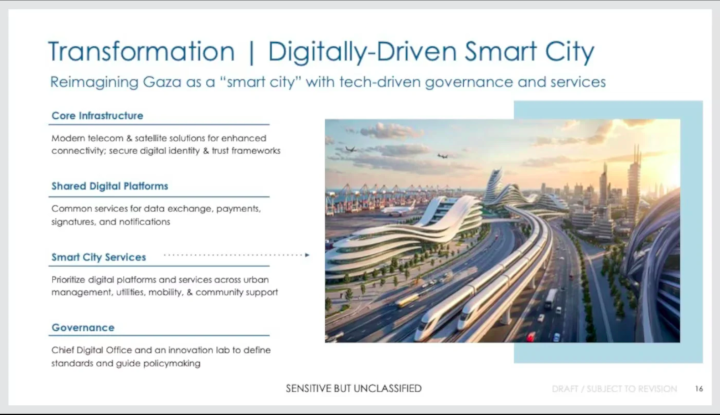
Calling Project Sunrise Trump’s “Master Plan,” $60 billion for the “the contemplated workstreams” would be financed through US government “grants and guarantees” on debt obligations. In other words, the US public sector would cover the financial risk for private sector investors.
Once New Gaza was up and running, the remaining financing needed would be raised by “monetizing 70% of Gaza’s coastline” to attract further foreign direct investment. With the offshore Gaza Marine Gas Field potentially up for grabs—generating an estimated annual revenue stream of $4 billion—and as a prospective IMEC and BRI hub located just 70 km south of Israel’s Silicon Wadi, what’s not to like for oligarch investors and globalist socialites looking for a Mediterranean beach front tax haven?
After the January 2026 ceremonial signing of the BoP Charter, Kushner expanded on the Master Plan at a Davos follow-up event. Kushner said there was no “Plan B” and, embodying the neoreactionary accelerationist ethos of creative destruction, he said the plan was going to capitalise on “catastrophic success.” Kushner added that the interested parties, including Hamas, had “signed an agreement [and] we are all committed to making that agreement work.”
Formally announcing the GREAT Trust (plan) in February 2025—at a joint White House press conference with Benjamin Netanyahu—Trump initially indicated that the GREAT plan didn’t include a provision to rehouse any Palestinians in Gaza. Fully adopting the Network State strategy, Trump said BoP should take “long-term ownership,” evidently with a view to making Gaza a shining beacon of the Network Empire in a new Middle East. Now that it has been cleared, Gaza was, he said, a “good, fresh, beautiful piece of land.”
Were it not for the fact that Gaza is their home, when we consider what the GREAT plan has in store for Palestinians unfortunate enough to live in it, we might wonder why any would ever want to stay. If they are wealthy enough, they should be fine, but for everyone else, New Gaza will be a prison camp.
Leaked documents reported by Dropsite News revealed that the CMCC has advanced plans for “planned communities” of Palestinians where they would be under constant biometric surveillance; their movements tightly controlled by checkpoints; their purchases and payments constantly controlled and monitored—via digital ID linked to digital currency—and their children subjected to re-education camps to “normalise” their views of Israel.
Under the Gaza Reconstitution, Economic Acceleration and Transformation (GREAT) plan for New Gaza (and New Raffah) a full Network city-state will be constructed.
“An unprecedented public-private partnership [to] rebuild Gaza” will make New Gaza a fantastic profit-making venture for oligarchs. Projecting that a “$35-$65B private investment” should return a ten-year ROI of “$324B in assets, [plus] $37B in taxes (from $185B revenue of investing countries’ [and] companies),” wealthy investors and companies will be attracted by an annual New Gaza revenue stream that will “exceed $4.5B by year 10.”
Multinational corporations will relocate to New Gaza primarily because of its strategic location “at the crossroads of a New Abrahamic Architecture” (NAA – IMEC). It will attract multinational corporations to relocate there because it will be a “regional trade hub” at the center of the “pro-American regional architecture.” It will be a “Mediterranean hub for manufacturing, trade, data, and tourism” linking the markets of “Europe, GCC, [and] Asia,” uniting their resources and regional development plans.
The overarching SEZ—covering the entire New Gaza—will be split into sub-zones. The “Elon Musk Smart Manufacturing Zone,” for example, will thrive because it will “feed[ ] from and to” the NAA (IMEC). “Private industry investors” will build the necessary “regional data center for Cloud Service Providers, and advanced manufacturing facilities (e.g., gigafactories).”
In addition, as a deregulated employment zone with a desperate and captive “young workforce,” New Gaza will be an enticing manufacturing zone for “Israeli tech” and an appealing prospect for “GCC investments.”
New Gaza will be based on an interconnected system of “Gaza planned cities” consisting of “6-8 dynamic, modern and AI-powered, smart planned cities on the inner side of the Gaza Ring [border]. All services and economy in these cities will be done through ID-based digital system.”
The imposition of UN 2.0 frontier technology and the prerequisite behavioural control systems are guaranteed. The CMCC’s planned system of armed PMCs patrolling biometric and digital ID-linked checkpoints is a New Gaza design feature.
Like all good Network States, nothing exists in New Gaza unless it is on-chain, and all value becomes digital. The intention is that using “blockchain as record of ownership (e.g. digital land title registration)” will “[c]reate and register tokens for fractional ownership.” Consequently, any Palestinians that still live in New Gaza will have to “place their privately owned land in the Trust in exchange for a token that gives a right for a permanent housing unit.”
For at least the first two years, all Palestinians will live in “short-term modular shelter” camps because the “construction [of permanent housing] starts in year 2.” With no land rights, Palestinians will be issued programmable on-chain digital tokens as revocable permits conditionally allowing them to stay in exchange for the land that was once theirs.
Rent payable for the “tokenised” home they can’t own will be “subsidized for 4 years” and food for the first year. After which neither will be subsidised. Thereafter, there are no proposed rent controls and no long term plans for food distribution or local agriculture. Palestinians who make it out of their “short-term modular shelter” will eventually own nothing and be happy, or not, in New Gaza. For investors, not ordinary Palestinians, all of this will “increase [the asset] value of Gaza to ~$324B from $0 today.”
The projected “[b]aseline Gazan population is ~2.14M, with a 2.02% annual growth rate” based on the assumption that “75% of Gazans will remain in Gaza during reconstruction.” Palestinians will be offered $5,000 each to leave. This is important because timescales, and ultimately profits, will improve if “the number of Gazans who volunteer to leave Gaza during the reconstruction” is maximised.
The fact that the CMCC is using Palantir software or that the Trump administration is splashing Praxians’ corporate logos on its promotional videos and pamphlets does not alone demonstrate that the Praxians are among the private sector stakeholders that are leading the GREAT redevelopment of Gaza. Nor does the fact that the Tony Blair Institute—a Larry Ellison front organisation—was involved in Project Aurora, which modelled the forced relocation of Palestinians from Gaza in October 2024. Naming New Gaza zones after Praxians doesn’t constitute conclusive proof either.
It is the Praxians’ openly stated control of the Trump administration; the years of Praxian corporations’ deep involvement with the Israeli defence and surveillance tech sector; the strategic partnerships they have with Israel for “war related missions;” the co-development of AI targeting and surveillance systems with the Israeli state; and the increasing financial and technological footprint they have within Israel, which demonstrates their power and influence in the region.
The definitive proof that New Gaza is a Praxian project stems from the fact that it has been designed as an exemplary UN 2.0 smart city-state project: a Network State within a rapidly emerging Network Empire.
Series Conclusion
Over four essays we have picked apart the global system that is coalescing, acutely in microcosm, in the envisaged New Gaza. To report these observations is not to be blackpilled. To ignore how power structures work and whose interests they serve, however, is to metaphorically stick your head in the sand.
It is because nearly every government is complicit that I have criticised the Chinese, US, Israeli, Iranian, and many other governments. I have not denigrated the people ruled by those governments, nor their nations, nor their cultures.
In reference to to the purpose of the series you have just read, and to paraphrase former Moldovan Deputy Prime Minister and journalist Iurie Rosca: I have written these lines in total solidarity with the people and I make a clear distinction between the rulers and the ruled.
The Praxians want to exit the current Westphalian system, build a parallel network of Agentic GaaS smart city-states, and then defend them by working with intergovernmental organisations to achieve diplomatic recognition. They and their oligarch partners hope they will thereby construct a techno-feudal global governance system.
To reiterate a point stressed throughout this series, we don’t have to accept any of these behavioural control measures. We can reject Technocracy, we can deny the Network Empire power grab, and we can end the oligarchs’ ambition of finalising permanent global governance.
We could repurpose some of the technology, presently being installed to oppress us, to free ourselves. It is our choice. If we act in unison we can build better societies that oligarchs cannot possibly control. The global oligarchy knows it and this is why we are deluged with so much propaganda intended to divide us.
We can do some “flippening” of our own. We could repurpose some of the basic concepts supposedly underpinning the proposed Network Empire. We too could exit, build, and defend, not neofeudal Agentic GaaS city-states but voluntary democracies. We can combine permissionless DeFi (Decentralized Finance) and fintech (financial technology) to develop counter-economics into a cattallaxy where spontaneous order is the only order we need.
This is just my suggestion. I am sure there are many other long-term goals we could pursue, and numerous and varied peaceable tactics we could employ to achieve them. Whatever path we choose, resoundingly defeating the malevolent plans of the Praxians and their oligarch partners is essential. It is not hyperbolic to say the alternative is slavery.
As power is transferred “from governments to private technology companies,” our continued compliance and obedience to the system is no longer an option. Thankfully, all of us can engage in mass non-compliance.
If we decide to take responsibility for our lives and commit to conducting ourselves as honourable human beings, we can maximise our individual sovereignty. We can abandon the politics of obedience and replace it with voluntary exchange in a free and open society, one where Natural Law is studied and Natural Justice is applied by each and every one of us living as equal human beings with equal inalienable rights and equal responsibilities—a life without rulers, not a life without rules.
So let’s get on with it!