




Op-ed: This is an opinion piece published on Unlimited Hangout. Most articles published on UH are not opinion pieces, so we are clearly labeling those that are.
It should be no secret to readers of Unlimited Hangout that I have a very negative view of the impact that Artificial Intelligence (AI) is having on independent media and media in general. As someone who has been impersonated by AI daily on large video platforms for a few years now, I have come to acutely feel that AI is becoming a dangerous force that is making it increasingly difficult for well-meaning readers/viewers to distinguish between what is real and what is false. I don’t mean just for those hoping to view my content, as the personal issue I am facing is a microcosm of a much larger problem.
As a result, one might think that I would have been pleased, if not relieved, to see Substack, a large platform for professional writers, partner with an “AI detection tool.” Not only am I not pleased, but I have now taken the time to write an opinion piece explaining why I think this is bad and to also explain where I think a lot of this is going.
Substack’s new partner and, apparently, the AI detection tool of choice for most major media outlets right now is called Pangram. Pangram was founded in 2023, originally under the name Checkfor.ai, by Max Spero and Bradley Emi. Both Spero and Emi are Stanford graduates who, prior to Pangram, worked for companies like Nuro and Tesla where they both worked on AI self-driving car software (i.e. replacing human drivers with AI software). Both founders “have long been excited about the potential for AI to transform society” and say they created Pangram “to mitigate new issues caused by the proliferation of powerful generative AI models.”
I find it interesting that two Stanford graduates passionate about AI’s potential to “transform society” who then worked to facilitate AI-powered, human-free driving software decided to quickly pivot to “mitigate” issues caused by generative AI. A lot of the issues caused by generative AI were actually predicted years ago by figures like former Google CEO Eric Schmidt (Pangram co-founder Max Spero previously did work for Google). Schmidt, in a 2021 book authored with war criminal Henry Kissinger, essentially predicted that AI’s “transformative potential” would cause what he called “cognitive diminishment” in the masses and make it almost impossible for people to distinguish between what is real and what is not on their own. Perhaps unsurprisingly, Schmidt and Kissinger’s preferred “solution” to this problem was that we become reliant on AI to distinguish for us what is real and what is not –– in other words, to let another AI become the arbiter of our reality.

I have written before about this Schmidt-Kissinger book and its predictions. There, I noted that these predictions and warnings –– given the power networks in which both men are/were enmeshed –– were more likely to be disclosure of what had already planned with respect to AI rather than warnings about what might happen upon the mass adoption of AI. Nevertheless, the Schmidt-Kissinger “warnings” were unusually prescient. In addition, their proposed solution is very similar to what Pangram is currently offering –– in that Pangram uses AI to recognize AI vs. human writing. Pangram thus becomes the currently preferred AI arbiter of what is real human writing and what is not.
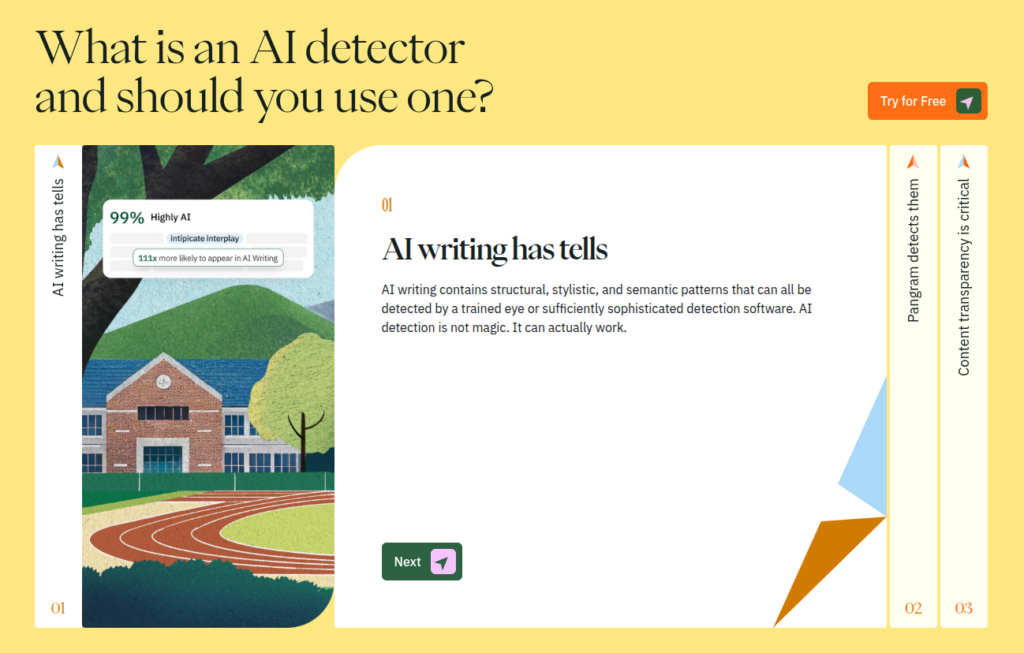
There has certainly been a successful marketing campaign to convince us that Pangram is the “most accurate” AI writing detection tool on the market. Headlines of articles promoting Pangram essentially communicate that it will definitely tell you whether AI wrote something. If you read past the headline, which many don’t, you will see the fine print that Pangram will also mark something as AI generated even if AI was only used to edit a human-generated piece of writing. Pangram’s AI-generated label doesn’t really distinguish between the two, even though, as co-founder Max Spero acknowledges, that label “changes how people approach the text.”
The fact that Pangram can’t meaningfully distinguish between a text fully generated by AI or one simply edited by it reveals that it is not an “AI detector” at all. As noted by Tim Requarth back in April:
The term AI “detector” is a bit of a misnomer, as tools like Pangram don’t scan a database of known AI text for a match; they make a guess about likely authorship based on differences in patterns between AI-generated and human-generated text. Rather than a detector, thinks of it as an “AI inferencer” or more colloquially, an “AI best guesser.”
As an inference tool, Pangram is vulnerable to everything that makes inference so difficult: small sample sizes (a single article rather than a corpus), small effect sizes (as the statistical distance between human and AI writing shrinks), and confounds (a human who reads and mimicks AI-generated text before writing her own).
Indeed, the way Pangram works is by making inferences about whether a given piece of writing features enough of the words, phrases, sentence construction, etc. that are currently common in AI-generated text. However, many human writers, long before generative AI, used a lot of those words, phrases, etc., too. As a consequence, we now have writers who are altering their entirely human writing style in order to please the Pangram gods and hope they won’t be falsely labeled as AI slop purveyors.
A good example of this was recently discussed in a piece by Alex Kirshner for Slate. In that article, Kirshner writes:
Whatever the future holds for the accuracy of A.I. detectors, I am unsettled by what both the A.I. writing and the detectors are doing to me right now. I worry about how A.I. writing and efforts to sniff it out are changing fully human writing. I write all week, every week, and can feel this story’s arsonists (LLMs, particularly when used the wrong way) and firefighters (A.I. detectors) weighing on my process in negative ways.
Like many journalists, my writing style comes from the books, news articles, blogs, and (yes) social media posts that have latched on to my brain over the years. A.I. writing is now in my water supply, whether I can identify each new gulp or not. It feels inevitable that I’ve started to internalize its tics, even the most infamous ones, like incessant em-dashing and overreliance on the “It’s not x but y” structure. For one thing, I fear this will make me a worse writer, dragging a talent that was good enough to get me hired here (and elsewhere!) back toward the A.I.-generated median. Scarier yet, it’s possible that someone—or, heaven forbid, some A.I. detector—might mistake my text for ChatGPT’s. I have started to self-police against this outcome. A few times lately, I’ve caught myself modifying my own work to sound “less like A.I.” In the process, I’ve probably picked words I wouldn’t have settled on otherwise. It feels dystopian—and I doubt I’ve succeeded.
I would go a step further than Kirschner and say that this outcome is definitely dystopian. It becomes more so when one considers that the supposedly “telltale” patterns of AI-generated text change as new, improved models are released, particularly as they are literally ripping through mountains of obscure, human-written books to train them to write more and more like humans. Meanwhile, the actual humans, to keep a job in a world where the pool of writing jobs is already shrinking rapidly, are scrambling to not sound like something that is rapidly being trained to sound like them as much as possible. Perhaps by design, this is not a game that humans are meant to win and, as I will explain later on, that means it is a game that writers should quickly stop playing.
Before we get there, there are a couple of other things to note about Pangram and other AI “detection” companies. One is the issue of false positives. Yes, it is true that Pangram is considered by ostensibly independent researchers (and also itself) to have the smallest false positive rate in the industry. For the purpose of this example, let us use Pangram’s claim that only 1 in 10,000 Pangram-generated labels regarding AI or human authorship are false positives, meaning the text is labeled AI generated when it is not. On Substack, which now has Pangram embedded within it, we do not know exactly how many posts on average are made a day, as Substack does not disclose, but we can guess. The site itself claims that over 1 million posts are “discovered by potential subscribers in the app every day.” The site has over 2 million active publications, most of which publish at least weekly. Let us say, for the purpose of this example, that those 2 million publications do publish weekly. Then, 200 of them, per Pangram’s rate, will be marked as false positives every week. Over a year (52 weeks), we get over 10,000 Substack articles that are falsely labeled as AI, even though they are not. While this figure is still certainly smaller than what Pangram’s competitors offer, if we assume that those 10,000 false positives affect different publications, that could be 10,000 human writers being falsely labeled as AI slop, thereby affecting their reputation, revenue and, perhaps most crucially, their trust with their audience over that calendar year. I see it as a push to outsource trust about a writer’s authenticity from being between a writer and their audience to being between Pangram and a writer’s audience.
While these are statistics used by Pangram and its partners for marketing purposes, behind those numbers are real human writers facing an accusation from Pangram’s AI that could ruin their business. As this effect stacks over years, it could theoretically make the pool of human writers whose work has not been labeled as AI by Pangram smaller and smaller as time goes on. It is also fair to say that the false positive rate that Pangram cites is also the lowest one that has surfaced in research about its product, and it is cited most frequently because the company considers it most favorable to its interests. It is entirely plausible that the actual false positive rate is higher. There is also the added issue that if you run the same text through Pangram more than once, you’re likely to get highly variable –– as opposed to consistent –– results, making Pangram’s verdicts look more based on the luck of the draw than any meaningful “detection” of AI use.
Another important angle to explore with respect to Pangram is the potential for this tool to be deliberately wielded as a weapon for the purpose of censorship and/or discrediting a given journalist or outlet. Max Spero, Pangram’s co-founder, has notably been accused of using his Twitter account to call out specific outlets and journalists for using AI, which has –– in recent months –– generated major headlines and controversy. I don’t really think it’s relevant for the purpose of this article to investigate whether the claims levied against those journalists and outlets are true or not. As recently noted, Pangram does generate false positives, but it is also possible that these journalists did use AI in some way but did not disclose it. However, what is relevant here is that Spero in particular has used the verdict of his company’s AI “detector” to make weaponized claims against specific journalists and outlets.
As a long-time writer in independent media who has consistently written about controversial topics before it later became safe to do so (see my early work on Epstein’s Israeli intelligence ties, Peter Thiel and Palantir, among other topics), I am not a fan of mainstream or “legacy” media. On more than one occasion, they have either defamed me or used my research and writing without citing me. A good part of my career has also been spent picking apart the often misleading narratives they promote. As a result, I tend to be skeptical about the authenticity and veracity of the articles published by many of the same large outlets that Spero has targeted. However, there is another Spero quote that may get your attention if you have been closely following independent media over the past ten years.
In an article published by TechCrunch about Pangram’s recent raising of $9 million from investors, Spero discussed wanting to start Pangram to mitigate new issues that emerged following the public release of generative AI tools. As an example of what types of new issues had emerged as a result of AI’s growing use, Spero offered “LLM-powered Russian disinformation campaigns and UAE-influenced campaigns on Twitter.”
Perhaps you remember the time, beginning roughly ten years ago and continuing for many years since, that any piece of reporting from independent media that was deemed inconvenient to the powers that be (particularly about US proxy wars abroad) was falsely labeled as “Russian disinformation.” Perhaps, more recently, you may remember pro-Israel influencers and media outlets similarly claiming that criticism of Israel in recent years has allegedly been driven by funding from Qatar, as opposed to public outrage over Israel’s live-streamed genocide of Palestinians in Gaza. Or what about the newer claim that LLM-powered bot accounts from China that had no reach whatsoever are really secretly behind Americans’ growing distrust of Big Tech and discontent over data centers?
If you have been following long enough, you may have noticed a trend whereby critics of certain power structures are routinely and falsely labeled as state-sponsored propagandists or “bots” as a way to discredit, not only the critics themselves, but also to discredit the broader concern –– be it the impact of data centers or imperial wars. I do not know if Spero’s intent with Pangram is to similarly weaponize his company’s product in a similar way, but it is certainly possible.
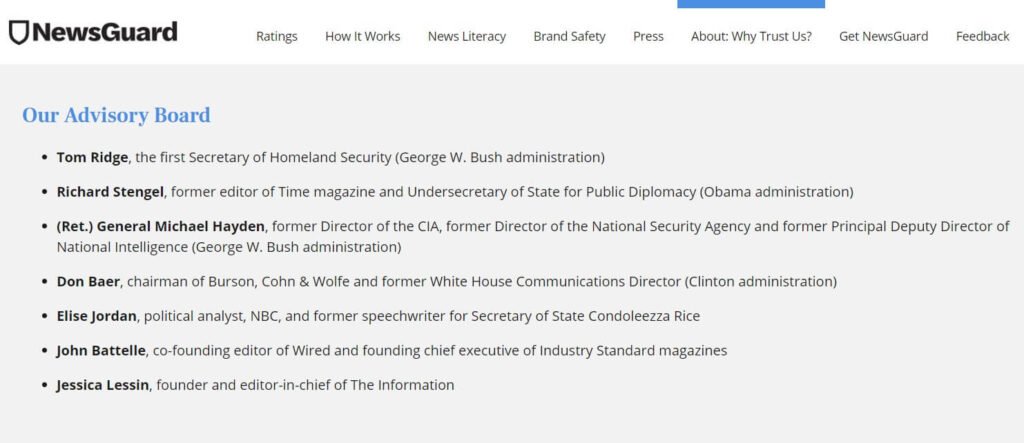
However, the fact that Spero’s Pangram is partnered with Newsguard certainly increases that possibility. As I wrote back in 2019, Newsguard is a dubious “fact checker” that was initially created to discredit independent media outlets critical of US foreign policy, while giving admitted US propaganda organs like VOA a pass. It is also worth mentioning Newsguard’s national security connections — for example, it originally counted the former heads of the CIA and DHS under George W. Bush among its advisors on determining what is “fake news” and what is not. One of their top investors is the founder of Kroll Associates, often referred to as the “private CIA,” Jules Kroll. Now, with Pangram, Newsguard is determining what is “AI slop” and what is not and has used Pangram to launch a “real-time ‘AI content farm’ detection” service.
What better way to digitally nuke a group of reporters and any accompanying wave of public sentiment than by using a now “trusted” AI detector to label both the writers and the sentiment as inauthentic and machine-generated. The potential is for Pangram to become a new way for censoring human-authored, yet inconvenient content, particularly if content labeled AI-generated eventually becomes algorithimically demoted over what Pangram labels as human-generated. The public will be told that the “AI slop” is being buried, when — in reality — it is dissent.
The way it looks to me is that Pangram is currently in the phase of normalizing the ubiquity of its product and building “trust” with those who use Substack or any other platform (or browser plug-in) that integrates Pangram. During this period, readers will be trained to see a Pangram label and trust its results with no further information needed. This is how a company like Pangram can raise $14 million in financing (including from one of Anthropic’s main investors) for a product that it is available for free. As has been said before about online products, if the product is free, then you are the product. In this case, I think that training you to outsource your “trust” to Pangram from the person or outlet you are reading is the product. Once you trust an AI “detector” tool, you will trust its verdicts, perhaps even over the writer you had grown to trust.
Pangram’s co-founders did not make Pangram to protect human-generated writing and speech. Pangram’s co-founders have long been excited that AI will “transform society,” and immediately prior to Pangram, were developing algorithms to replace human drivers with AI. As noted above, they created Pangram to stop what they referred to as state-sponsored influence operations among other “issues” that emerged upon the public release of generative AI tools. With their former Big Tech employers having public sentiment move against them, whether on data centers or “smart” glasses or something else, Pangram’s co-founders may offer a new way of doing away with accounts deemed too critical of AI’s “transformation” of society. Maybe not, but forgive me for being skeptical.
To conclude, I would like to again return to the Schmidt-Kissinger book on AI and its predictions. In independent media, many warn of the Hegelian dialectic, also known as “problem-reaction-solution.” That is, the powers that be first create the problem, then wait for the public to react and finally offer the public the policy outcome they always wanted as the solution. It certainly is convenient that Schmidt and Kissinger, two very terrible people who both helped create this mess in different ways, presciently predicted that AI would make it so people could no longer tell what was real and what was not. Now their prediction has become our reality and, right on cue, the company Pangram has stepped in to solve the AI slop problem (from which its own investors profit) by offering us what was also the Schmidt and Kissinger’s preferred “solution” –– people relying on an AI arbiter to tell them what is real and what is not.
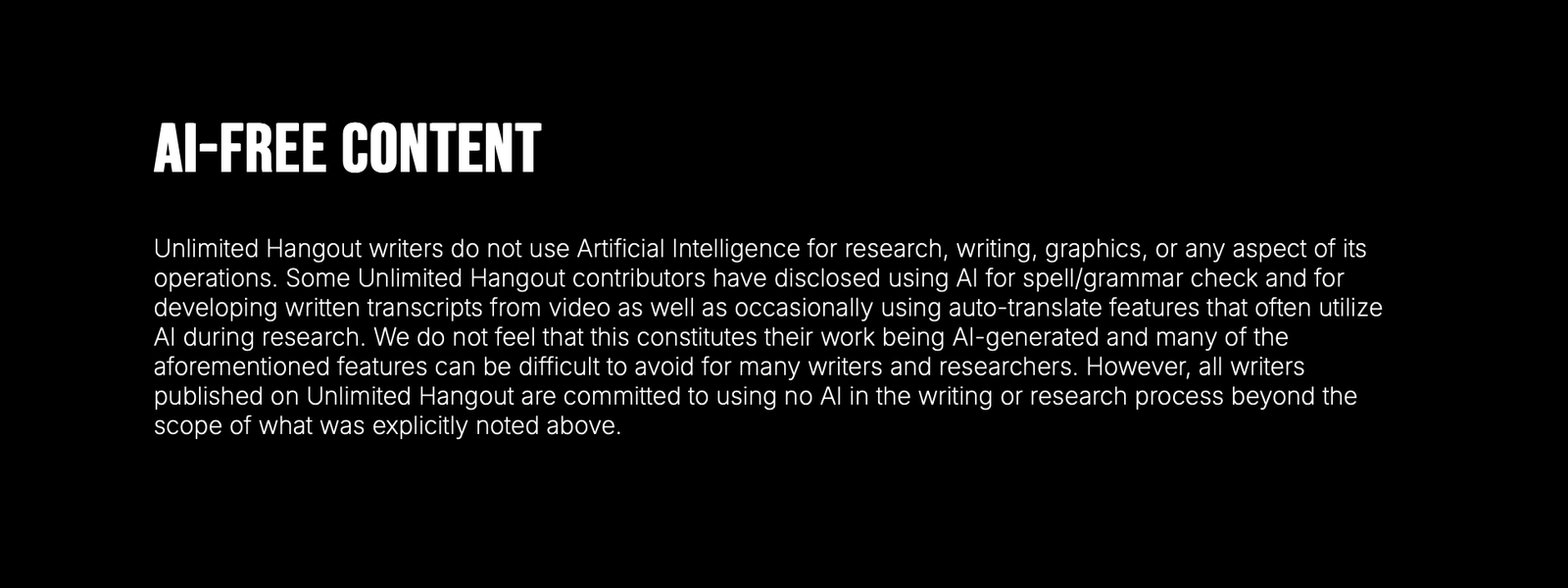
As I wrote earlier, the obvious way out of this dystopian game is not to play it. Do not trust Pangram’s AI just because it looks “authoritative” and has had some positive PR. It is not a “detector” as it claims to be and its results for the same text are rarely consistent. If you are a reader, ask the writers you are reading to disclose their use of AI. Trust should be built between writers and their readers directly, without an AI middleman and arbiter of authenticity or “humanness.” At Unlimited Hangout, we never use AI for writing, research or editing of our articles. This is made clear in our AI use policy, which you can read on our “About Us” page upon the imminent launch of the newly redesigned Unlimited Hangout website (In the meantime, you can read it here). We created this policy after helping create the IMA AI Transparency Pledge, which encourages independent journalists and outlets to voluntarily disclose if you choose to use AI and how.
Just like any other human writer, all I can offer to my readers is my research, my sourcing and my authentic analysis and, in the case of this article, my opinions. I am not going to run my articles obsessively through Pangram hoping for a “100% human-generated” result. I am not going to let fear of an unfavorable Pangram result change how I write and make me afraid of using words like “delve” or “profound” because Pangram might punish me. I know I write without AI and I have enough trust with my readers that they know I don’t use it in my writing either. Not unlike the entities that have labeled inconvenient reporters as Russian/Chinese “bots,” Pangram assumes that you can’t determine what is authentic and inauthentic on your own and that you need them to tell you.
While critical thinking may be in low supply in the age of AI, don’t let it be. You don’t need another AI to “help” you determine what does or doesn’t feel or seem authentic to you. You don’t need it to tell you what you should or shouldn’t read and who you should or shouldn’t trust. It’s never a good idea to outsource your critical thinking and your opinions to others, especially a non-human AI.




You’re the best Whitney!
I concur!
I NEVER engage my eyeballs or ears with AI by choice. I read real books. The only interviews or instructional I view are UH and … UH. That’s it. I’ve found wrong motives or wrong info from everyone else. I have detested the very idea of AI from the start. I may not put content out like a fucking machine but it’s my own work. I feel, I care, I am trying to help people navigate this blenderized shit storm! And I work hard – I very much resent being plagerized under the limp notion of it’s all collaborative AI. Where are my AI co workers when my back and shoulders are fucked up from working 6-10 hours writing for the third day in a row? Getting it right. Going over it until I’ve got every point. Where are these tech guys when my work has pissed off the local goose stepping moron? When my social credit score earns me a 2/3 loss of food stamps per month? No. AI is the dull, throbbing beige that tunes out the brain until it doesn’t care anymore. And it is subverting the west into being accomplices for the mafia state.
Use AI for the purpose it was designed for, as a weapon….
I NEVER read or listen to AI anything if I can help it. I read books. I read and watch UH. That’s it. AI is the mass normalization stage of taking the US- over and over again. Combined with the real estate takeover our little real lives will be taken away from us if we do not resist. I very much resent the AI suck up of my work. The intent of using AI for the written word is to me heinous in concept. No integrity of at least forming and carving out your own words from genuine thought and feelings. It is to the soul what eating a shower curtain is to the body.
PS… it is for removing our creativity. To make the creative act on par with nothing. Unimportant. Valueless. Rendering people as unimportant, valueless, unimportant. That’s what these enemies want us to think of ourselves and one another.
Whitney write: “Just like any other human writer, all I can offer to my readers is my research, my sourcing and my authentic analysis and, in the case of this article, my opinions. I am not going to run my articles obsessively through Pangram hoping for a “100% human-generated” result.”
If you go even slightly into that I don’t think you’ll ever get out. Any artificial ‘verification’ to that simple act of forming trust over time opens the back door to endless technical mind games. Even if the original intent is not weaponization it will soon become a sophisticated weapon. So no matter what you do you will eventually be accused of “inauthenticity”.
It is so simple it is easy to predict. No matter what you do, no matter how pure you are, you will inevitably be labelled an automated ‘cheater’ if you piss off certain people.
Basically the aim would be to destroy any sense of unmediated trust in the original “classic” research of another human being. To destroy using evidence-based research to communicate directly with another human being using your own critical thinking skills and your abilities to verify claims (without AI help).
High on the target list: “classic research”, original research, research on key social ‘third rail’ subjects, research on planetary power dynamics, researchers outside of university and media institutions.
You are wise to stay completely away from any automated verification of how ‘authentic’ you are. Automated verification of ones own authenticity sounds like being in Hell. Even the slightest alteration to your writing style or research style to pass some automated verification and you are already trapped.
You can do what people have always done. You can give your word to your reader. You give your word and follow through because trust is earned. They will verify it in the work product. This is an old tested method I think you have already been using effectively.
Right. Exactly right. All great things to consider. Thank you.
Anthropic has reportedly started using a system to watermark it’s text output by statistically skewing the language it uses. The details have not been disclosed publicly (to my knowledge). One wonders how this applies to text generated of various lengths. Legislating disclosure of AI use could be a nightmare without Orwellian surveillance. Anyone have suggestions?
What an outstanding op/ed you have here! Thank you for sharing your thoughts as a professional writer on this crucial topic. The student’s use of AI is front and center in the high school where I teach, and it would be so convenient to use more tech to,“put a stop to it.” Not on my watch! I can only hope that the friends and colleagues I share this piece with take it to heart and be prepared to face the current AI cheating predicament with their own critical thinking.
We should not in any way knowingly contribute to the long-term plans of the war criminals who are pushing for singularity.
God bless you, Whitney Webb
Thanks for helping to draw attention to this aspect. We’ve been warning about the potential for the AI panic to be leveraged for covert censorship as you know. Your findings confirm the too obvious.
Let’s hope others start to realize the dangers
Ms Webb – I hate to bury you but on top off all the horrified thoughts this op-ed has touched, it further begs the question. How shall I credit your work? I ask here for other readers to see your requirements.
My research led me to your 2 volume set. I had the same question. Why did E do it? How did he get away with it? I began in 2001 with Bush and the mind fuck of the church. I knew it had to be global and systemic but I was pretty dumb and very ignorant. I make no claims for any degree of improvement but I’m trying. I did one experiment with what I had in 2023 and then added as I learned more. A stopping point on the journey. It’s on KDP “ Return To Jesus- ripping the mask off a cult mafia dictator.” It’s horrible writing but I was terrified the goons would drop me down a dark hole. And I just wanted to end the process. I know.
At present, I am writing a series about this mafia state/ creeps like Epstein. Wexner will come into it. But the first book is focused on the Nazi infiltration since Operation Paperclip.
Much of my background on criminal intelligence is based on your work and Mark Goodwin’s. Simon Dixon’s fiat currency stuff. Crypto history. And a million other books. So in regard to YOUR work, how do both you and Mark Goodwin want me to credit you. Tell me the format and I will use it unless it’s unworkable.
Thank you for all you’ve given and still provide more.
I’m really enjoying your content Whitney! I recently over from Australia to Paraguay and so the Starship Patagonia pieces were fascinating!
Pangram The Thief?
If a publishing platform still uses an article it knows is human-written, but their Pangram had labelled it ‘AI slop’, is that theft? Can the writer claim copyright theft of original content etc etc?
Amazing article. If it wasn’t so serious the whole idea of USING an AI company to detect AI would be hilarious. like an Onion article. Sadly it’s not funny!
I disband from any organization which uses AI. After 10 years of being affiliated with a national esoteric and healing organization they decided to add Ai to their database. I protested at our online conference in front of 100 +/- participants. I’ve never looked back. I was shocked how people I knew and trusted could be swayed by a few individuals who pushed the agenda 2 years ago when Ai was just growing. How empathetic healers could trust big software companies is beyond belief. I believe there was a new “insider to the industry” who convinced a few greedy practitioners looking to grow their client and student list anyway they could. The rest were trusting sheep. I’ve witnessed and researched enough to know that the Ai industry is to be used slowly with regulation around every corner.
I’m also old enough to have witnessed many breakthrough bubbles: the hype, over investment and the cost to many.
Thank you Whitney, for not being a sheep and for using your Ajna and Throat Chakra.
Yes
We have every reason to believe that the delegitimization, if not outright silencing or erasure, of dissent is the likely result of this technology. This should be required reading for all Substack writers.
Thank you.
I believe we are moving into the Age of Discernment, and this fits right in with that. I am not an AI bot, and I approve this message.
I am divesting from Substack due to the Pangram partnership. I did not receive any disclosure from Substack. I prefer independent, decentralized journalism that does not employ AI policing.
Thank you for bringing this to my attention Whitney.
I don need no stinkin’ Pangram! I love your honesty in this topsy- turvy world. Whitney, you are truly a breath of fresh air!
I totally agree with you.
Sophistry is a real effort to confuse and misdirect an audience to achieve a goal. This has been adapted further by Machiavelli and Hegel. Notably, Machiavelli advises deception and demagoguery at its core, the opposite of stoic truth. Hegel suggests changing a truth by adding a falsehood to a narrative thus creating a synthesis of less truth, repeat enough and one would believe snow is black. Both of these sophist rhetoric linguists use information as a weapon in a coercive exploitation of reality. As a book by William Sargent “the battle for the mind” diagrams in 1952. AI is anti-human at its core as it seeks to undermine and lower human reason. In a bread and circus world, reason is in short supply already. I only hope people like you, Whitney, and our friends at IMA can get enough folks to see the light of education in truth as preferable to becoming an obsequious Sotus by allowing their reason and mind to be raped (stealing the title of Joost Merloo’s Rape of the Mind). God bless you Whitney, you are a stoic philosopher.
garbage in => AI => garbage out.
data, no matter how big, don’t produce meaningful knowledge until organized through a philosophical perspective.
those who design AI either don’t understand that or don’t want to admit that there are a whole world of “meaningful understandings” that can’t be reduced to 10101010, for financial and/or ideological reasons.
what matters is that humans with the ability to think critically can write what AI can’t, and the rest will continue consuming and producing garbage as writing and knowledge, as before the arrival of AI.
I believe they are still trying to make “mis-information, dis-information, and mal-information” work to snuff out dissent. But they always need new quivers in their arsenal, so, why not an Ai slop detector to eventually make online honesty rare and public discourse doubted and dissent unlikely.
How can this opportunity for censorship not be a part of a plan?
I have wondered — if this tech is so thoroughly amazing, why hasn’t it been programmed to carry coding/MARKERS labeling it clearly?
o Ai-generated material should have a source note indicating from when and where it was sourced so tracing is automatic
o I want to see all Ai-generated visual material with screen markers that clearly indicate Ai made it from trawled visual/art data.
o I want to see Ai-generated copy to appear in a distinct typeface.
Publications give us footnotes, indices, and bibliographies. Why is it impossible for this highly advanced, promised-to-be-on-its-way-to-consciousness-Ai not automatically providing similar sourcing information through its programming/coding?
Why does this remind me of the Fraudulent PCR Diagnostic Tests? It definitely is not a direct match. But maybe it is the presumptuous manner in which is being used that is the common denominator? Maybe it’s the false positives? Maybe it is the unproven claims? Maybe it is the intent to mislead?
Thank you!
You are sui generis Whitney, no one like you doing this work with such painstaking thoroughness and perspicacity.
Sui generis
In this age of rampant deceit, Whitney has become a reliable beacon of ‘truth disclosure’ through hard work and phenomenal deep-dive research. Once again, her opinion aligns with everyone, “with open eyes” to see the precipice of human evolution we face in this dark era of antihuman technological exploitation, with the final goal of “transhuman ascent” and spiritual bankruptcy. Please keep your integrity and conviction for honesty and Truth, so that many can follow your example. THANKS!
I have always liked using em-dashes—it’s a predilection, not a weakness. And I don’t plan to change—certainly not because some random AI happens to agree with my tastes.
The core problem with AI detection is exactly what the article highlights: these tools rely on statistical patterns that can be gamed, and Pangram’s own claims about accuracy don’t hold up when applied to anything beyond its narrow training data. If a detector can’t distinguish human editing from AI generation on a simple college essay, why should institutions trust it for disciplinary decisions?
Recently I had the wonderful privilege of listening to your refreshing, knowledgeable and insightful discussion with Chris Hedges regarding the phenomenon of Data Centers and of course AI and the true purpose of their creation and continued growth. It is a dark and sinister agenda at work motivated by a hunger for power, control and greed along with an ideology that will ultimately prove detrimental to us as a society and civilization. As a historian, researcher and a firm believer in Bible prophecy I have come to understand where this is all heading and who exactly are the PuppetMasters…I wish you heartfelt continued success with your so very important and necessary work. The world desperately needs more people like you Whitney Webb🩵