




As far back as the 1970s, CCTV cameras have decorated private businesses and public buildings — providing a means of deterring theft for property owners and keeping records of activity through omnipresent VCR and later digital cameras. At its inception, there was virtually no backlash or critique against the new technology’s surveillance potential, allowing for a smooth implementation over the years. Now, decades later, it has become ubiquitous. Shoppers accept its existence and, consciously or not, adjust their behavior around it. For almost all, it is not a problem, but a fact of life.
Why, then, was there such an uproar when a popular East Coast supermarket chain revealed they are not only surveilling their customers with CCTV — but using their cameras to collect shoppers’ biometric data?
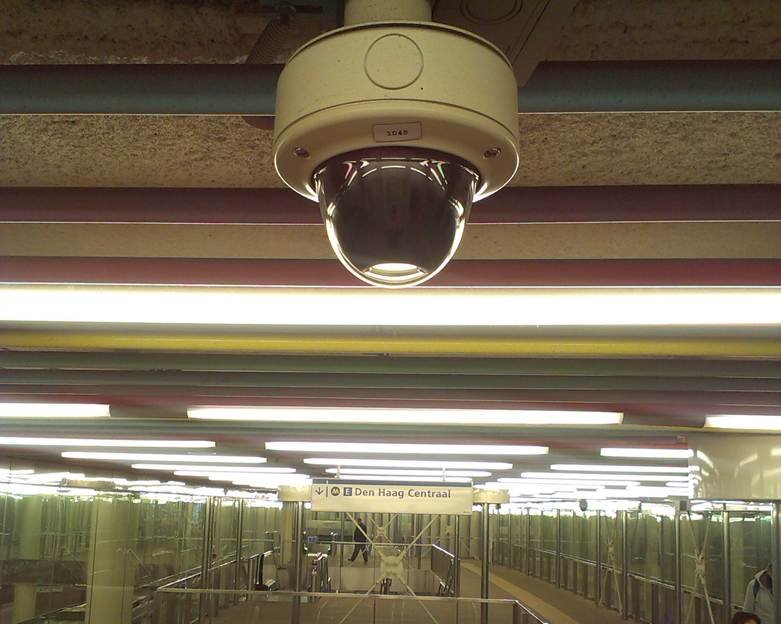
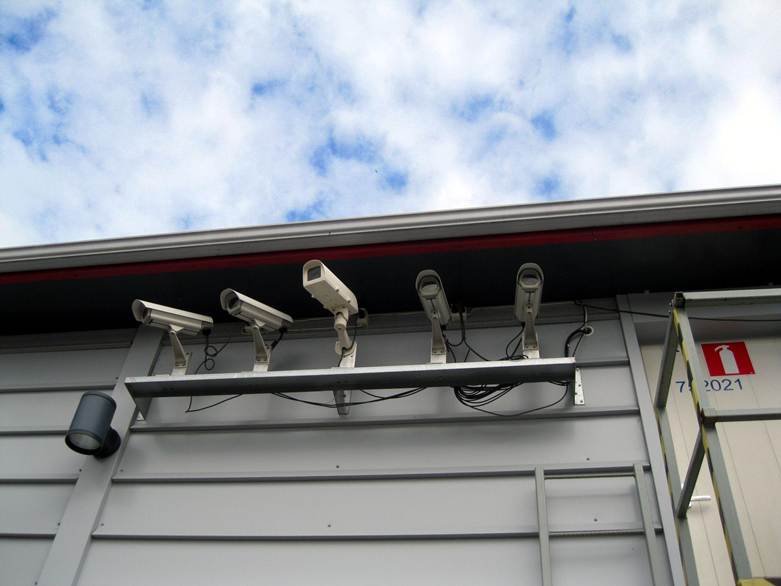
PTZ camera in dome housing, subway station, Central Station, Rotterdam, The Netherlands
— Source
Gothamist, the NYC-fixed blog, reported in January that Wegmans grocery stores in Manhattan and Brooklyn had put up signs that read “biometric identifier information collected at this location,” including facial recognition, eye scans and voiceprints.
The story caught wind — multiple New York State legislators and an NYC assembly member wrote letters to Wegmans disapproving of the practice. Some even proposed laws to make it mandatory for the chain to disclose these new surveillance systems in their areas outside of the city.
The resulting P.R. crisis pressured the grocery chain into a response. Though the company assured the media that the sole purpose of the technology is to keep their “stores secure and safe,” it admitted that their “system collects facial recognition data” in order to “identify individuals who have been previously flagged for misconduct.” In other words, Wegmans is building privately owned profiles of its customers, and categorizing some of them as potential criminals.
The statement claimed that “[i]mages and video are retained only as long as necessary for security purposes and then disposed of,” likening the technology to 20th century localized CCTV recordings — i.e. contained securely in one place and easily destroyed. The following sentence, however, casts an eerie ambiguity on this data retainment time frame: “For security reasons, we do not disclose the exact retention period, but it aligns with industry standards.” Without an “exact retention period” codified, Wegmans’ publicly-issued policy effectively gives them carte blanche to store biometric data for as long as they please, so long as the company deems it “necessary for security purposes.”
A Wegmans spokesperson told the Buffalo-based Investigative Post that the company shares data collected from facial recognition technology (FRT) with law enforcement. When asked whether Wegmans shares information with Immigration and Customs Enforcement (ICE), she refused to comment.
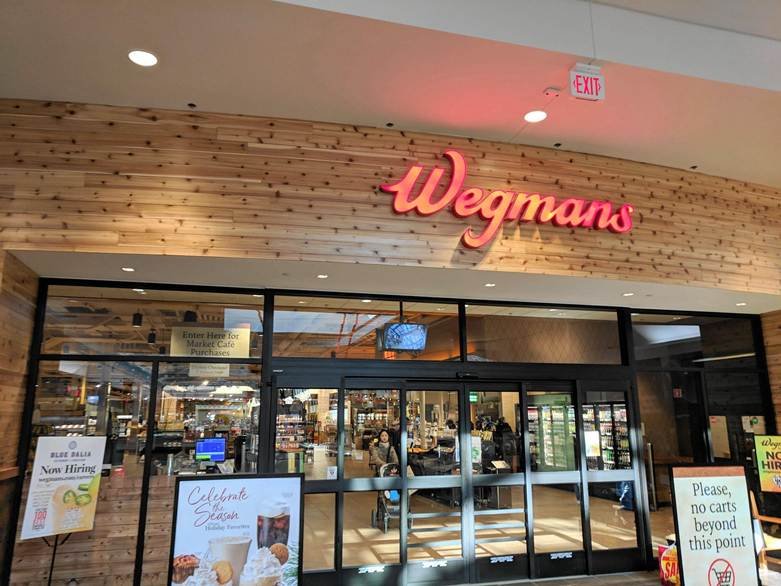
The cameras that Wegmans uses come from a Swedish company called Axis Communications, which has contracted with the Department of War (DoW) and actively works with law enforcement. Wegmans, however, has declined to disclose the software-end of their system.
The Investigative Post was told by a Wegmans spokesperson that: “[…] in-store cameras ‘are simply getting video of our stores’ and said the company does not use AI camera programs to track customers.” The Post also noted that“[t]he company privacy policy, however, states Wegmans ‘collect[s] information about you in a number of ways’ including ‘through in- store technology, such as … video cameras.’”
The statement Wegmans released in response to the controversy further compounded its contradictory statements, as the company had previously stated that “the system collects facial recognition data.” Furthermore, Wegmans claimed that “[p]ersons of interest are determined by our asset protection team based on incidents occurring on our property and on a case-by-case basis, on information from law enforcement for criminal or missing persons cases.”
Thus, if AI programs are not being used to track customers, then how is Wegmans collecting facial recognition data on its customers and linking that data to previous incidents where individuals were “flagged for misconduct,” as well as to the information they receive from law enforcement?
Furthermore, an examination into the law that required the popular chain to post the signage disclosing their biometric data collection brings to light further inconsistencies in Wegmans’ public remarks. N.Y.C. Administrative Code § 22-1204 (Local Law 2021/003) states that a business is exempt from disclosing collection, use, and retention of biometric identifier information if:
“the images or videos collected are not analyzed by software or applications that identify, or that assist with the identification of, individuals based on physiological or biological characteristics [and . . .] the images or video are not shared with, sold or leased to third-parties other than law enforcement agencies.”
Therefore, the mere act of disclosing their use of the technology strongly suggests that they are engaged in either one of these practices.
Wegmans, in their statement, however, explains that they “do not share facial recognition scan data with any third party.” However, their privacy policy counters this by stating that the “security information” they collect, which includes facial recognition data, “is only accessible to a limited number of Wegmans employees, third-party service providers, and/or law enforcement…”
The contradictions here amalgamate into something deeply concerning. It appears that Wegmans is obfuscating the press’s inquiries into the totality of its digital surveillance infrastructure, likely to avoid disclosing the software being used to collect, analyze and share the biometric data it is collecting on its customers. Why?
Perhaps their reticence to comment on whether they share biometric data with ICE — which is increasingly becoming an unaccountable, biometric-surveillance-powered police force — illuminates their motive. As reports continue to emerge of ICE utilizing invasive apps developed by the CIA-funded company Palantir to make its arrests, and as Americans’ disapproval of the deportation authorities skyrockets, the unveiling of such a collaboration would thrust the company into an even worse P.R. crisis.
Shareholders of Home Depot, for example, are pressuring the company to “evaluate and report the risks associated with sharing data with third-party surveillance vendors” after it was revealed that that Flock Safety, a surveillance company with whom Home Depot partners, was giving federal officers “side-door access” to its trove of license plate data for immigration-related investigations.
Flock Safety’s entanglement with ICE is particularly worth noting. Even though ICE does not directly contract with Flock, “the agency sources data from Flock’s cameras by making requests to local law enforcement.” Such an arrangement is indicative of the hall of mirrors that sensitive data enters when it is obtained by private companies — bouncing across the public and private sector with ease and little transparency.
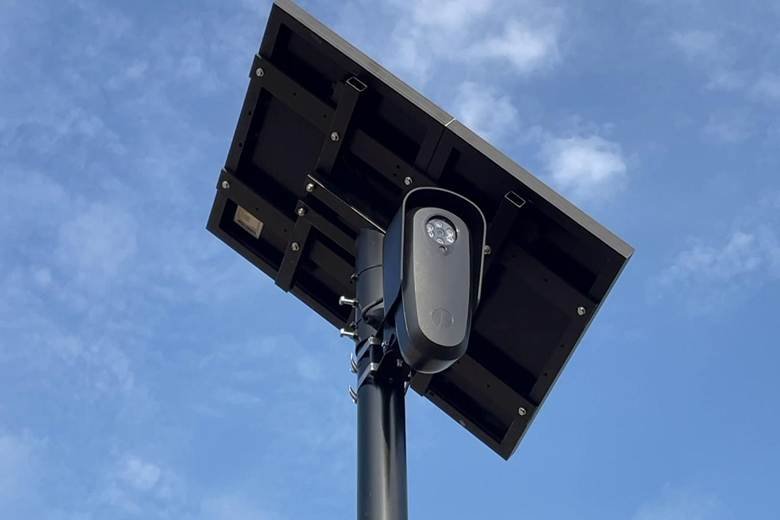
Though Wegmans seems intent on hiding the software it uses for its biometric surveillance – an author of this article asked customer service employees at the Manhattan location to disclose this information, and was quickly referred to corporate, where his questions received answers analogous to other coverage of the story — an inquiry into the most prominent software providers of facial recognition technology in retail/grocery stores uncovers an industry wound up in the ties between Silicon Valley and the national security state, including federal agencies such as ICE.
While Wegmans’ software provider remains unclear, its biometric surveillance policy is not an anomaly, but rather a more recent development in the expansion of public-private mass surveillance. A deeper investigation into the most prominent software providers of facial recognition technology in retail/grocery stores uncovers an industry enmeshed in the intersection between Silicon Valley and the national security state, including federal agencies such as ICE.
Silicon Valley, in conjunction with the Intelligence Community and the Pentagon, have constructed the pillars of our digital ecosystem — the roots of which can be found all the way back in Pentagon projects of counterinsurgency from the Cold War, and now in the expansion of ICE. As the origins and connections of the proceeding companies make clear, facial recognition technology is only one of the more recent — and technologically advanced — iterations of this apparatus’ inventions of control.
Situated in the private sector, however, the surveillance applications of facial recognition have also been used to serve the direct business interests of the tech companies’ clients. Deployed as part of the profit-building agendas of massive retail and grocery corporations, this technology is thus utilized for multiple purposes — both as a weapon of the security state, and as a dystopian tool of profit extraction for corporate behemoths.
These uses, however, are not isolated from one another. In the pursuit of each, by deploying this technology for different intents and purposes, both the corporate and public sectors shore up their respective power and ability to further the class interests of the American oligarchy, which dominates American politics. This is most clearly demonstrated by the official partnerships and agreements between these sectors which, though the details of their activities remain scant, are a window into the structural enmeshment of these ostensibly isolated entities.
To begin to grasp the structural functions of this network, an understanding of the way in which this technology has been deployed in the private sector is necessary. The first section of this article will detail these uses. This exploration will inevitably entangle the public sector into the mix, as a major function of corporate surveillance technology involves collaboration with the U.S. government, its security agencies and law enforcement. From there, this article will recount the origins of two specific companies — Clearview AI and Oosto — to further demonstrate this point, and also reveal some of the specific political milieus within American politics that have accumulated significant surveillance capabilities by hitching their wagons to the ever-expanding partnership between the national security state — what the late academic Michael Parenti described as a “mostly secret unit of misgovernment that is capable of the most unspeakable crimes, crimes that are perpetrated against people all around the world and dissidents at home” — and its private sector collaborators.
What is uncovered is a seemingly inescapable panopticon that is dedicated, not to the vague promises of “security” that its owners promise through press releases and media comments, but to hyper-capitalist power from every angle — from maximizing profits to criminalizing anyone who challenges their right to rule.
What is Grocery/Retail Surveillance?
Ultimately, facial recognition technology is aimed at building sophisticated profiles of individuals — profiles that, with faces attached to them, can provide an ostensibly undeniable link between data-driven insights and particular people. In other words, it acts as a tool of intelligence gathering, capable of putting a face to — not the name — but the data. From there, the ways in which the owners of this intelligence may utilize this data are seemingly limitless. Almost all of these uses, however, are dedicated to furthering the class interests of those deploying it, as well as those creating it (since the two parties, customer and vendor, are dependent on each other in this scenario for different reasons).
Last month, WIRED published a chilling exposé into the surveillance operations headed by the owner of Madison Square Garden (MSG), James Dolan, and his head of security, John Eversole. The story demonstrates one particular way facial recognition technology (FRT) shores up the power of those able to access its vast digital eyes; it can be used to identify agitators, perceived delinquents and political enemies of the technology owners. From there, after identification via FRT, these subjects can be handled accordingly.
The rampant and unabashed private surveillance apparatus being run out of Dolan’s multiple stadium empire has targeted cheeky fans, former players, celebrity super fans as well as litigators deemed hostile to MSG and whom Dolan has placed on his “legal” blacklist. The new exposé, however, gives readers a closer peek through the curtain shielding MSG’s executive offices — revealing that Dolan has effectively constructed a rogue, privately owned intelligence agency within MSG. WIRED referred to this as Dolan’s “own deep state.”
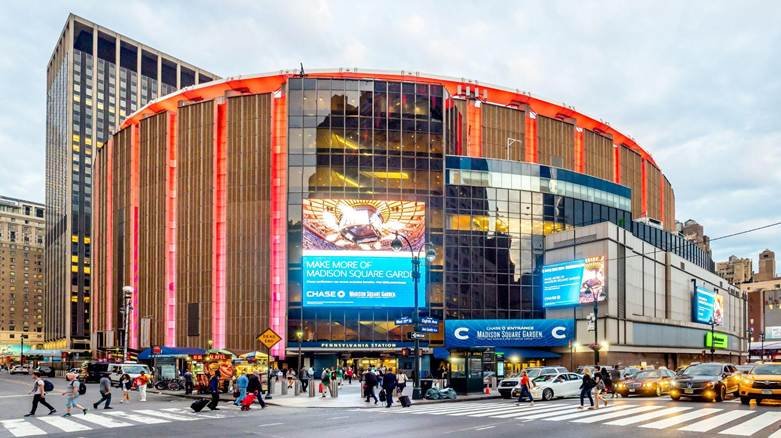
Beyond surveilling perceived adversaries of Dolan at the stadiums themselves, the CEO’s mini-intelligence agency allegedly enacted spying operations aimed at enemies outside of his stadiums, for purposes ranging from the collection of blackmail to keeping tabs on potentially litigious adversaries.
FRT played an undeniably important role in the covert operations of this private intelligence agency. Beyond allowing Dolan to enforce his blacklist by detecting enemy lawyers upon their entering MSG, it also enabled them to track persons of interest as they moved through the stadium. WIRED uncovered a telling example, utilizing inside sources and court documents, in which extremely detailed tabs were kept on a transgender woman with a prominent social media following named Nina Richards (alias) as she navigated the stadium.
The surveillance team kept minute by minute tabs of her every activity, attempting to constrict her movements to ensure that she didn’t interact with players despite the fact that she posed “no threat,” according to Donnie Ingrasselino, a disgruntled former security staffer of MSG whose lawsuit against Dolan is heavily cited in the WIRED exposé.
Eversole, the head of security, saw her as a different kind of threat—one who, solely by existing and enjoying the services of MSG, could “damage MSG’s reputation” because she was an “openly” transgender woman. His concern continued to fuel the surveillance campaign, and eventually accumulated in the banishment of Richards from the Garden. WIRED noted that, according to Ingrasselino’s suit, “Mr. Eversole [f]abricated a stalking allegation to justify banning.”
Furthermore, it seems that the effects of quelling Richards’ presence went beyond her removal from stadium grounds. According to WIRED, “Richards used to have an active, vibrant presence online. Today, Richards has functionally erased herself from the internet. Her 44,000-follower Instagram account has been nuked.”
This anecdote mirrors another noted in the WIRED exposé. When Donnie Ingrasselino was seeking out a lawyer to pursue his lawsuit against MSG, three firms refused to represent him “because they were not willing to subject their firm to the ‘lawyer ban,’” he alleged in a court document. “In other words,” WIRED notes, “Dolan’s face-recognition tech had the effect of serving as a proactive deterrent, a warning shot for lawyers and disgruntled employees not to fuck with him.”
These two incidents — along with others — illustrate how Dolan’s mini surveillance empire reinforces MSG’s status through forceful coercion. Utilized in this fashion, FRT becomes a weapon of intimidation and a tool to manufacture pretexts for the punishment of enemies.
WIRED importantly notes, however, that Dolan’s indulgence in corporate espionage is not anomalous, but “a model” of private surveillance operations at large. While the outwardly hostile and offensive tinge of Dolan’s surveillance team is not the most common style employed by corporate entities, the baseline tactics of MSG — most notably, using facial recognition technology to compile privately owned lists of customers and suspected “terrorists” or agitators — are utilized throughout the corporate and retail sectors.
Target, for example, runs a crime lab that is so sophisticated it helps solve cases for police departments and the Federal Bureau of Intelligence (FBI). It is called “Target Forensic Services,” and was started by the company to combat shoplifting — a problem that results in billions of dollars in lost revenue annually for U.S. retailers, who have enjoyed immense growth this century as wealth inequality has hit its widest gap in more than three decades.
In 2008, the lab had already worked with at least 136 police departments, the FBI and the US Bureau of Alcohol, Tobacco & Firearms (ATF).
Beyond solving murder cases for public agencies, it “can hack cell phones,” and utilizes devices that can “keep cell phone data from being erased so that Target investigators can mine that information, including audio and text messages, images and telephone logs, from cell phones that are turned over to them by police.” Infringing on the civil liberties of its customers, Target appears to believe, is a necessary step in its battle against shoplifters.
Target’s forensics department began in 2003 with the hiring of experts such as Brent Pack, “a former criminal investigator with the US Army who had retrieved and analyzed evidence in the abuse of detainees at the Abu Ghraib prison in Baghdad.” The current director is Rick Lautenbach who, according to his LinkedIn, formerly worked in Military Police for the US Army.
These state connections are not unique. Like Dolan’s operation — which is composed of “Veterans of the FBI, CIA, DEA, and NYPD” and is led by John Eversole, a former US Marine and Army warrant officer who previously held senior positions at the CIA-created intelligence contractor Oracle — these surveillance structures are closely linked to the world of national security and shadow governance.
Protestors that disrupted Target’s daily operations during the Minnesota ICE raids earlier this year were vaguely clued into this reality, as detailed in an article by The Guardian. Enraged at Target’s silence in response to ICE forcefully detaining two Target employees, they “planted themselves in the atrium of the store” and chanted “Something ’bout this isn’t right – why does Target work for ICE?”
The activists’ chant, though catchy and potent, appears hyperbolic. Target opting to not comment on the abuse of its workers by ICE agents does not actually mean the company works for ICE. It turns out, however, that a much closer relationship between Target and the deportation authorities does indeed exist. The string that ties them together reveals not just Target being linked to America’s domestic security apparatus, but multitudes of major retailers and grocers.
Take, for example, the public-private partnership program called the Retail and Hospitality Information Sharing and Analysis Center (RH-ISAC). ISACs are Department of Homeland Security (DHS) information sharing initiatives. According to a Government Accountability Office report, ISAC partners participate in “information sharing exercises—including regularly scheduled daily or biweekly meetings.” As a core member of RH-ISAC, it is thus highly likely that Target is much more involved in the operations of ICE — a DHS agency — than the Guardian article that reported on the Minnesotan protests detailed.
Indeed, another partner of RH-ISAC includes the FBI, which Target already has a history of working with. It also partners with the Secret Service, the Office of the Director of National Intelligence, Cybersecurity & Infrastructure Security Agency and the National Cyber Security Center.
Furthermore, a huge amount of other retailers are likely involved in similar collaborative measures as core members of RH-ISAC, including Albertsons, Costco, Cracker Barrel, CVS, Darden (the parent company of restaurants like Olive Garden and Red Lobster), Dollar Tree, Fareway, Gap, Home Depot, JCPenney, Kroger, Lowe’s, Starbucks, Wendy’s and more.
The actual functions of this near industry-wide public-private partnership can be partially discerned by RH-ISAC’s participation in the DHS Cyber Information Sharing and Collaboration Program (CISCP), the agency’s most important program for “public-private information sharing” in which “DHS and participating companies share information about cyber threats, incidents, and vulnerabilities.”
This collaboration works both to reinforce the state’s ability to expand its surveillance capabilities, allowing it to more effectively pacify enemies of American financial power, and also to expand the abilities of private corporations to engage in their own intelligence operations (be they profit-focused or security-focused). DHS neatly explains the interconnected nature of this alliance on its website:
“Information shared via CISCP allows all participants to better secure their own networks and helps support the shared security of CISCP partners. Further, CISCP provides a collaborative environment where analysts learn from each other to better understand emerging cybersecurity risks and effective defenses.”
Indeed, every April leaders of cybersecurity and partner organizations gather at the annual RH-ISAC summit to participate in “sessions delivered by prominent thought leaders and experts, along with collaborative workshops, cybersecurity exercises, and exceptional networking opportunities.”
Despite this collaboration with government security services, much of this technology’s usage is still situated in the private sector. When put to use by profit-driven corporations, surveillance technology is not only deployed to make lists of suspected criminals and petty thieves. In fact, it is primarily used to compile lists on an entirely different segment of the population: consumers.
This has manifested itself most notoriously in the practice of “surveillance pricing,” a method that utilizes the collection of maximal amounts of data on both individuals and retail/grocery locations to find the “optimal” price point for any given product. The goal is clearly to maximize profit extraction per customer.
Surveillance pricing is usually launched as a honeypot, designed to lure customers into a surveillance trap. Corporations launch loyalty programs, often in the form of online apps, replete with personalized profiles that contain special discounts and perks, enticing customers to join. Often, all they must do to acquire these dividends is surrender their personal information to the corporation. Many don’t think twice.
In reality, however, these digital cost-saving schemes are effectively fronts for a more sinister agenda. As More Perfect Union revealed in collaboration with Consumer Reports, this surveillance is conducted in order to gather behavioral data on consumers, determining how they shop in order to most optimally price items for maximum profit extraction.
Even Kirat Anand, former VP of Pricing at Walmart, admitted that “[m]erchants, pricing teams, they all rely on technology and algorithms to safeguard their profits.” Indeed, there is an entire industry “built around optimizing grocery prices.”
A patent owned by grocery delivery company Instacart reviewed by More Perfect Union and Consumer Reports clues us into the deeper objectives of these supposed loyalty programs. While surveillance pricing utilizes methods such as “personalized pricing,” which uses behavioral data to set different prices for individuals, and “dynamic or surge pricing,” which uses “non-customer-specific variables to change prices” during specific events like “rainy weather, last-minute flight prices increasing, [etc.],” the patent suggested a system of corporate profiteering.
As More Perfect Union asked, “Would you rather charge $10 for a bottle of water during a single hurricane? Or 20 cents more every day?”
The patent “described an infrastructure for constant in-store price testing. Take dozens of stores, cluster them together, test different prices in different clusters. The purpose? Find out the most profitable price point.”
While Instacart denied that they utilize this price optimization infrastructure, More Perfect Union found it listed as a feature on their website. After More Perfect Union asked if Instacart uses the feature, the company took it off their site. Subsequent evidence documented in their report strongly suggests that Instacart indeed was utilizing these methods despite their denial.
While this larger system of price optimization is geared towards organizing individual data into collective trends, the individual profiling of customers is still an indispensable node within this broader system of surveillance-driven profiteering. The implications are grave for the protection of individual civil liberties against giant corporations and their government collaborators.
For example, grocery giant Kroger utilizes electronic shelf labels (ESL) to change prices in real time from an app. They have also partnered with Microsoft to install facial recognition technology throughout their stores — sparking concern from outlets like The Nation that companies like Kroger could combine FRT with ESL pricing to adjust prices based on people’s faces. While Kroger denied these insinuations, the prospect is not unthinkable.
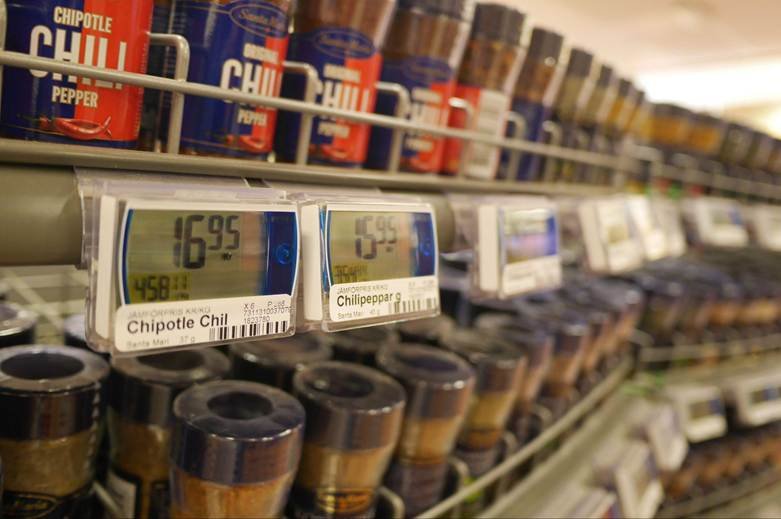
Yet, what Kroger has admitted to doing with this technology is equally disturbing, and still ultimately aimed at using surveillance to increase the amount of money spent by each customer. In its press release, it described the “EDGE shelf” as enabling “Kroger to generate new revenue by selling digital advertising space to consumer packaged goods (CPGs) brands. Using video analytics, personalized offers and advertisements can be presented based on customer demographics” (emphasis added).
According to reporting from business magazine Fast Company:
“The digital displays will be placed with special product offers at the ends of aisles. A camera at each display will determine through facial recognition AI the gender and age of the shopper passing by. If the person has not already opted in through the Kroger app, the display will show ads or coupons based only on age and gender and will use no personally identifiable information for targeting, Microsoft says. However, if the shopper has opted in, the displays may do some truly Minority Report-style customization. When the shopper comes into the vicinity of the display, they may see or hear something like, ‘Hello Mr. Sullivan, would you like to buy some more of the Pepsi you got last weekend?’”
The possibility that this data will seep into public sector data pools or into the data troves of other companies once it is acquired by Kroger and its subsidiaries should not be lost on anyone. This is especially true considering that Kroger is a core member of RH-ISAC — making it an open collaborator with U.S. intelligence and law enforcement — and Microsoft contracts directly with ICE, powering its surveillance infrastructure, as well as with the Pentagon, the CIA and the General Services Administration (GSA) as part of the Trump administration’s effort to “advance AI adoption across the Federal government.»
From all angles, the entire American retail and grocery industry is exercising the power granted to it by surveillance technology, profiling its customers to increase its ever-expanding profits and build out the ubiquity of the panopticon powered by Big Tech and the national security state. The technology, in other words, is not separate from political power but a tool of it, both within the confines of corporate empires as well as the grander borders of America’s domestic and foreign policy objectives.
The revolving door between the national security state and the private sector detailed in the next section make this claim evident. By examining the origins of the most prominent FRT companies, the line between the state and the private sector becomes so blurred that it elucidates the actual function of this technology, as well as the ostensibly independent industries wound up in its development and usage. All are vessels of oligarchic power, working to construct a surveillance system that empowers the wealthy and marginalizes its opponents by rendering their civil liberties obsolete.
The most telling example is the history of a company with deep ties to the current presidential administration, and underpinned by many of the same financial power brokers and Trump-adjacent media propagandists.
Clearview AI
In March of 2020, The New York Times reported a story about John Catsimatidis, the heavy-set and droopy-faced billionaire owner of the Gristedes grocery chain, spying on his daughter at an Italian restaurant in Manhattan. The story, presented as a playful father and daughter moment, involved Catsimatidis asking a waiter to go over to his daughter’s table and take a picture of her date.
“I wanted to make sure he wasn’t a charlatan,” Catsimatidis said. He scanned the picture of the man’s face through an app — available only to those who’ve been granted access by the company — and found that his daughter’s suitor was a venture capitalist from San Francisco. The app Catsimatidis had used was Clearview AI — a surveillance product powered by facial recognition technology as well as a vast database of over 70 billion images scoured from public web sources “including news media, mugshot websites, public social media, and other open sources.”
This playful spying, in reality, is a microcosm of how Clearview is often used. Its tools are often employed unofficially and unannounced by the powerful institutions and individuals who have been granted access to the company’s software, resulting in persistent rogue and unchecked usage.
It also demonstrates the regulatory environment (or lack thereof) in which products like Clearview exist; currently, facial recognition technology is entirely unregulated at the federal level, its vast power only sparsely held back by minimal state-level restrictions. As a result, the limits on the ways in which facial recognition technology is deployed bears almost no limits, and requires no transparency.
Indeed, the only reason we know of Catsimatidis’ personal usage of Clearview, as well his grocery chain using it to identify “shoplifters or people who had held up other stores,” is because the billionaire himself told the Times. The only reason we know that Clearview has been deployed by a myriad of grocery chains, retail stores, federal agencies and police departments is because of a leaked tranche of documents reported on by Buzzfeed in 2020.
While Clearview advertises itself as being a tool of law enforcement and government agencies, its usage in Gristedes was not a one-off; its tech was significantly piloted in the private sector. In Buzzfeed’s investigation, they found that a myriad of retail and grocery stores had utilized the technology.
Walmart had nearly 300 searches in the ever growing annals of Clearview’s database, Best Buy had more than 200, grocer Albertsons had more than 40, and Rite Aid had about 35 searches. Kohl’s and Macy’s combined carried out nearly 10,000 searches. Buzzfeed also found that Madison Square Garden, EventBrite, Las Vegas Sands, Pechanga Resort Casino, the NBA, Equinox and Coinbase were among the private companies that composed Clearview’s client list, though some of these companies, like the NBA and Madison Square Garden (MSG), told Buzzfeed that they had only utilized Clearview via a trial period.
Two years after this claim, however, The New York Times reported on Dolan’s aforementioned use of FRT to enforce his “attorney exclusion list.” This resulted in a personal injury lawyer from Bergen County, N.J. being barred from seeing the Rockettes at Radio City Music Hall and another attorney from her firm being denied entry to a New York Rangers game at Madison Square Garden.
A lack of an official partnership with Clearview, however, does not indicate whether an institution utilizes its software or not. Buzzfeed found that police departments, schools and government agencies have utilized the technology without any formal agreement between parties. This has created a company culture in which, at times, employees of institutions may be utilizing Clearview, while the institutions themselves “have no idea the tool is being used…”
The dynamic works to shield Clearview and these institutions from transparency, sewing a veil of secrecy that obfuscates inquiry into the depth of Clearview’s role in their surveillance infrastructure. Professor Nolan Higdon, co-author of Surveillance Education, told Unlimited Hangout that this is not an anomaly exclusively applicable to Clearview, but rather “a pathology of the industry” resulting from “the lack of legislation to say where expectations of privacy should exist.”
Yet, the rogue and unofficial usage of Clearview by institutional actors is not only concerning for the threats it poses to civil liberties and privacy, but because the company is deeply tied to the American national security state. Clearview’s links to the American Empire’s covert governance are most pronounced through its longstanding relationship with Immigration and Customs Enforcement (ICE). Dating back to the company’s origins, when it was still called Smartcheckr, ICE was always one of its main intended clients.
According to Mother Jones, in 2017, Clearview’s founder, the self-proclaimed descendant of Vietnamese royalty, Hon Ton-That, “envisioned using facial recognition to compare images of migrants crossing the border to mugshots to see if the arrivals had been previously arrested in the United States.” He proposed screening migrants for “sentiment about the USA,” which he reportedly conflated with support for Donald Trump, as part of his larger effort to build “algorithms to ID all the illegal immigrants for the deportation squads.”
The blatantly fascistic proposals of Ton-That were out of the ordinary at the time for an up and coming Big Tech player — during this period, the industry had fostered an aesthetic of liberalism, concerning itself with “hate speech” and “misinformation,” eventually resulting in the banishment of President Donald Trump from most social media platforms. But Ton-That, on the other hand, was ingrained in an alt-right, neo-Nazi milieu that has since emerged as the most prominent private sector coterie of businessmen and thinkers in the age of Trump 2.0.
In 2015, according to Mother Jones, he was communicating online with far-right activists such as Milo Yiannopoulos, Mike Cernovich and formerly open neo-Nazi Andrew “weev” Aurenheimer, who has a swastika tattoo inked across his left breast. In these radical surroundings he discovered the neoreactionary movement — an “intellectual” framework characterized by an embrace of dictatorship via corporate governance, spearheaded most notoriously by the Peter Thiel-linked Curtis Yarvin. During this period, a friendly relationship between Yarvin and Ton-That reportedly blossomed — bringing Ton-That closer into the orbit of Thiel-funded alt-right proxies.
This continued in 2016, when he met federal informant and Thiel-ally Chuck Johnson (who is also an advocate for pardoning convicted sex trafficker Ghislaine Maxwell). Johnson soon introduced Ton-That to Thiel at the Republican National Convention. That year, Johnson also introduced Ton-That to Richard Schwartz, a former top aide to Rudy Giuliani, at the Manhattan Institute for Policy Research, the conservative think tank founded by former CIA director William Casey. Soon after, Ton-That, Schwartz and Johnson launched the company that would become Clearview — Smartcheckr — with seed money from Peter Thiel’s venture capital firm Founder’s Fund.
A cadre of white supremacists and eugenicists, as Mother Jones reported, went on to fill the ranks of Smartcheckr.
The political origins of Clearview cast a looming shadow on the company’s extensive relationship with ICE. By 2020, the agency had already engaged in thousands of searches, including as a component of its Enforcement and Removal Operations (ERO) — the sect of ICE responsible for the detainment and deportation of undocumented immigrants.
While in 2020, ICE attempted to distance itself from the technology by telling Buzzfeed that ICE ERO officers only “occasionally used the technology…on human trafficking investigations,” ICE in the age of Trump 2.0 acts unabashedly by comparison; it openly uses its own facial recognition app called Fortify to scan its subjects, including American citizens who film deportation officers. From there, those scanned can be entered into any number of over a dozen databases, and may be flagged as a “domestic terrorist,” according to two senior national security officials who spoke to reporter Ken Klippenstein.
This political environment is perfect for Clearview’s business model.
Indeed, privately developed technological surveillance has fueled Trump’s surveillance-driven deportation agenda. A slew of reports from 404 Media have revealed a significant expansion of contracts with the Thiel-founded Palantir since Trump took office, including building the agency a master database and sophisticated tools to track down targets by collating digital data points from a seemingly endless array of sources.
While Clearview is directly involved in this surveillance infrastructure construction, to what degree and extent remains obscured by the haze of government classification and the vague nature of government-corporate press releases. Contracts the company has scored in recent months elucidate important dynamics of the company’s role in current ICE operations, however. In February, Customs and Border Protection (CBP) contracted with Clearview for a year of access to the surveillance tech company’s database — this is on top of the $9 million contract it secured with ICE last fall to, in part, “support cases involving assaults on law enforcement officers.”
These recent contracts raise the question of whether Clearview, whose database has in part been built up via its expansive client list in the retail and grocery sectors, is helping power ICE’s facial recognition app Fortify along with Palantir. When asked whether or not Clearview played a role in helping develop Fortify, ICE and CBP did not respond to a request for comment. If Clearview has been used towards this end, however, it would only be the realization of Ton-That’s initial vision for the company.
Indeed, this prospect only becomes more likely — though still speculative — when considering that Thiel, Clearview’s initial backer, is extensively tied to the current presidential administration, as Unlimited Hangout and other outlets have documented extensively (see here, here, here, and here).
Furthermore, some of Ton-That’s friends that he made early on in his path to radicalization, such as Mike Cernovich and Milo Yiannopoulos, who helped churn this right wing radicalism into reality, are tied to Thiel as well. These figures have, importantly, become some of the most viral proponents of The Great Replacement Theory — the idea that there is a slow motion genocide of the white race through unfettered mass immigration — on the Elon Musk-owned X, seeding a pretext for Trump’s racist domestic securitization agenda — and by extent, the use of Clearview’s “product,” and the surveillance technology owned by Thiel — by stoking fear on the social media platform. These very figures have reportedly been bankrolled by Peter Thiel via his longtime associate Jeff Giesea — The Sparrow Project was told as much by an anonymous source, and the account was partially corroborated by a subsequent Buzzfeed report that discovered Thiel had hosted Cernovich and Yiannopoulos for dinner at his house back in 2016.
Elon Musk’s own ties to Thiel are especially worth noting in this context. While heading the Department of Government Efficiency (DOGE), Musk, who was deeply involved in the founding of PayPal with Peter Thiel and is a major U.S. security contractor, installed multiple Palantir employees in prominent positions at government agencies and also recruited Palantir to build a “mega-API” for the IRS. DOGE as an operation was thus critical to stacking the Trump administration with officials directly linked to Thiel. It also helped to make government data “interoperable,” or, more simply, making computers spread across different institutions “talk to each other.” Palantir, whose software acts as a window into giant datasets, is a major advocate for data interoperability, which it describes as “Connect[ing] your systems and operations to drive automation across the enterprise.”
All of this implies that Clearview may be one within a complex of companies that have coordinated their efforts to expand the power of the national security state, and position a particular faction within it extremely close to the most influential centers of government in the U.S. Whether or not this is true, this inter-institutional enmeshment is a unique attribute of Silicon Valley’s newfound dominance of the military-industrial-complex. In addition to producing the technological infrastructure that the state depends on for its military expansionism and domestic counterinsurgency, Silicon Valley also directly controls much of the world’s knowledge production through social media and algorithmic ownership. Thus, this web of Thiel-linked influencers and defense contractors were integral to Clearview’s rise — and now, its increasing success.
Clearview’s new co-CEO Hal Lambert “is already in business with both Elon Musk’s SpaceX and the Department of Defense through a separate satellite company,” positioning the startup at arms length from other lucrative contracts in America’s security industry. Indeed, the company has long positioned itself as a prospective candidate to enjoy the spoils of the war economy. For instance, in 2022, it supplied Ukraine’s American-funded defense ministry with free use of its technology to “uncover Russian assailants, combat misinformation and identify the dead.”
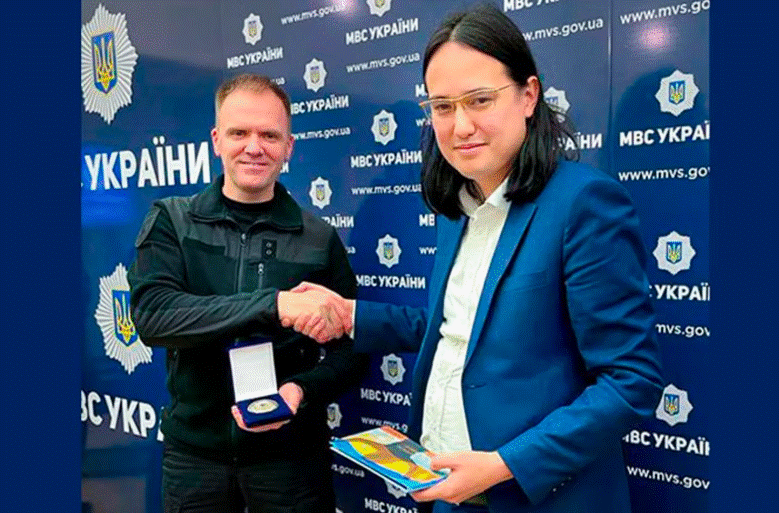
Clearview AI CEO Hoan Ton-That with Leonid Tymchenko, Deputy Minister of the Ministry of Internal Affairs of Ukraine — Source
Furthermore, while the company has come to embrace its relationship with ICE, it also contracts with elements of the federal government less amenable to the MAGA base. The Department of Justice, the FBI and the Army have all made use of Clearview’s technology. Perhaps most revealingly, it was utilized by police departments to crack down on participants of the January 6 riots that protested the 202o election results. The persecution of these people notoriously infringed significantly on their civil liberties, including by holding some for years in solitary confinement as part of pretrial detention, despite the fact that “the vast majority of those caught up in the incursion of the Capitol did not commit serious crimes, engage in violence or know what they would do in Washington other than protest the election results.”
This bipartisan deployment of Clearview is evidence that the technology and its owners are not loyal to one political party or the other. Instead, their product is a weapon of oligarchic power and a tool of counterinsurgency, aimed at criminalizing populations to justify the expansion of the public-private surveillance panopticon.
Clearview’s history, and its central role in the buildup of the government’s domestic surveillance machine, make it a clear example of a facial recognition firm whose product is not separate from imperialist power, but entirely enmeshed within it. Yet, these ties are anything but anomalous; they are symptomatic of the facial recognition industry at large, and exemplify the ethos of the types of companies retail corporations contract to spy on their customers.
Oosto
In 2011, the idea for a company that came to be known as AnyVision took shape when an Israeli businessman and a British professor/defense executive began working on a facial recognition project.
The British professor, Neil Robertson, had started his career at the UK Ministry of Defense’s Defense and Evaluation Research Agency (DERA), a conglomeration of military technological research centers, shortly before its assets were balkanized and a majority of them were incorporated into an entity called QinetiQ. In 2002, the Carlyle Group purchased a significant stake in QinetiQ, and the company became a public-private partnership. By this point, Robertson had a position at the company, familiarizing the professor with the profitable opportunities that are situated at the intersection of the public and private sectors of the defense industry.
The Israeli that approached Robertson was named Eylon Etshtein, a scruffy-faced “serial entrepreneur” who previously served in a commando recon unit of the Israel Defense Forces (IDF), according to Crunchbase. Robertson, his colleague and Etshtein soon formed a “very strong working relationship,” and, according to Robertson, “the rest [was] history.”
They soon bestowed a name upon their facial recognition product — “Better Tomorrow.” It was named this because, in Eylon’s words, its creators “actually want[ed] a better tomorrow.”
In reality, however, AnyVision, similar to the aforementioned British company QinetiQ, was likely the product of a concerted effort to transition government intelligence work into the private sector. Though conceived in 2011, the company was founded in 2015, just three years after it became official Israeli government policy to transfer “cyber-related and intelligence projects that were previously carried out in-house in the Israeli military and Israel’s main intelligence arms” to private front companies.
Indeed, beyond Etshtein — who just recently gave a talk to Israeli Special Forces soldiers on “step[ping] into civilian life after finishing their service” — much of the company’s leadership boasted prestigious positions within the world of Israeli intelligence. It counted among its advisory board members Tamir Pardo, the former head of Mossad. The company’s president, Amir Kain, was the head of the Israeli Defense Ministry’s security department for eight years up until AnyVision’s founding. In 2019, NBC found that several employees did their Israeli military service at the “elite cyberspy agency Unit 8200, equivalent to the NSA or the United Kingdom’s GCHQ.”
The startup secured funding from the Bill Gates-founded Microsoft, a company that has long advertised itself as committed to protecting democratic rights and, via Gates, is associated with the ostensibly humanitarian philanthropic endeavors of the massively endowed Gates Foundation. Yet NBC found that, contrary to upholding democracy, AnyVision’s technology was actually powering a “secret military surveillance project” throughout Palestine’s occupied West Bank.
The secret project’s nickname, then, appeared to more accurately reflect Better Tomorrow’s use than its Orwellian advertising. It was reportedly called “Google Ayosh” in Israel — “Ayosh” being a Hebrew acronym for the land of Judea and Samaria, and “Google” alluding to the software’s capacity to “search for people.”
The tech’s surveillance powers were expansive; it allowed users to “identify individuals and objects in any live camera feed, such as a security camera or a smartphone, and then track targets as they move between different feeds.” It proved so effective that the Israeli Ministry of Defense awarded it with “its top defense prize” in 2018. According to NBC, Israel’s defense minister praised the startup during the presentation for “preventing ‘hundreds of terror attacks’ using ‘large amounts of data.’”
NBC’s exposé engulfed the company in controversy, damaging its reputation to such a degree that Microsoft withdrew its investment in 2019. This pressured its leadership into a 2021 rebrand for the startup. The company was renamed “Oosto” and began a collaboration with Carnegie Mellon University’s CyLab Biometric Research Center.
The year prior, in 2020, Macy’s got hit with a class action lawsuit after a Chicago woman alleged that the retail store was violating Illinois’ biometric privacy law by sending “pictures of customers captured by store video surveillance to Clearview to identify them and obtain their personal information” and “actively profiting” from doing so (emphasis added).
While Macy’s never publicly admitted it was using Clearview, or announced that it had stopped using their services, presumably sometime in between that lawsuit and now, under ostensible public pressure from the negative P.R., the retail store adopted Oosto as a client — switching its facial recognition capacities from one military- industrial- complex-linked outfit to another (or, potentially, retaining the services of both).
Furthermore, while the litigation concluded in a settlement in which Clearview agreed to pay out $51.75 million, the suit’s conclusion “preserv[ed] Clearview’s business model” and “insulat[ed] Clearview from subsequent or parallel regulatory investigations without requiring the company to jeopardize the liquidity necessary for continued growth,” according to Regulatory Oversight. Professor Higdon said deals like these are par for the course in the surveillance tech industry. He claimed that these kinds of fees that data barons are often forced to pay out are inexpensive in the grand scheme of their business models. “Data keeps some value forever,” he said, “so a small fine here or there for collecting data is irrelevant, and that’s general in the entire industry.”
Macy’s is only one of the corporate entities counted amongst Oosto’s client list; Deloitte, Morgan Stanley, Ford, and Verizon all utilize the company’s apartheid-tested technology, according to a report from Biometric Update. Other clients or partners listed on their website include Honeywell, NVIDIA, the New Orleans Saints and the Santa Fe Independent School District.
In 2025, Oosto was purchased by the American AI-based parking lot operator Metropolis Technologies after investors “[threw] in the towel,” “replac[ed] the management” and fired “more than half the employees.” The once-hyped company was sold off for $125 million — not even turning a profit— because of its pathetic generation of only $10 million in annual revenue despite it having raised more than $350 million from investors.
Despite the firing of its original leadership and the relocation of its main office to New York, the company is still closely tied to Israel. Nikunj Mistry, Oosto’s VP of finance, previously was the VP of finance for the American drone company Skydio — whose drones have been widely used to carry out the genocide in Gaza. The former COO of Oosto, who has a lengthy work history in Israel including as a project manager for the IDF, Michal Braverman Finkelshtein, notably began working at Metropolis almost two years before its acquisition of Oosto, according to her LinkedIn. At Metropolis, her tasks include “Business Development — Growth & Partnerships” as well as “Corporate Business — Commercial Strategy & Scale,” suggesting she may have played a role in Metropolis’ acquisition of Oosto. Metropolis responded to a request for comment on Finkelshtein’s potential role in the acquisition with a request for further information, and upon receiving a more detailed inquiry from Unlimited Hangout, did not answer our question.
Contextualized with the background of its founders and the timing of the company’s incorporation, Oosto may still be serving an ulterior function — albeit secondary or tertiary — as a vehicle for Israeli economic interests.
As the Brookings Institute has noted, because “the export basket of Israel has consistently moved towards high-technology goods…that are not easily replaceable,” and “banning Israeli goods would affect consumers in countries that currently import those goods” — a movement like the Boycott, Divestment and Sanctions Movement could be “broken before it begins.” Whether Brookings was correct in its analysis, the more companies like Oosto are utilized in the U.S., the more the U.S. and Israel become intertwined and thus, the more potent this description of the American-Israeli economic relationship becomes.
The purpose here of Israeli tech as a bulwark against targeted disruption of Israel’s financial entanglement abroad demonstrates that surveillance technology — despite being increasingly deployed in centers of civilian life — is enmeshed with imperial power. Indeed, according to Gaza Humanitarian Foundation whistleblower Anthony Aguilar, while he was overseeing the distribution of aid to Gazans during Israel’s genocidal bombardment last year, Israeli security cameras would utilize facial recognition technology to profile starving Palestinians at aid checkpoints — sometimes targeting them for assassination at later points.
Aguilar told Unlimited Hangout that, like the surveillance technology launched in the private sector, the facial recognition software used in Gaza was advertised under a benign pretense. Contractors were told that “the facial recognition and data collection was to make the distribution sites more efficient…What’s the best way to conduct site distribution? That was the benign reason we were told. [But] that wasn’t why it was being used.” In reality, he says, they were “field testing” the technology — and using it for “targeting” potential members of Hamas.
The commercial deployment of this technology, he says, draws a stark parallel. “The excuse will be a benign offering,” Aguilar told Unlimited Hangout. “But in actuality, you’re training, so all AI or artificial intelligence…refines itself through machine learning…all you have to then do is give it a simple input to get the information you want out of it, whether it’s benign or nefarious.”
Aguilar warns that enticing offers such as this technology paving the way to enhanced shopping experiences are merely a front. To him, the commercial presence of this technology is directly intertwined with its wartime usage.“It is the further implementation, and the organic progression, of the Patriot Act.”
Reinforcing Hegemony
This “dual-use” function of Western technological enterprise — that which allows its products to flow between government and corporate environments with ease — comes from a long lineage of military research that elucidates the contradictions of the ostensibly “free market” that the tech industry is situated in.
It goes back to the privatization of the internet. The person tasked with this historical mission was a military man named Stephen Wolff who worked on early iterations of the internet for the Department of Defense. Later, as Yasha Levine notes in Surveillance Valley, Wolff transferred the tech he helped develop for the Pentagon into a new structure — creating with public funds “a dozen network providers out of thin air” that were then spun off into the private sector, “building companies…that would become integral parts of the media and telecommunications conglomerates we all know and use today — Verizon, Time-Warner AT&T, Comcast” and more.
This transformation, which produced the modern Internet, embedded in civilian society a dependency on what was actually a weapon of the national security state. It would soon become ubiquitous, extending the reach of this surveillance infrastructure into virtually every sector of public life. That legacy lives on today, as the line between the public and private sectors of technological development continuously proves to be virtually nonexistent — only officially separating entities that, in reality, are intimately connected.
Facial recognition technology — whose development was funded by the U.S. government, and is rumored to have been funded by the CIA — emerged out of this very context. Indeed, beyond Clearview and Oosto, a variety of additional facial recognition firms boast their own ties to the national security state.
FaceFirst, which uses its software for “airport security, retail theft deterrence, VIP customer recognition, and counter-terrorism,” is Airborne Biometrics Group’s facial recognition product. Airborne Biometrics Group, according to Security Info Watch, was a “venture-funded spin-off” of Airborne Technologies, Inc., “a worldwide supplier of precision structural components and assemblies for military and commercial use for more than a quarter-century.” Like Clearview, the system works by linking pictures to “existing image databases” for individual identification.
Clarifai, which advertises itself to retail buyers, partners with NVIDIA and Amazon — both of whom contract with the U.S. military. Their CEO is Matthew Zeiler, a colleague of Yann LeCun, Meta’s Chief AI Scientist that was once in communication with Epstein to work on a research project nicknamed the “Epstein brain.” In 2020, the company was working on a secret Pentagon project that utilized “machine-learning algorithms to interpret drone-surveillance imagery” on a Project Maven contract. Those working on the operation, notably, were strictly prohibited from discussing the project with other employees.
Then, there is the case of the facial recognition firm Raptor Vision, which has been used at Kroger and Albertsons. Its president, Paul Gain, was the founder of the CMStat Corporation, which “delivered enterprise systems to NASA, Boeing, Lockheed Martin, General Dynamics, Rolls-Royce, and the U.S. Military,” according to Gain’s LinkedIn.
Veesion, which has been used by Key Food, Food Town and Ace Hardware, is a French company founded by Benoît Koenig, Thibault David and Damien Ménigaux. The trio were students from the graduate program at École Polytechnique, which is “supervised” by the French Ministry of Armed Forces and has partnered with Google.
Lexius, an AI-powered security software that connects to existing cameras, detects “suspicious behavior in real time, such as item concealment in aisles,” and immediately sends alerts to “security team’s mobile devices, enabling discreet, proactive responses…” The software is used by the luxury grocery store Erewhon in Beverly Hills — and has already made its leadership “addicted” to surveilling customers through the software. Lexius came to fruition with seed capital from Y Combinator, the Sam Altman- and Peter Thiel-linked startup accelerator and venture capital firm.
Though companies often pitch their facial recognition technology as commercial products — manipulatively erecting a barrier between their ostensible civilian usage and military applications — virtually the entire industry is tied to America’s security apparatus.
As ICE utilizes facial recognition technology to store the records of dissidents and perceived enemies of the state in secret databases, this technology’s function, whether situated in the toolkit of federal agents or in the security room at Wegmans, becomes even more evident. By empowering the owners of technology and their collaborators to profile average people wherever they go, the elite class is carefully studying, and exercising control over, an increasingly unsatisfied population.
While legal reforms, such as those being enacted by legislators like Shahana K. Hanif and Linda B. Rosenthal, are important battlegrounds for change, the intention of the ruling class to reinforce the conditions of their own power will certainly not dwindle. As this struggle for power persists, the Tech class and its allies will make use of the tools in its arsenal — surveilling, profiling and tracking us, and everything we do, along the way.