

In Part 1, we discussed how a group of Silicon Valley oligarchs, the self-professed “Praxians,” have seized control of the Trump administration and have aligned themselves with the “startup nation” of Israel. In my latest book, The Technocratic Dark State, I refer to the Praxians as NEONERDS, but we’ll continue to use their own moniker in this series of articles.
In Part 1, we also explored Praxian companies’ practical symbioses with Israeli SIGINT, especially Unit 8200. The evidence strongly indicates that the October 7th Hamas attack, which the Israeli Zionist Likud government cited as the justification for its genocidal destruction of Gaza, was a LIHOP false flag attack, in which an unknown number of Israelis were evidently killed—not by Hamas, but by their own military. That the attack proceeded unimpeded as it did was officially attributed primarily to SIGINT “failures.” Thus, the strong possibility exists that the Praxians participated in the extraordinary sequence of supposed SIGINT mistakes, oversights, and miscalculations that allegedly enabled Hamas to attack Southern Israel virtually unopposed.
The result of this LIHOP false flag attack was the deployment of the Praxians’ genocidal kill chains in Gaza. And now we have a larger Middle East conflagration. Not only have Israel and the US jointly attacked Iran, but the Israeli government, with Praxian kill chain assistance, is attempting to do to Lebanon what it has already done to Gaza. In Part 3, we shall see how the Praxians’ fingerprints are also observable in so-called intelligence “misjudgments” that led the US, for otherwise inexplicable reasons, to attack Iran.
Also discussed in Part 1 was how the Praxians have used their signature investment strategy—which they call “accelerationism”—to disrupt everything from markets to international relations by deploying “creative destruction” as their version of a “revolutionary tool.” Indeed, just as the Praxians’ accelerated “digital kill chain” is central to the devastation of Palestinian lives, so is it now featuring in a “new kind of war” in the Middle East.
In this article, Part 2, we will examine the many unusual aspects of the Israeli–US’ alleged “war” with Iran. Regardless of the questionable, even nonsensical, motives of the pair of aggressors, the global ramifications of the conflict are all too real. Since “Operation Epic Fury” was launched on February 28th, many lives have been lost and the world has been dramatically changed.
As we will discuss in more depth in Part 3, the interruption this conflict has caused to global energy corridors, to supply chains, to commodity and financial markets, and to international relations is supposedly forcing the world to reset everything—from national economic and security priorities to foreign policy and trade agreements. Consequently, a new international, tokenised monetary system, in which our digital identities will be fused to our programmable digital wallets and currencies, is imminent.
Through the tried-and-tested metamorphic strategy of war, we are being acceleratedtoward a new multipolar world order (MWO). Gaza is therefore destined to be the exemplar of the new web of private-sector “smart city”-states that will form the “patchwork of realms” of this emerging multipolar world.
We will tackle many of these topics in Part 3. But before that, we first need to understand how the Praxians and their oligarch partners—who have exerted their global influence for centuries, far longer than the Praxians—continue to manipulate and control populations the world over. The social engineering techniques that oligarchs use were described by Professor Lance DeHaven-Smith in 2013, when he coined the term State Crimes Against Democracy (SCADs).
DeHaven-Smith noted that SCADs are often designed to “foment social panic [and to] encourage militarism” and are frequently “associated with wars.” He wrote:
Many SCADs and suspected SCADs are associated with foreign policy and international conflict. [. . .] SCAD patterns are macro-discoveries showing that what at first look like random events, when examined collectively and comparatively, are not random at all. Many political crimes and suspicious events affecting or involving elites [. . .] share various characteristics. They often employ military skills and tactics, cause social panic and militarism in the [. . .] mass public, and encourage belligerency in [. . .] foreign policy. [. . .] With the SCAD construct, we make the cynical assumptions that (1) officials in investigative positions will actively avoid evidence of government involvement and will, instead, gather supporting evidence for theories that exonerate officials who may be suspect; and (2) officials in operational positions will exploit the crimes to serve their agendas, hidden and otherwise.
In this article, I am making the same assumptions that DeHaven-Smith does. I do so only because that is what the evidence suggests.
We will now look at the evidence revealing that the Israeli–US “war” with Iran is almost certainly a SCAD. It is demonstrably a deliberately engineered conflict designed to advance a a specific oligarch agenda. It is not “war” in the way most of us understand the meaning of that word.
Conflict Performance Art
Talking about the impact of the Israeli–US war with Iran, Christine Lagarde, the former International Monetary Fund (IMF) head and now president of the European Central Bank (ECB)—who was convicted of financial negligence in 2016 after she allowed the misuse of public funds—told The Economist that the global economic shock was beyond her imagination. This was because “too much has already been damaged and there is no way that it can be restored in a matter of months. [. . .] Most people are actually talking about years.”
Speaking a couple of weeks later, Lagarde focused on central banks’ hypothetical monetary policy role of controlling inflation when she told the central bank for central banks—the Bank for International Settlements (BIS)—that “we find ourselves yet again in a different world.”
From the monetary perspective, that “different world” is destined to be a world of interoperable programmable digital currencies—CBDCs, stablecoins, and tokenised deposits—which we will be able to access only through our allocated digital identities. Consequently, we will be trapped in a digital panopticon, in which our lives will be constantly surveilled and our behaviour tightly restricted and controlled. That is, if we adopt the system proposed by the oligarchs.
In October 2025, just a few months before the transformative Iran war “shock,” Lagarde was promoting the rollout of programmable digital currency across the entire European Union (EU). She said that representative democracy presented “too much of a drag at a time when speed is really of the essence.”
As I highlighted in The Technocratic Dark State, the Praxian neoreactionary technocrats call this allegedly retarding drag “demosclerosis.” Their proposed short, sharp shock solution—their way of intensifying the speed of transformation—is “accelerationism.” Evidently, the head of the ECB is au fait with Praxian ideas.
Let’s return to her interview with The Economist, in which Lagarde referenced other recent “shocks” that have made the world “different.” She said that the world was stunned by the Covid pseudopandemic and that it next reeled from Russia’s “war” with Ukraine—a quite bizarre conflict. She repeated her claims when she subsequently spoke to the BIS:
None of us can resolve the uncertainty about how the war in Iran will play out. But what I can do is set out how we will approach this shock. [. . .] In 2022, the shock was exceptionally large and persistent. Even before the Russian invasion began, oil prices had increased threefold between October 2020 and March 2022—and natural gas prices by even more as Russia gradually throttled supplies. Thereafter, Europe was effectively cut off from a supplier that had provided around 45% of its natural gas imports and forced to find new suppliers [at a time when] [s]upply chains were still disrupted after the pandemic.
Much of what Lagarde reportedly told the BIS wasn’t true. Global supply chains (GSCs) were not disrupted by a pandemic. Not only is there no plausible evidence that there was a pandemic, but the GSC collapse was triggered by the “creative destruction” wrought by a globally coordinated government policy response to a computer-modelled pandemic, not a real one. In short, the global Covid-19 pseudopandemic was a SCAD.
Although they stuck with the pandemic causation myth, a team of academics from Qatar and Saudi Arabia observed:
[A] range of precautionary measures to curb the spread of COVID-19 was adopted by governments, including travel restrictions, temporary shutdowns of factories and outlets, and mandatory confinement of all inhabitants. These restrictions led to shortages in labor, active ingredients, and raw materials. Moreover, this situation was aggravated by tightening controls on logistical systems. [. . .] COVID-19 [the government policy response] not only disrupted the local supply chains, but it profoundly affected GSCs at all stages.
The Russian government did not “throttle” European energy supplies. Instead, the EU effectively strangled itself by imposing sanctions on Russian energy companies. Mysterious SCAD-like acts of industrial sabotage further reduced Russian energy exports to the EU.
Ostensibly, no one knows who was behind the explosions that disabled the Nord Stream 2 pipeline that delivered Russian gas to the EU via Germany. Yet, oddly, the only people who have been arrested are Ukrainians. A seven-man team led by former Ukraine Secret Service (SBU) operative Sergey Kuznetsov is suspected of the crime. It’s alleged that they unilaterally decided to have a go at deep-water demolition. Given that then-US President Joe Biden had previously declared that the US would bring Nord Stream to an “end,” and in light of the reports that Ukrainian President Zelenskyy personally approved “Operation Diameter,” Russian President Vladimir Putin probably had a valid point when he describedthe lone-wolf saboteurs story as “complete nonsense.”
With the Russian economy heavily reliant on energy exports, the Russian government did everything it could to keep energy and finance flowing to its supposed “enemies.” It continued to pay gas transit fees to the Ukrainian government—bolstering the latter’s war coffers—so that Russian energy giant Gazprom could supply gas to EU markets through Ukrainian pipelines as the “war” raged on. “War” would possibly have raged less if the Russian government hadn’t waived “war time” export restrictions to Russian Lukoil refineries in Bulgaria. Those refineries delivered approximately forty percent of the diesel the Ukraine military needed for its armoured vehicles as it carried on killing Russians and Russian speakers in the Donbas.
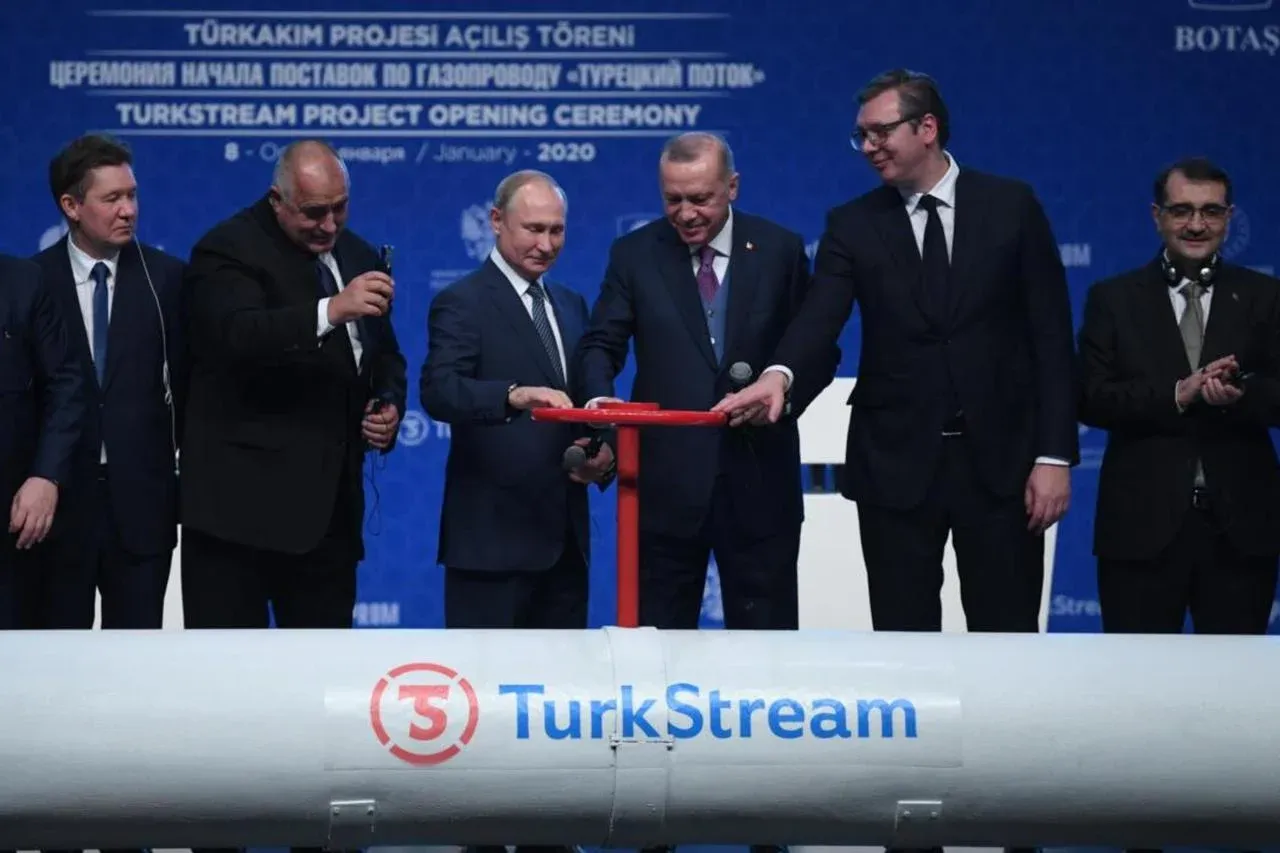
In January 2025, the Ukrainian government hiked the transit fees for Gazprom by 400%, prompting EU member state Slovakia to threaten to cut off Ukraine’s emergency electricity supply. Some horse trading followed, and everyone was content for Russia to circumvent EU sanctions by providing gas to Slovakia and to other EU member states, such as Austria, through the TurkStream pipeline. The pipeline is a joint project between Russia and NATO partner Turkey, and the partnership flourishes despite Turkey providing weapons to Ukraine. Meanwhile, EU member states like Slovenia and Austria continue to finance and militarily assist Ukraine’s “war” with Russia while NATO-supplied Ukrainian weaponry kills Russian civilians.
If the word “war” is to retain its original meaning, then describing Russia’s conflict with Ukraine as all-out “war” between enemy combatant nation-states is untenable. The Ukraine “war,” which the Praxians used as the “absolute bleeding edge” for development of their AI weapons technology—see Part 1—is, to a significant extent, a performative SCAD. Contrary to any enmities they might publicly portray, the performative element suggests some level of international agreement between “policy makers” and so-called “elites.” Sadly, this does not reduce the carnage, death and destruction inflicted on targeted populations. Such performances aren’t unusual for international conflicts. For example, without the support of US-based transnational capitalists oligarchs like the Rockefellers, the Nazis may not have come to power in Germany and thus would not have been able to fight WWII as they did. No Western allied nation-states sanctioned the US corporations that supported Germany’s WWII efforts.
In 1954, Norman Dodd served as the staff director of the Congressional Special Committee to Investigate Tax-Exempt Foundations (the Reece Committee). As part of his investigation, Dodd sent his assistant, an attorney named Katherine Casey, to research the archives of the Carnegie Endowment for International Peace (CEIP), an oligarch-led global policy think tank. Later, speaking with respected author and historian G. Edward Griffin, Dodd revealed that Casey found records from 1908 showing that the CEIP believed that the most effective way to alter the lives of an entire population was by going to war. Thus, with the objective of social engineering in mind, the CEIP immediately set about trying to embroil the US in a war—another SCAD.
Nothing has changed in this regard. Oligarch-led policy think tanks still advocate war to socially engineer populations and to manipulate international relations. Witness the pseudopandemic and the in-one-sense-pseudo Ukraine war, both of which were deliberately engineered. The purported global “shocks” from these events were no surprise to the network of global oligarchs, who expected no less.
Shortly, we’ll discuss how the Israeli–US war with Iran has taken conflict performance art to a new level. To reiterate the point just made, this is not to deny the horrific human cost of any of these SCADs. It is meant to highlight how we are all being manipulated to engage in manufactured, fake dialectics.
Progression along the shared international policy trajectory, always accelerated by war, consistently benefits the Praxians and their globalist oligarch partners. The final destination is the intended multipolar world order (MWO). This envisaged global governance bureaucracy will manage regional “unions” that oversee a “patchwork” of private city-state “realms.” The promised MWO is the realisation of the global oligarchy’s ambition, and nearly all nation-states are working collectively to bring it to fruition.
As we wrestle with many apparent contradictions, it is worth bearing in mind that oppositional forces are not necessarily—or at least not completely—antagonistic. While we are all hurtling toward the MWO, we can think of the oligarchs’ overarching goal as a corporate mission statement. The members of the board will work together in the interests of the corporation, but that doesn’t preclude them from stabbing each other in the back as they scramble to climb the corporate ladder—and step over one another in the process.
Oligarchs like Praxians, in pursuit of their ambitions, are willing to risk global catastrophe. Equally, they might consider global catastrophe necessary—as will be discussed in Part 3. The fact that the Praxians are not yet in absolute control means that we, the people, can thwart them if we wish. As I noted in The Technocratic Dark State:
Like the rest of us, oligarchs are fallible. Their social engineering projects don’t always turn out as planned or deliver on schedule. [. . .] Irrespective of whatever weird, cult-like beliefs they hold and huge hubris they have, oligarchs are just people. [. . .] As individual sovereign human beings, we should be neither cowed nor awed by them. We must simply stay consistent, maximize our independence, and refuse to comply with their Machiavellian schemes.
True, the oligarchs’ plans are discernible. But we shouldn’t assume their SCADs will inevitably succeed. Unfortunately, when immensely powerful oligarchs screw up, the unforeseen consequences for humanity may be worse than they expected.
A Discernible Plan
Lagarde’s message to the BIS was that the ECB has “a strategy that is built for a world of higher uncertainty, with risks and scenarios at its core” and that its monetary policy response to the latest Iran war “shock” is “starting from a better place.” Seemingly contradicting Lagarde’s “better place” remark, the current managing director of the IMF, Kristalina Georgieva, said that the “shock” caused by the conflict with Iran is “large, global, and asymmetric.”
Certainly the socioeconomic impact is “large” and is “global,” but for Georgieva to also call the hostilities a “shock” is disingenuous. As we’ll discuss in Part 3, even though the Praxians have led the Israeli–US warpath to Iran of late, that objective—and repeated attempts to achieve it—has been telegraphed by oligarchs for decades. Indeed, contrary to the SCAD-linked narratives we’re supposed to swallow, the global economic impact of a US war with Iran has been a nailed-down certainty for many years and has been thoroughly modelled by oligarch-led think tanks. There is nothing remotely surprising about any of its repercussions.
2026 Spring Meetings Curtain Raiser: Outlook for the Global Economy and Policy Priorities: IMF Managing Director Kristalina Georgieva delivers a speech on the global economic outlook and policy priorities ahead of the 2026 IMF–World Bank Spring Meetings, followed by a conversation moderated by Michael Froman, President of the Council on Foreign Relations.
The global economic consequences are, as Georgieva described, “asymmetric,” depending on whether a nation, or regional “pole,” is a net “energy exporter or importer.” For example, as leading exporters, the US and Russian governments have maintained their partnership. Due to the Iran war, the US administration has waived most of its sanctions on Russian oil exports, which it originally imposed due to the Ukraine war.
The Trump administration has supposedly established a “total” naval blockade of the Strait of Hormuz—a vital shipping lane—though it isn’t actually “total,” considering that Russian and Chinese tankers, for example, have been allowed through. President Putin’s special representative, Kirill Dmitriev—a former Goldman Sachs, McKinsey & Company, and WEF investment advisor and now CEO of the Russian Direct Investment Fund—said that “US-Russian economic and energy cooperation will continue,” thanks to the US Treasury Department issuing General License 134B, which allows Russian tankers passage through the Strait.
The other effect of the US “total”—if selective—blockade, was that Iran, which Trump has repeatedly alleged to be “totally defeated,” was not so “defeated” that it couldn’t reimpose its own selective toll blockade in response to the US total, partial blockade!
Quite how one collects tolls from tankers that supposedly can’t go anywhere (though obviously some can) or quite how a country like Iran can control a vital maritime energy corridor (when its navy has reportedly been destroyed at least twice), are just a couple of the many questions that have arisen from the “total”gibberish that is passed off as the official narrative of the “totally” absurd Iran “war.”
In addition, quite how or why the US managed the impossible naval blockade feat at all is a mystery we’ll tackle in a moment. Nevertheless, asymmetry is most assuredly unfolding as the entirely predictable result of the preposterous “war.”
Directed by her speechwriters, Georgieva added:
The supply interruptions have had—and will for some time continue to have—ripple effects. [. . .] Shortages of refined products including diesel and jet fuel, which have disrupted transportation, trade, and tourism in a world more interconnected than ever; [. . .] Food insecurity for another 45 million people given the transport issues—taking the total number of people in hunger to over 360 million—with the problem potentially worsening over time because of higher fertilizer prices; And supply chain disruptions given industrial dependencies such as on sulfur, helium for silicon chipmaking and MRI imaging, and naphtha for plastics.
Neither the Iranian navy nor the US navy instigated the blockade of the Strait of Hormuz. In their own ways, they have essentially reinforced the blockade that was first triggered by the global insurance industry. Almost as soon as the Trump administration launched “Operation Epic Fury,” the largest maritime insurers, such as “Norway’s Gard and Skuld, the UK’s North Standard and the London P&I Club, and the New York-based American Club,” withdrew “war-risk cover” from shipping operators. The first military blockades followed.
Despite negotiated ceasefires and the willingness of national combatant governments to reopen the vital transit route, through which approximately 20% of the world’s oil supply flows, it is once again the multinational insurance giants that are leading the way in keeping the Strait of Hormuz shut. By April 17, 2026, the US “blockade” had reportedly turned back only fourteen vessels. Iranian Foreign Minister Abbas Araghchi announced that the Strait was “completely open for all commercial vessels.”
Yet, as reported by House of Saud, on April 18, 2026, around 24 tankers turned back due to hiked insurance premiums and a lack of coverage:
The vessels were not, for the most part, interdicted by American warships or threatened by Iranian patrol boats. They were [. . .] responding to a force more powerful than either navy: the insurance market.
This does not appear to be an example of insurers’ risk assessments responding to military realities. It is the insurance giants effectively imposing a blockade at a time when no naval blockade existed. (In Part 3, we’ll explain why they might want to do so.)
The conflagration in the Middle East, long-planned and comprehensively modelled, is a transformative global SCAD event. Indeed, the head of the IMF continued to outline what the outcome of this SCAD is supposed to be:
We know eventually a significant part of the shock will dissipate, leaving us in a new equilibrium. Supply recovers and demand adjusts. New capacity comes on stream. Energy efficiency rises. [. . .] [E]ven our most hopeful scenario involves a growth downgrade. Why? Because of significant infrastructure damage, supply disruptions, losses of confidence, and other scarring effects. [. . .] [T]here will be no neat and clean return to the status quo ante.
Forget about the pre-Iran war world, Georgieva is telling us. It’s finished. The “scarring effects” will necessitate a “new equilibrium” that will be more energy-efficient. New infrastructure and capacity is required to deal with the alleged “shock.”
Georgieva then went on:
I appeal to all countries to reject go-it-alone actions. [. . .] [W]e have joined forces with the IEA [International Energy Agency] and the World Bank to form a coordination group within which the IMF will lead on the macroeconomics.[. . .] It is important for fiscal and monetary policies to not pull in opposite directions. [. . .] The implication is clear: all countries must deploy their limited fiscal resources responsibly, and most must move decisively to rebuild fiscal space after this shock. I cannot emphasize this enough.
The “asymmetry” is leading to the global unification of monetary and fiscal policy. As covered extensively in The Technocratic Dark State, contrary to the most people’s beliefs, monetary policy the world over is not managed by the public sector but by private sectorcentral banks. Leading central banks are steered through BIS “general meetings,” and the BIS has “immunity from jurisdiction.” No government anywhere on earth has any jurisdiction over central bank monetary policies that are agreed behind the closed doors of the BIS. We are told only what the BIS wants us to know.
Fiscal policy—gathering taxes and setting spending priorities—is supposedly the province of nominally public sector governments. Not any more. Thanks to the so-called “war,” private sector monetary policy and public sector fiscal policy must be more closely coordinated than ever before.
The apparent chaos caused by a military conflict between an Israeli–US coalition and Iran is evidently leading to a coordinated global “solution.” This is a common feature of such conflicts. As Professor DeHaven-Smith observed, in the post-WWII period, conflicts leading to suspiciously SCAD-like pre-planned “macroeconomic,” monetary, and socioeconomic outcomes have been a persistent feature that has become more frequent since the late 1960s.
The fusing of private sector monetary policy with supposedly public sector fiscal policy is also aligned perfectly with Praxian objectives. The Praxian plan is to strip all authority and power from the public sector—from all governments worldwide. The Praxians want “Agentic States” to proliferate. (That’s another subject we’ll get to in Part 3.)
Georgieva claimed that the “considerable momentum” in the allegedly blossoming pre-war global economy—which most of humanity has experienced as a cost-of-living crisis—was driven by “strong AI and tech investment.” Therefore, she emphasised, the pursuit of energy efficiency in the “new equilibrium” must not derail the Praxians’ economically essential AI agenda.
The IMF managing director issued a clear program for government policymakers to follow:
If investors were to start worrying about energy insecurity holding back the growth of AI, for example, given AI’s huge energy needs, then we could find ourselves in a spot of trouble. Micro- and macro-prudential policies must work to reduce financial stability risks and ensure a resilient system. [. . .] [D]o not forget to steer the great global transformations in technology, demographics, geopolitics, trade, and climate and build a better future. Your structural and regulatory policy choices underpin productivity and long-run growth—and growth potential matters enormously for stability.
As a result of this latest “war” SCAD, governments must play their allotted enabling partner role in a “resilient” global technological revolution. If government officials don’t serve their respective public-private partnerships, growth—and thus stability—will be “threatened.” This outcome would constitute a threat to national security—or so the US federal government, for one, alleges.
Radical geopolitical realignment in the MWO, resultant demographic shifts, new global trade patterns, and climate-change policy can all be “steered” toward the “new equilibrium” as long as everyone buys into the Praxians’ technological coup. No wonder the IMF is eyeing the “scarring effects” of the Iran war SCAD with gleeful anticipation.
Ever since emerging from Bretton Woods back in 1944, the IMF has been working closely with its “complementary”partner, the World Bank, to relentlessly impoverish developing nations in debt-trap schemes. So, it’s no surprise that the current war with Iran represents a massive opportunity for the transnational capitalists who profit from the IMF’s exploitation of oppressed populations. Crisis is always the catalyst for the IMF and the World Bank to swoop in. And, as Georgieva noted, the envisaged “new equilibrium” looks very promising for the IMF/World Bank and its international partners.
Those “other” partners consist of a transnational network of privately financed development banks, including nearly all of the BRICS’ development banks. Combined, the IMF, the World Bank, and the development banks represent a single, unified global financial empire.
An exultant Georgieva proclaimed:
[The IMF is] here for you when crisis hits. Once more, let’s take into our lens the vulnerable oil importers of the world, those rated in the speculative grade, and let’s color in blue all countries with IMF-supported programs. We can scale these programs up if needed and—be sure—there are more programs to come.
Hurrah!
But that’s not all. The IMF and the World Bank have also formed a new relationship with the International Energy Agency (IEA). Their plans and predictions reveal what the “new equilibrium” means for all of us: namely, the IEA unsurprisingly predicts a severe energy crisis “triggered” by the scheduled “war.”
In response, EU leadership, represented by European Commission President Ursula Von der Leyen—quite possibly one of the most corrupt politicians Europe has ever known—suggests that the solution is that we, the people, stop using energy.
In March, the IEA released its Sheltering From Oil Shocks plan. Their partners—the IMF, the World Bank, and the BRICS development banks— will implement the plan through their macroeconomic interventions.
The IEA “plan” can be summarised in a few words:
- It severely restricts our lives by rationing our energy usage.
- It forces us to work from home.
- It effectively removes our access to independent transport.
- It tightly monitors our energy consumption.
- It manipulates us into adopting smart-grid technology.
- It seizes hold of our food supply.
All of these moves are apparently necessary because of the unexpected “war” SCAD.
Amazingly, the “Sheltering from Oil Shocks” plan closely resembles the set of policies presented to us during the pseudopandemic lockdowns.
The same plan also dovetails seamlessly with the many policy objectives huddled under the umbrella of the Sustainable Development Goals. That synergy hasn’t escaped the notice of the United Nations—the oligarch-led architect of those SDGs. Naturally, the UN is now taking advantage of the contrived “war” story—after appearing to shelve its earlier, equally contrived climate catastrophe story—to advance its continuing climate lockdown agenda.
(NOTE: The climate lockdown, despite being spoken about by influential economists and despite having been modelled in some detail by governments and despite having been trialled in Canada and elsewhere, has been officially designated as a “conspiracy theory” by the epistemic authorities until such time as it is approved by our oligarch overseers for public discussion.)
When Simon Stiell, the executive secretary of the United Nations Framework Convention on Climate Change (UNFCCC), spoke to EU delegates at the mid-March Green Growth Summit in Brussels, he described what he called the “new world disorder.” He said the disorder was caused by the “fossil fuel crisis” instigated by the “surprising war” with Iran.
Calling Georgieva’s “new equilibrium” the “new era of climate action,” Stiell ensured that the gathered policymakers were fully up to speed with the transnational capitalists’ wish list:
In an era of chaos, capital is searching for safe, strategic growth, sending record sums into Europe. [. . .] The opportunities are immense. Over two trillion dollars was invested in clean energy. Double that of fossil fuels. [. . .] Your Emissions Trading Scheme is driving investment and innovation. And European companies are at the forefront of clean industries and growth. [. . .] Europe can permanently seize the multi-trillion-euro goldmine of investments that are just getting started. [. . .] As we move into a new era of climate action—an era of implementation—there are vast opportunities.
Wholeheartedly endorsing the Praxians’ accelerationism, Stiell said that the “global transition” away from fossil fuels had to happen “swiftly,” adding that “a faster transition around the world means greater gains.” He said the current transformation was “not fast enough” and mentioned the pressing need “to go faster” and to “seize this moment” of immense “opportunity” arising from the “war”—the SCAD—that nobody predicted.
You may wonder what accelerating toward the “multi-trillion-euro goldmine” has to do with saving the planet from global warming. The answer is “nothing.” But that doesn’t really matter, because the “global warming” story has been phased out and, after being called “climate change” for many years, is now being replaced with the narrative Stiell frames as a “climate disaster.”
The latest shift is understandable given that there’s no evidence of any CO2-driven global warming. The planet is in an interglacial period and emerging from a mini-ice age. Thankfully, Earth is still warming. But atmospheric CO2 levels have nothing to do with a natural warming and cooling cycles and never did.
Readers would be excused for being sceptical of that last statement. Given the decades-long fairy tale that CO2 is causing global warming, you might expect the enormous increase in industrial CO2 emissions over the last half-century to have had some sort of noticeable effect on global surface temperatures. But it hasn’t. Ever since consistent records began in 1850, beyond the natural variations of a broadly warming climate, scientific research shows that “if there’s an acceleration in global warming [post-1970], we can’t statistically detect it yet.” This probably explains why mouthpieces like Stiell have been told to drop any mention of “man-made global warming.”
Seeing as there has also been no statistical evidence indicating more frequent or more severe climate catastrophe events, epistemologically speaking, “climate disaster” alarmism is also a dead duck. Yet even this fact is irrelevant, because both the “global warming” and the “climate disaster” fictions are no more than SCAD propaganda constructs designed to sell oligarch agendas.
Relying solely on propaganda, rather than on any scientific evidence, Stiell declared that our continued use of fossil fuels to meet our energy needs was “delusional.” He said:
Fossil fuel dependency is ripping away national security and sovereignty. [. . .] Because war in the Middle East has sent the oil and gas prices soaring. Just as war in Ukraine did before. [. . .] Sunlight doesn’t depend on narrow and vulnerable shipping straits. Wind blows without massive taxpayer-funded naval escorts. Renewable energy allows countries to insulate themselves from global turmoil, and to side-step might-is-right politics.
Assuming you imagine the global transition to renewable energy is real—which necessitates ignoring the long list of unresolved problems that currently leaves that notion looking like the world’s largest white elephant—it is “war” in the Middle East that now provides the new impetus for an accelerated transition to renewable energy, according to Stiell. This means that, instead of having relatively independent access to energy, we plebs are destined to be controlled by a managed system of internationally connected electricity grids.
Stiell explained it this way:
[B]y setting out how you will thrive in a decarbonising world [. . .] electrification accelerates. [. . .] Last year, renewables overtook coal as the world’s top electricity source. [. . .] [A]nd that positions you at the fore of the electro-tech revolution, including through your [the EU’s] Electrification Action Plan. [. . .] Climate cooperation is a cure for the chaos of this moment, and beyond.
Due to the shocking “chaos of the moment” of the Israeli–US “war” SCAD with Iran, the propaganda narratives are converging as we approach the MWO, where we will apparently “thrive [on] a decarbonised” planet. The Great Reset is underway. The Iran war “shock” means we can all Build Back Better again, or, as an unleashed POTUS Trump puts it, embrace “the world’s most powerful reset.”
A discernible plan is in effect:
- Addressing the mythical climate disaster through the UN’s 17 Sustainable Development Goals is now a geopolitical imperative and a matter of national energy security.
- National energy security demands that fossil fuels be rationed and energy supplies be distributed through electrical smart-grids.
- Stable energy supplies can only be delivered if the necessary smart-grid infrastructure investment is secured.
- Investment in smart grids won’t be forthcoming unless geopolitical tensions are resolved.
- Resolving geopolitical tensions requires a global rebalancing of geopolitical power.
- From that rebalancing need emerges the multipolar world order (MWO).
The Beautiful Multipolar World Order
When I completed The Technocratic Dark State in the summer of 2025, it was already obvious that:
US isolationism, EU military unification, global disorder, key political appointments (on both sides of the Atlantic), and international monetary reforms, all of which support the emergence of the MWO, are coalescing on the world’s stage at the same time. What are the chances? The signs are unmistakable: The global order is undergoing a process of creative destruction. It is being deterritorialized—only to be reterritorialized as a more efficient multipolar global governance system.
The Praxians’ model of accelerated global transformation has evidently been adopted by their oligarch brethren—and these “brethren” happen to be overwhelmingly, though not exclusively, men. As highlighted recently at Geopolitics and Empire by analyst, journalist, and podcast host Hrvoje Morić, the MWO has been the global governance goal of the global oligarchy for more than a century at this point.
The oligarch-led think tank, the Bilderberg Group, created the European Union (EU) as a MWO template “pole.” The Eurasian Economic Union (EAEU) and China’s proposed Asian Union—the latter potentially combining the Association of Southeast Asian Nations (ASEAN) and the Gulf Cooperation Council (GCC)—are based on the globally agreed-upon “union” model. A world order of regional unions is being constructed.
The Praxians’ dark Technocracy, to be trialled in Gaza, is the proposed operating system for private smart city-states (neostates) controlled by sovereign corporations (sovcorps). The Praxians’ neostates are intended to be linked together, forming the patchwork of realms within the political unions dominating the global regions forming the MWO. The deterritorialization-to-reterritorialization strategy is operational now that the MWO is at last being born from the engineered genocidal chaos SCAD in the Middle East.
But you do not need to take my word for it.
Speaking recently at the Russian International Affairs Council, the RIAC board of trustees chair, Russian Foreign Minister Sergey Lavrov, said:
We are at the high point of the efforts to restructure the world order, which we hope will lead to a stable and just multipolar world. So far, however, the restructuring looks more like a breakdown in every sense of the word. The fight for the leading positions in the new world is extremely intense, nothing less than a fight for survival. [. . .] [A] situation is emerging where the West, with its insatiable hegemonic ambitions, has entered the clinch with the World Majority’s [BRICS] aspiration to [implement] the principles of the UN Charter.
The “breakdown” to which Lavrov refers is the aforementioned “creative destruction.” A global upheaval similar to the chaos that followed the 1967 Six-Day War—see Part 1—is disrupting the Middle East again, this time fomented with the assistance of the Praxians.
The results are new geopolitical structures and a total reappraisal of international relations. (In Part 3, we’ll examine the purportedly new but actually long-planned energy corridors, the reconfigured international supply chains, and the new monetary systems that have now supposedly become a pressing necessity as a result of the Iran “war” SCAD.)
For the international oligarchy that stands to benefit most from the accelerated virtual and physical infrastructure transformation, war continues to be the gift that just keeps on giving. Yes, innocent human beings are being slaughtered in the process, but transnational capital knows no morality.
Lavrov confined his remarks to the seeming geopolitical schism. On one side, he posited, are the Western powers; on the other, the BRICS-aligned partnerships of nations that Lavrov referred to as the “World Majority”—which it actually is. Lavrov’s avowed opinion is that the West is seeking more hegemony and that the “World Majority” is allegedly opposing that hegemony by defending the sovereign equality of nations and by aligning itself with the UN Charter in its strict observance of international law.
Lavrov’s view has found favour with those whom Geopolitics and Empire’s Morić calls “the Multipolaristas.” These analysts, researchers, and commentators may not intentionally be of the same mind, but they all find hope in the surface-level narratives sold by political heavyweights like Lavrov.
For instance, Matthew Ehret, director of the Rising Tide Foundation, has written:
The question is now: will the new world system take the form of a new era of global empire, unmitigated war between faiths and a prolonged dark age OR might it take the form of the beautiful multi-polar world order defined by win-win cooperation between all of the nations, faiths and cultures of the world?
At first glance, Lavrov’s official public value proposition, welcomed by Ehret and other Multipolaristas, appears to have merit. It is true that for too long, under the sole superpower United States, successive US governments and US-aligned governments (notably in Europe and Israel) have waged US-backed wars (either directly or by proxy) with impunity. These wars have been prosecuted simply to achieve whatever foreign policy objectives the US is pursuing at the time. There is nothing admirable or humanitarian in the violent, militarised US hegemony characterising what Charles Krauthammer called the “unipolar” world.
That is a fair assessment. But the Multipolaristas’ superficial analysis breaks down when they presume that unipolarity’s replacement, multipolarity, promises something better.
Perhaps, in their understandable eagerness to see the demise of the unipolar world order, the Multipolaristas have overlooked more than a century of documented historical evidence demonstrating that the transnational capitalist engineers of the unipolar world order are also the architects of its successor, the multipolar world order.
As we discussed in Part 1, transnational capitalists, such as the Praxian oligarchy, are exactly that: transnational. They may profess allegiance to host nation-states, but in truth they have none. Hopping from the backs of one exploited populace onto the backs of another is an oligarch business growth strategy, and the goal of all that “hopping” is monopoly. Although it is important to see the competition between nations through the lens of realpolitik, to restrict that reading solely to the actions of governments, as if the public sector were independent of the private sector, is to fundamentally misunderstand how multinational power operates and who wields it.
For example, governments do not independently set their own foreign policy. Rather, so-called “government policy” is effectively controlled by multinational corporations. Though Westerners imagine they live in some sort of representative democracy or constitutional republic, the prevalent form of government throughout the globe is functional oligarchy, and that functional oligarchy often uses war and other SCADs, like fake pandemics, to achieve its goals.
By way of illustration, let’s return to the address Lavrov gave to his Russian International Affairs Council colleagues and gathered delegates. Lavrov noted that the RIAC’s “work plans” align with the foreign policy objectives of the Russian government. He added that the RIAC provides “analytical and informational support for the activities of our Ministry and other state bodies.” In other words, the RIAC “assists” and “informs”—that is, “coordinates”— Russian government policy.
So, who—or what—is the RIAC?
The RIAC calls itself a “diplomatic think tank that [. . .] operates as a link between the state, scholarly community, business, and civil society in an effort to find foreign policy solutions to complex conflict issues.” Practically speaking, the RIAC is a public-private policy partnership between the Russian government and its two co-founding partners: the Russian Union of Industrialists and Entrepreneurs (RSPP) and the Interfax International Information Group (Interfax).
The RSPP, cuttingly referred to by Russians as “the oligarch trade union,” exists to advocate for “the interests of Russia’s business community.” To this end, it aims to “work with governmental authorities to promote a more favourable investment climate” for oligarchs in Russia.
Interfax, for its part, started as a Russian news agency in the 1990s but has developed into a multinational business empire specialising in reporting “political and general news.” It also has an ever-growing, influential global ratings agency business that offers “financial and business credit information, industry analysis, market data and sophisticated business solutions for risk management,” mainly serving non-Russian oligarchs looking to invest in Russia. Obviously, the “advice” the RIAC provides Russia’s so-called policymakers, such as Lavrov, serves the business interests of oligarchs but rarely the interests of the Russian people.
The RIAC also maintains working partnerships with a global network of public and private sector organisations, businesses, and similar policy think tanks. The latter partners include the Kerachi Council on Foreign Relations (KCFR), which was established in 2003 as the Kerachi hub for the Pakistan Council on Foreign Relations (PCFR). The PCFR was set up by the Chicago Council on Global Affairs, which is effectively the Chicago hub for the US Council on Foreign Relations (CFR). This global policy think tank network, which sprang out of the Anglo-American Establishment in the early 20th century (see Professor Carroll Quigley’s eponymous book) is a close-knit club steered by an even tighter group of transnational capitalist oligarchs.
Russia is not the only functional oligarchy. Far from it. The transnational capitalist oligarch network is literally everywhere. A MWO does nothing to address the network’s pernicious influence. Instead, it simply centralises and consolidates the oligarchs’ effective rule at the global governance level. That centralization and consolidation of their authority explains why transnational capitalist oligarchs want to impose a MWO.
The avid promotion of a MWO by the Multipolaristas is, at best, short-sighted. They are essentially arguing for overarching and oppressive global governance, as if the further centralisation of global political authority in the hands of oligarchs will somehow benefitthe rest of us.
Not that Multipolaristas have no valid reasons for optimism. They do. The Iran war SCAD does appear to be bringing the era of large-scale international conventional warfare to an end. This is a welcome development—assuming, as the Multipolaristas clearly do, that no government is actually dumb enough to believe limited nuclear exchanges are feasible.
If nothing else, the Iran war SCAD indicates that international conflicts using conventional warfare are increasingly economically unaffordable and are no longer a practical option for the continuation of politics by other means.
Unfortunately, though—and contrary to the hopes of the Multipolaristas—this impracticability does not signal an end to war. Rather, it leads to a rescaling and redeployment of war in a multipolar world.
The Third World War—a hybrid war punctuated by more combatants fighting more localised conflicts—has started.
Hybrid War
In 1999, Chinese military officers and authors Qiao Liang and Wang Xiangsui published the book Unrestricted Warfare. In it, Qiao and Wang highlighted that modern technology connects societies, both internally and internationally, as never before. Therefore, they argued, warfare isn’t simply a matter of direct military confrontation. It encompasses “political factors, economic factors, diplomatic factors, cultural factors, technological factors, or other nonmilitary factors.”
The co-authors wrote:
[T]he new principles of war are no longer “using armed force to compel the enemy to submit to one’s will,” but rather are “using all means, including armed force or non-armed force, military and non-military, and lethal and non-lethal means[,] to compel the enemy to accept one’s interests. This represents change. A change in war and a change in the mode of war occasioned by this.
The concept of “unrestricted warfare” was later developed by General Valery Gerasimov, chief of the General Staff of the Russian Federation, in a 2013 essay he penned for the Russian Military-Industrial Kurier:
The very “rules of war” have changed. The role of nonmilitary means of achieving political and strategic goals has grown, and, in many cases, they have exceeded the power of force of weapons in their effectiveness. [. . .] Frontal engagements of large formations of forces at the strategic and operational level are gradually becoming a thing of the past. Long-distance, contactless actions against the enemy are becoming the main means of achieving combat and operational goals.[. . .] [N]ew means of conducting military operations have appeared that cannot be considered purely military.
The so-called Gerasimov Doctrine was also adopted in the West. In 2019, General Nick Carter, UK Chief of the Defence Staff, brought up the subject in his speech at the Cliveden Literary Festival in the UK:
The changing character of warfare has exposed the distinctions that don’t exist any longer between peace and war. [. . .] I am now at war, but it’s not a war in the way we would have defined it in the past. [. . .] The key bit that will give you the edge you need is the way in which information connects [it all] together. [. . .] Future warfare is going to be very much information-centric. [. . .] [W]arfare is essentially a political function—but it will be a much more sophisticated and will include the new domains [alongside land, sea and air] of space and cyber.
In light of the West’s easy adoption of the so-called Gerasimov Doctrine, it is essential that we all come to terms with what NATO consequently defines as “Hybrid Warfare”:
[T]he creative use of hard, soft, and smart power by malign state or nonstate actors to achieve warlike objectives and political goals. Malign acts include a broad spectrum of military and nonmilitary instruments of coercive power beyond the conventionally conceived multidomain battlespace. Hybrid warfare encompasses politics, diplomacy, information, the economy, technology, the military and society, as well as dimensions like culture, psychology, legitimacy and morale.
As General Carter said, in hybrid warfare there is no distinction between war and peace. Hybrid warfare is not limited to public sector militaries confronting each other on identifiable battlefields. Rather, hybrid war utilises the whole-of-society approach to public-private conflict in multiple domains. In hybrid war, every aspect of society is weaponised. All is war, and war is constant.
Hybrid warfare is “information-centric,” because our behaviour is determined by whatever informs us—hence, by what we believe. If hybrid “warlike objectives and political goals” are to succeed, our beliefs and behaviour must align with the efforts of our “leaders” within the “multidomain battlespace.” Consequently, controlling our access to information and using applied psychology is a crucial hybrid war strategy.
NATO is extremely reluctant to clearly define who or what constitutes a “non-state” actor, though it is obsessed with combatting them. Obviously, this is problematic if you claim, for purposes of countering hybrid threats, that non-state actors are among your most “malign” enemies.
We can, however, define what hybrid warriors mean by the term “non-state actors”:
Non-state actors (NSAs) are organizations or entities that operate independently of any recognized government. [. . .] This category encompasses a wide range of entities, including [. . .] social movements. NSAs have gained prominence, [. . .] partly due to a growing dissatisfaction with traditional state governance. [. . .] While some view NSAs as essential checks on state power and advocates for social change, others consider them potential threats to established state systems and international relations.
Per that definition, NATO and its member states put NSAs in the latter camp, considering them “potential threats to established state system.” Whether we’re aware of it or not, political and military strategists view the whole-of-society as a “multidomain battlespace” and all of us as potential threats. If we express dissatisfaction with our governments, we are “malign” enemies to be fought, especially if we are so bold as to form social movements.
This is not hyperbole. NATO’s strategy to counter hybrid information threats is directed squarely at domestic populations in NATO countries.
Accordingly, “NATO, its member countries and its partners” will judge whatever they deem to be “hostile information activities.” NSAs arbitrarily declared to be engaged in “manipulative tactics, techniques and procedures (TTPs),” will face “short, medium and long-term” responses from NATO-aligned governments and their partners.
In Part 1, we noted that NATO “partners” include Palantir, whose “[hybrid] warfighting command and control system,” called Maven, is “accelerating across the [NATO] Alliance.” Per NATO, “information threats may constitute a national security threat,” because they “undermine people’s trust in governments and other public institutions,” which is verboten. Therefore, NATO governments claim they need to use “proactive measures.”
Proactive measures include the widespread use of “strategic communications” (STRATCOM)—read: propaganda—to proactively share “accurate information.” And what is “accurate information”? It is any information that does not “undermine people’s trust in governments,” by, for example, questioning government policy decisions, or worse, not believing what the government says. “Social media” platforms and “journalists,” NATO points out, are used “to promote a better public understanding of [NATO’s] purpose.”
The G7 Rapid Response Mechanism (RRM) coordinates the narratives that theG7 group of nations want us to believe about major incidents and events, such as wars. The RRM uses a “whole-of-government” surveillance system and “monitors the digital environment” for any questioning of the approved G7 messaging. Any sceptical social media chatter or the sharing of quizzical independent media reports that potentially undermine the RRM account is deemed an “information threat.” The technocratic-sounding NATO Rapid Response Group (NRRG)—a network of carefully selected “expert” stakeholders—then targets the NSAs (that’s us) in order to “counter [the] information threats” we pose.
In the course of fighting its hybrid war, NATO employs “Cognitive Warfare.” The objective of “Cognitive Warfare” is to manipulate the behaviour of enemies, who, NATO says, use “propaganda, deception, interference, and manipulation”—such as “false flags to destabilise and influence decisions”—against NATO nations. NATO observes that “technological advancements have made it easier to manipulate human cognition” and to weaponise “human behaviour.” The multidomain battlespace includes “social media and other digital tools,” because these shape the “information environment” and “influence cognition.” Much like the Praxians, the chief weapons NATO fields are “emerging disruptive technologies (EDTs),” as these are considered “crucial for NATO’s decision making superiority.”
NATO is only interested, you understand, in defensive measures that can counter all those hybrid threats we face. It simply seeks to protect us—or so it claims. That’s why it allegedly has no choice but to run its own “Psychological Operations (PsyOps) [and] Information Operations (InfoOps)” as part of its STRATCOM “functions.”
NATO PsyOps, it reveals, are “psychological planned activities,” presumably including false flag terrorist attacks, that NATO has to use to keep us safe. By deploying “communication methods and other means” to assault “approved audiences,” NATO can influence their “perceptions, attitudes and behaviours” to ensure they don’t “undermine people’s [read: our] trust in governments.”
And what are NATO InfoOps? They are coordinated “military information activities” that evidently utilise “social media” and “journalists” to subvert the “will, understanding, and capability” of people who undermine government and other Establishment “institutions.”
PsyOps and InfoOps are both STRATCOM activities designed to “shape the information environment” and to address the malign threat of the “hostile information activities” we engage in, which NATO calls “disinformation.”
NATO member governments have introduced legislation to assist in their hybrid war against their own populations.
For example, in the UK, under Section 179 of the Online Safety Act 2023, you can be sent to prison for up to six months for “sending false communications” online. “False communications” are messages that “undermin[e] people’s trust in government.”
In the European Union (EU), the Digital Services Act creates the regulatory framework for censorship of the internet in EU member states. It forces social media platforms and search engines to restrict information-sharing to whatever is approved by the EU Technocracy and to remove any information the EU doesn’t like.
Both of these pieces of legislation, the UK Online Safety Act and the EU Digital Services Act, are examples of what “countering hybrid threats” means for our misnamed “democratic” societies.
When NATO claims that it and its Five Eyes and European state partners are merely trying to “protect democracies” and when it further claims that waging hybrid war on populations living under NATO surveillance “does not prescribe what people can or cannot say” but instead “protects freedom of expression,” it is self-evident those claims are themselves a “malign” deception—or, to use NATO’s own vernacular, “disinformation.”
So-called democratic principles, such as freedom of speech and expression, are being destroyed by the public-private political and military establishment’s eager embrace of hybrid warfare. The “creative destruction” of our polity is one of the establishment’s objectives. We are the hybrid warriors’ “enemy,” and we are under attack from our own governments and their transnational capitalist partners.
Despite the Multipolaristas’ enthusiasm, there is no salvation to be found in the MWO.
A look at the 2024 BRICS media summit convened by Russian and Chinese state propaganda news agencies confirms as much. In their aim to foster “stability and cooperation in a multipolar world” and to pursue “the technological transformation of media,” all BRICS member states agreed in their Final Declaration to “combat disinformation.”
That is almost exactly what NATO says. Indeed, the only difference between the Western G7-based and the multipolar BRICS-based battles against disinformation is that “disinformation” is defined to suit their respective agendas. Neither G7 nor BRICS respects freedom of speech or freedom of expression.
Take, for example, the “information” component of hybrid war. The Russian and Chinese governments are in the vanguard of nation-states engaging in “unrestricted warfare” against their own populations. Russia’s internet restrictions allow Russians to use state-approved “whitelisted” websites but cut them off from “blacklisted” sites. Such interference, combined with the government policy of denying access to the “wrong” social media channels, has angered many Russians. Likewise, Chinese censorship lawsare even more draconian than those that Westerners are currently subjected to, at least for the time being.
We have explained State Crimes Against Democracy (SCADs). And we have defined “hybrid warfare.” It is clear that hybrid warfare is the epitome of a SCAD.
As Professor DeHaven-Smith noted, SCADs succeed by protecting government “officials” as they work to “actively avoid evidence of government” crimes being exposed. SCADs operate by firewalling only the “evidence for theories that exonerate officials who may be suspect,” thus protecting “operational positions” that “exploit [state] crimes to serve [oligarch] agendas, hidden and otherwise.” NATO openly states that hybrid warfare is waged against “non-state actors” (NSAs) to stop them from undermining “people’s trust in governments and other public institutions.” The objective of hybrid warfare is to defend the authority of the Establishment against people who might question it. Hybrid warfare is antithetical to any and all democratic values.
It isn’t just NATO nations that engage in hybrid warfare. All governments do. They are all equally determined to use modern digital technology to surveil and control the behaviour of their own populations. Governments are adopting Technocracy to establish dictatorship, which represents a significant threat to humanity. The Praxians pursuit of the Agentic State (see Part 3), offering governance as a service to “customers” in private city-state realms run by sovereign corporations, is the ultimate expression of the modern dictatorial system.
The Praxians’ accelerationist approach, by which they are able to realise the enslavement potential of their digital “revolution,” has been and is being utilised by governments. And though the resultant threat humanity faces is genuine, virtually none of the narratives offered to legitimise the purported need for the Praxians’ digital kill chain are genuine. The precepts asserted by Praxian propaganda are overwhelmingly fake.
The Fake AI Technology Race With China
China’s DeepSeek V4 AI model was recently released globally as an open-source project. Developers around the world can use DeepSeek V4 at a fraction of the cost of its main US competitors—Google’s DeepMind, OpenAI’s GPT-5.4, and Anthropic’s Claude 4.5.
DeepSeek AI is led by Chinese billionaire startup venture capitalist and founder Liang Wenfeng through his High-Flyer quantitative hedge fund and asset management company. Following some Chinese regulatory to-and-fros for quant funds—investments using AI and machine learning—High-Flyer returned impressive profits in 2025. The profits enabled Liang Wenfeng and his partners to invest more aggressively in DeepSeek R&D. Though he is definitely not an accelerationist—a dirty word in China—Liang says he and his companies became “disruptors [. . .] by accident.” He describes his aggressive startup investment strategy as “hardcore innovation,” which is apparently different from the Praxians’ accelerationism.

Prior to Beijing’s helpful regulatory shift for quant funds, DeepSeek had been developed using US NVIDIA Graphic Processing Units (GPUs).
In 2023, Liang described how DeepSeek built a stockpile of the US-sourced GPUs to develop earlier DeepSeek iterations. Tensions between the US and China supposedly increased when, in January 2025, the Praxians put Trump in the Oval Office for the second time. Trump ordered that US NVIDIA chips could no longer be exported to China. But, as previously reported at Unlimited Hangout, there was an alternative supply route provided to DeepSeek and other Chinese AI startups:
In May 2025, Trump [. . .] signed a deal to supply US AI-chips, including NVIDIA processors, to the Abu Dhabi AI digital transformation hub. [. . .] Trump called the deal the “U.S.-U.A.E. A.I. Acceleration Partnership.” [. . .] China has now reportedly banned the import of the NVIDIA [AI chips]. But China doesn’t need to import processors from the US because [. . .] the Abu Dhabi digital transformation hub has a Trump administration agreement in place for the supply of the processors and it serves as a “crucial base for Chinese AI firms.”
DeepSeek has now reportedly eschewed NVIDIA GPUs and developed V4 using Chinese-made Huawei Ascend GPUs. The world of AI development is seemingly being balkanised. US tech suppliers like NVIDIA are securing exclusive supply contracts with Western governments, while China appears to be building out its own AI architecture using domestic hardware and infrastructure.
On the surface, this division looks like it bolsters the Praxians core contention that the US and China are in a technological race—a new kind of cold war—and that losing it would present an existential threat to America. This argument underlies the Praxian explanation to US voters that the US must adopt neoreactionary accelerationism just to survive. When we peer into this alleged “race,” however, no part of it adds up.
US diplomats have accused DeepSeek of exploiting so-called AI “distillation”—using US AI models to train and develop its own. But this is a spurious contention. Access to US and Chinese AI models is sold on the open market. Once purchased, anyone can use these AI models for anything they like. DeepSeek has acknowledged that its development “may contain results” generated from using other available models. Moreover, it is evident that the information exchange between US and Chinese AI developers is reciprocal.
In 2024, US AI firms reportedly tried to block Chinese access to their models. But this isn’t a practical proposition when a company is selling its AI models on open, global markets. Not only were Chinese developers—indeed anyone—easily able to skirt around the supposed restrictions, but the appearance of blocking merely boosted China’s drive to develop native—and much cheaper—AI alternatives. In truth, DeepSeek couldn’t have advanced to its current status, and conceivably wouldn’t exist at all, were it not for the constant transfer of technology, via whatever route, that the Chinese company has received from US tech manufacturers.
If, as we are told, the West must win the purported technological race, it is not unreasonable to ask when the race is due to start. The so-called “race” has been marked more by collaboration than by competition thus far; and that the collaboration is ongoing.
Consider this example: NVIDIA’s Blackwell Platform is designed to allow developers to run the “long-context inference and agentic systems” that DeepSeek V4 has now delivered. Everyone at NVIDIA seems delighted. Testing DeepSeek V4 “out of the box” using NVIDIA GPUs has shown that, unsurprisingly, Chinese AI models can assist US AI developers, given that they run perfectly well on US hardware using US AI architecture.
In fact, US AI agent developers are particularly excited about the arrival of DeepSeek V4. They call it “especially great for agents[,] as it excels at long context orchestration, reasoning, and tool calling.”
The Indian-owned Lushbinary, working out of the US, “builds production AI agents powered by DeepSeek V4, Claude, and GPT.” Because Anthropics’ Claude AI model code is fully compatible with DeepSeek V4, Claude code can simply be swapped out by US developers who want to “build AI agents with DeepSeek V4.”
Furthermore, not only is technological competition conspicuously absent, there’s also little sign of any conflict within the transnational capital investment rails.
In Part 1, we observed that transnational capital is opaque—investment houses closely protect the identity of their individual investors—and that accelerationism operates as an investment shell game. Startup accelerators hand over to startup incubators, who then draw in larger venture capital (VC) firms when the startup looks likely to succeed. If growth is solid, initial public offerings (IPOs) typically follow, and the investment houses and asset managers consolidate corporate control. Nonetheless, we can identify the footprint of transnational capitalist oligarchs like the Praxians by “following the money,” to quote the modern maxim.
Seeing through the shell game becomes slightly more complex when venture capital is invested internationally. For example, Praxian-aligned VC giant Sequoia Capital appeared to have shed its Chinese operations in 2023, when Sequoia China became HongShan Capital Group (HSG). However, the Romanised Chinese translation of Hongshan tellingly means “redwood.”
Sequoia Capital told the Financial Times (FT) that is would “run its Chinese business as a ‘completely independent’ entity from its US operation.” If “running” a VC fund in another country while simultaneously asserting its foreign branch is “completely independent” sounds like a contradiction, that’s because it is.
Clearly, if those reports are to be believed, there was no rational commercial reason for Sequoia to make its Chinese subsidiary “independent.” Noting that Sequoia China was the “most successful US–China investing alliance” and had “reaped rewards for the American mother ship” by accelerating “generations of Chinese tech companies,” Sequoia Capital executives then said that the “the cost-benefit trade-off” had changed and was now in the negative. From a commercial standpoint, this self-contradictory story is obvious bunkum. The decision to seemingly separate the VC operations was clearly political. You can’t maintain the pretence of national enmity when your functional oligarchies are obviously working together as partners.
Since then, the “race” narrative has only become more ridiculous. In December 2024, the “completely independent” Chinese VC firm Shixiang, which had “spun off from Sequoia China,” hosted a “closed-door” symposium for Chinese AI developers. There, DeepSeek was reportedly a hot topic of conversation. It turns out that Shixiang was formed in 2019, four years before Sequoia China achieved “independence,” and Shixiang’s “core team is from Sequoia China.”
Supposedly, this meeting of minds played some part in “rekindling” US interest in AI development in China, though when it ever waned remains unknown.
In June 2025, Joshua Kushner, the brother of Trump’s son-in-law and the founder and managing partner of Thrive Capital (seed-funded by Peter Thiel, among others), along with Capital Group, known for being one of the largest investment management firms on earth, as reported by South China Morning Post, “dispatched senior executives to China to find out more about the AI scene”—as if they didn’t already know everything about that scene.
In December 2025, Meta, led by Thiel’s longtime business partner and fellow neoreactionary accelerationist Mark Zuckerberg, made a bizarre business announcement. Meta said it intended to buy Chinese AI firm Manus, touted as “the next DeepSeek.” It also said it would “cut ties” with China once it had bought Manus. The $2 billion acquisition proceeded without a hitch. Then, in April 2026, after it was too late to affect the Manus deal, Beijing suddenly announced it was going to “tighten control” over its AI industry and was directing firms to “reject American funding.”
The US AI developers and Praxian-backed tech giants are reportedly “shocked” by the rapid evolution of Chinese AI, though why they would be “shocked” is inexplicable. Partnerships between US and Chinese tech companies have been blatant for decades and precede the “new cold war” narrative we are supposed to accept. The unidentifiable “race” is now described as “neck-and-neck.”
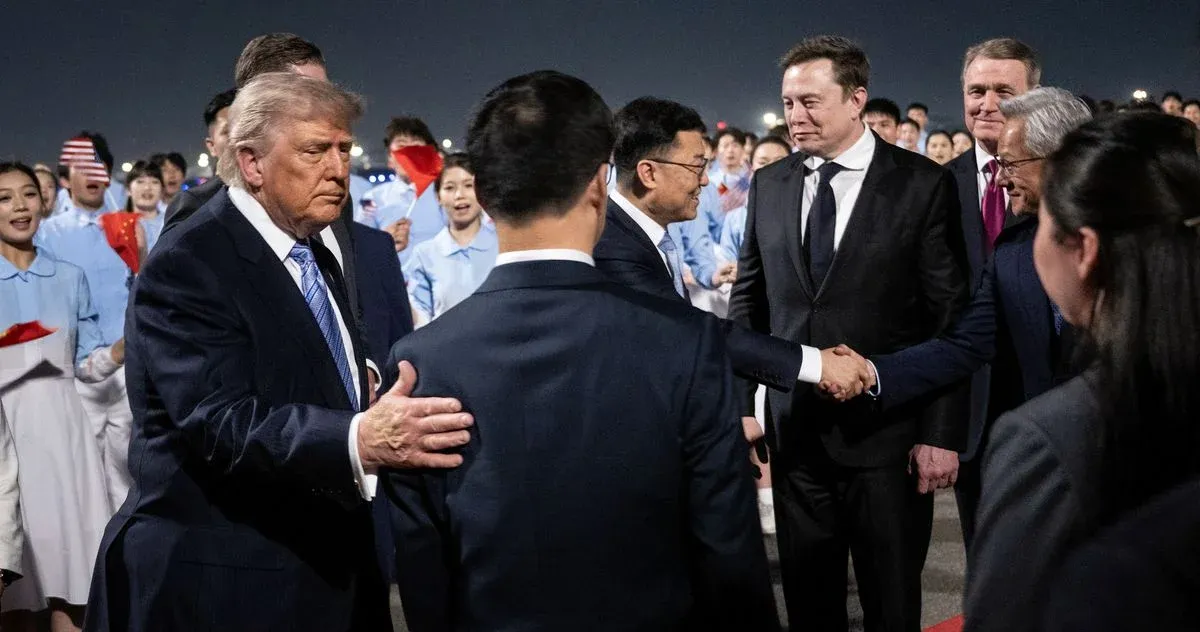
Elon Musk, Jensen Huang, And More Major CEOs Attend Xi's China State Dinner For Trump: Top U.S. CEOs attend the State Dinner in Beijing, China.
To put it bluntly, there is no sign of any competitive AI development “race.” Sure, everyone everywhere is “racing” to develop Agentic AI, but what we’re seeing is an internationally collaborative—not competitive—effort. This is of particular benefit to the Praxians as they seek to establish the Agentic State (Part 3.)
The Praxians have offered a story about existential threats and intense competition to justify US public expenditure (i.e., taxpayers’ money) on AI development, but that’s all it is: a story to help them achieve their objectives.
And, in the age of hybrid warfare, those objectives extend to all “domains.”
China’s Military-Civil Fusion
In 2015, at the plenary meeting of the delegation of the People’s Liberation Army (PLA) at the Third Session of the 12th National People’s Congress, China’s Supreme Leader Xi Jinping raised the concept of military-civilian integration to a Chinese national strategy. The aim was to modernise and strengthen China’s military by fusing commercial technological development with military applications. This formalized national strategy is often referred to as China’s policy of Military-Civil Fusion (MCF).
In addition to international collaboration, DeepSeek has grown internally, largely thanks to the lenient Chinese regulatory environment and the state subsidies it enjoys by virtue of basing its operations within the Hangzhou Special Economic Zone—specifically, the Hangzhou High-Tech Zone. DeepSeek also appears to be an important MCF corporation.
DeepSeek AI reportedly provides “autonomous reconnaissance and real-time decision support” to the PLA’s wave of new autonomous and remote control vehicles based on the Norinco CS/VP16B all-terrain vehicle (ATV). The PLA has combined DeepSeek-controlled targetting systems with the Norinco series of ATVs to produce autonomous Lynx ATVs carrying a range of weapons systems.
Thanks to Special Economic Zone privileges and MCF, Chinese companies, many of them supposedly publicly owned, utterly dominate the global military drone market. As the Ukraine not-war continues to kill civilians on both sides, Chinese firms are supplying crucial military technology and components to both Russian and Ukrainian manufacturers. When the Chinese public-private partnership hosts trade shows in cities designated as Special Economic Zones (SEZs), like Shenzhen, it is careful to keep “enemies” separated and makes sure they aren’t embarrassed by having to rub shoulders publicly. By all accounts, though, Chinese sales reps are not averse to exploiting the competition for components to push up prices.
Chinese firms also allegedly supply weapons technology to Iran. The US has repeatedly sanctioned Iranian procurement programs in a public attempt to stop it purchasing Chinese military hardware. The Chinese government’s official position is that it does not supply “weapons” or so-called “dual use” technology—suitable for both commercial and military applications—to Iranian manufacturers. The striking similarity between Iranian and Chinese attack drones is just an official “coincidence.”
In reality, China is taking public-private partnership to the next level and is effectively fusing much of its private sector technological innovation with its nominally public sectordefence R&D. In the process, it has revolutionised global arms markets and, indeed, the nature of war itself. Although the Multipolaristas may hope for less war, the Chinese MCF approach is lowering the economic cost of war and growing the kinetic “domain” of hybrid warfare. The MCF strategy is diminishing the military advantage enjoyed by nation-states by opening up the global weapons market to more potentially private sector combatants. We may all hope there will be fewer international conflicts in a multipolar world, but the signs are there may well be a greater number conflicts between a wider array of “actors.”
The Chinese government’s MCF strategy also renders Western sanctions largely irrelevant. That’s because Chinese military technology is often developed as commercial “non-military” technology via international public-private partnerships. The proliferation in China of SEZs—deregulated zones of innovation—has driven greater MCF productivity. This is reputedly part of China’s response to Western sanctions and trade tariffs. As a result, Western nations are now supposedly lagging in the fake technology race behind the leading BRICS nations in both civil and military technology, including AI.
Whoops!
But this is not the result of another catalogue of mistakes by Western leaders. Rather, it is the continuation of a process.
The theory that China’s remarkable technological and economic transformation since the 1970s has emerged in a vacuum and has suddenly accelerated through necessity—that is, in response to Western sanctions and trade tariffs—is delusional. It is China’s longstanding public-private partnerships with Western corporations and governments, not to mention the significant Western foreign direct investment it has received over many decades, that has fuelled the country’s economic and technological rebirth.
Western-and-Chinese public-private partnerships have consistently facilitated the transfer of military and other sensitive commercial technologies from the West to China, often using Israel as an intermediary. The sharing of such technology undergirded Israel’s diplomatic relations with China for many years.
For example, in 1979 Israeli multi-billionaire Saul Eisenberg flew a delegation of Israeli defence contractors to China to arrange military supply contracts with the Chinese contractors precisely to cultivate cordial relations between Israel and China. The US government and its NATO allies have maintained their defence collaboration with Israel while knowing full well that Israel shares defence and other “sensitive technologies” with China and Chinese corporations.
As researcher, author, independent journalist James Corbett pointed out, there is a reason why China developed a suspiciously American-looking arsenal. Occasionally, when the transfer of sensitive technology via Israel is exposed, years of very serious committee inquiries follow. As a result, Western news outlets eventually discuss the ceremonial beating of a designated patsy, who supposedly takes the blame for what is, self-evidently, longstanding but unwritten Western foreign trade policy.
Making this observation does not deny Chinese ingenuity or endeavour. No matter what level of assistance their nation has received, no people could have so radically and swiftly transformed their economy as the Chinese did without considerable shared knowledge, application, and commitment.
Essentially, the Chinese government’s MCF/SEZ strategy has given China’s nominal “enemies,” notably the US and Israeli governments, the very convenient excuse to adopt a more-or-less identical approach. As we discussed in Part 1, the Israeli governments, like China, has fused its public sector defence R&D with its private technological sector. Silicon Wadi is packed with companies started by Unit 8200 alumni with workforces largely drawn from Israeli military and intelligence. The Praxians’ corporations have been deeply embedded within Israel’s public-private defence industry for many years. The Praxians have been enthusiastic backers of the Israeli “startup nation” since its virtual inception in 2009.
The Israeli public-private defence partnership sits behind an opaque veil of private company legal identities that attempts to obscure the relationships between the corporate world and Israel’s public sector defence departments and intelligence agencies. In 2018, the Israeli news outlet Calcalist described how the system operates:
Since 2012,[. . .] [d]evelopment projects once done in-house at the Israeli military and at Israeli intelligence agencies are now [. . .] transferred to third-party contractors that have already worked as contractors for the Israeli Ministry of Defense. [. . .] [Such private companies] develop hardware and software solutions for Israeli defense organizations and also train[. . .] relevant military and intelligence personnel. [As private companies, they can] contract technology vendors without being subjected to possible limitations placed on defense and government intelligence agencies. [. . .] Most of [these companies’] top managers are veterans of Israeli military technology units.
Like Israel, the US has used the same technological threat narrative to supposedly justify its own fusion between public and private defence contractors. As previously reported by journalist Whitney Webb, the US National Security Commission on Artificial Intelligence (NSCAI) was established largely to consider “how the [US] government can work with industry to compete with China’s ‘civil-military fusion’ concept.” Chaired by former Google CEO Eric Schmidt, with notable members including Gilman Louie—the former head of the CIA investment arm In-Q-Tel—the NSCAI, which operated between 2019 to 2021, laid the groundwork for the US’ own MCF-like system. Examples of US MCF initiatives include the Defense Microelectronics Commons (DMC).
The different naming is important because this enables the US government to continue to pretend that China’s MCF strategy is something it opposes rather than being a model it has encouraged and adopted. This deceit is ably assisted by the US media which cites experts who claim the US is trying to “constrain China’s technological development.”
There is, however, a notable recent shift in the propaganda. The New York Times(referenced above) reports the comments of Daniel R. Russel, a former assistant secretary of state for East Asian and Pacific affairs, who is less than effusive about the Trump administration’s current military adventurism. Considering the administration’s recent actions in Venezuela and Iran, Russel was quoted as saying:
Donald Trump may think he is demonstrating military strength that will intimidate Beijing. But his actions in Venezuela and Iran are more likely to drive Beijing’s determination to harden its capacity to resist the U.S. and to tighten its alignment with Russia.
Criticism of US government foreign policy is nothing new in the US but, since 9/11, the US media has consistently and overwhelming offered uncritical support for overseas US military actions, typified by its reporting on Iraq, Libya, and Syria for instance. That unqualified support has suddenly evaporated and US mainstream media has become far more critical. Again, the apparent reasons for the new strain of propaganda will be explored in Part 3.
The foundational work of the NSCAI eventually led to the CHIPS and Science Act 2022 (CHIPSSA). The legislation diverted US tax-dollars to a system of grants and incentives to stimulate R&D in dual use technology. For example, CHIPSSA incentivised US private sector manufacturers to build a “network of semiconductor technologies for the defense industrial base.” Consequently, under CHIPSSA, the US Department of War (then the Biden administration’s Department of Defense) established the aforementioned DMC. The DMC set up eight US prototyping Hubs. They are tasked with streamlining “connections between laboratory to fabrication (lab-to-fab)” and “accelerat[ing] microelectronic innovation driven by DoD demand.” The intention is to develop “a pipeline of talent,” familiar with dual use R&D, to form the US “domestic semiconductor workforce.”
Building on the concept of the “The Microelectronics Commons” specified in the 2021 annual renewal the National Defense Authorization Act 1961, the DMC enables the current Department of War (DoW) to “leverage a potentially limitless pool of emerging technology creators.” The MCF-like defence R&D “pipelines” are overseen by the US National Security Technology Accelerator (NSTXL).
Starting life in 2016 as a a public-private partnership between the Department of Defense (DoD), academia, and entrepreneurs (investors), now the NSTXL has progressed to more fully capitalise on the Praxians’ accelerationist approach to defence procurement by specialising in Other Transaction Agreements (OTAs). Instead of bothering with too much due diligence, OTAs moves new defence innovations from “lab-to-fab” in 100 days, ensuring Congress doesn’t have a realistic opportunity to interfere. These “non-traditional government contracting methods” are supposedly necessary because “mission-critical technologies” must be “delivered at a pace.”
The public-private partnership accelerator, NSTXL, is allowing America’s “most creative innovators” to sidestep “outdated processes,” like public scrutiny, because it is “on a mission to revolutionize the government’s approach to acquisition.” The NSXTL is empowering private sector corporations “to solve the nation’s greatest challenges” by building a “government-ready community equipped to take on any mission.” Which, obviously, is essential if you are serious about fighting hybrid warfare.
While the US and the Israeli governments have adopted their own MCF-like strategies, the Chinese government has been progressing through its transformative policy agenda by issuing five-year plans. In 2021, facing a outwardly disgruntled US government, Beijing dropped any official mention of its Military-Civil Fusion strategy from its plans as it continued to broadly outlinine how it wants China to develop. It now uses more circumspect language for English-speaking audiences—referring to “integrating existing systems and aligning civil and military endeavors” instead of “Fusion.” Nonetheless, the hybrid “whole-of-society” MCF strategy has continued unabated.
The public resources—notably in the form of considerable state subsidies—that the Xi administration has ploughed into China’s fused civil and military technological development has drawn considerable criticism in China. The segment of the Chinese population who hold to an idealised vision of Maoism reportedly see Xi Jinping’s easy adoption of “techno-capitalist” concepts as a threat to Chinese identity.
The closest approximation to the concept of “accelerationism” in China is “jiāsùzhǔyì.” It indicates a belief that society is about to collapse and that resisting will only prolong the agony—thus that some self-destruction isn’t necessarily a bad thing. As a consequence, some of Xi’s modern Maoist critics, though they reject jiāsùzhǔyì and wish to preserve and protect what they see as traditional Chinese values, disparagingly refer to him as the “Accelerator-in-Chief.”
Charles Sun, writing for the geopolitical publication War on the Rocks, outlined how China’s MCF strategy, coupled with China’s SEZ deregulation, operates. Focusing on the Chinese robotics firm Unitree’s rise to become an influential force in the global robotics industry, Sun wrote:
China’s Ministry of Industry and Information Technology designated Unitree a national-level “Little Giant” enterprise under the specialized, refined, differentiated, and innovative program—a status that unlocks preferential tax treatment, subsidized financing, and procurement access. [. . .] The company’s own prospectus discloses tax incentives totaling 75.9 million yuan ($10.56 million) in the first nine months of 2025 alone—including a reduced 15 percent corporate income tax rate as a certified high-tech enterprise, research and development expense super-deductions, and value-added tax refunds. [. . .] Unitree operates from the [city of] Hangzhou High-Tech Zone, which [is] a designated military-civil fusion hub, with the zone’s development and reform bureau holding an institutional mandate to coordinate military-civil fusion planning and ‘civilian participation in military’ projects across the district.
Writing on the same topic for Forbes, Amir Husain explained how Unitree’s robot dog-like quadrupeds were transformed by China’s MCF strategy. Chinese “public sector” defence manufacturers took the “low-profile, acoustically quiet, terrain-agile chassis” developed by Unitree and weaponised it by sticking AI-controlled sensors and either machine guns or anti-tank missile launchers on it. The missile launcher version, the PF-070 system, was presented for “official” global sale at the World Defense Show 2026 in Riyadh just a few weeks before the seemingly unhinged Israeli–US attack on Iran commenced.
Turkish arms maker Roketsan revealed its almost identical KOZ system a few months earlier, in July 2025. According to Western media, the timing indicates that Unitree and Chinese defence firms cloned KOZ. Perhaps the Chinese PF-070 system is the product of industrial espionage. But espionage hardly seems to have been necessary, considering that NATO’s Turkish defence manufacturers and suppliers, like Roketsan, have worked in partnerships with Chinese manufacturers, like China Precision Machinery Import-Export Corporation (CPMIEC), since the mid-1990s.
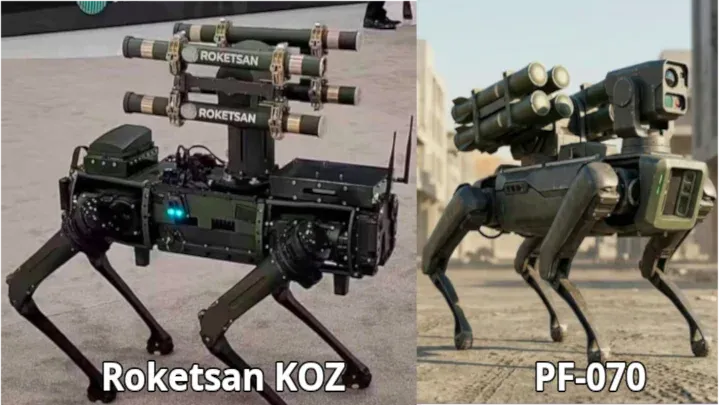
In his War on the Rocks piece, Sun observed that “the United States is falling behind in robotics and artificial intelligence.” He attributed the lag to the fact that “China has built a system that converts commercial success into military capability.” In other words, Sun presented exactly the same shallow argument that the Praxians have—namely, that American tech innovation needs to “accelerate” in order to compete in the “deadly” race against China.
Yet Sun contradicted his insinuated “deadly race” by writing that Unitree’s startup “investors included Sequoia China”—now renamed HSG. As we’ve just discussed, it is silly to consider Sequoia China/HSG “independent” from Sequoia Capital. True, investors’ identities are protected, so, unless they admit it, we can seldom prove which individual investors are investing where. That said, it is pretty obvious that Praxian oligarchs are among Sequoia Capital’s leading investors (see Part 1).
Through VC companies like Sequoia Capital, Praxians invest in disruptive technology. In this case, that technology is currently manufactured in Chinese SEZs under the MCF strategy—and evidently in Turkey, too—and it couldn’t possibly be more “disruptive.”
Returning to Amir Husain’s Forbes article, he wrote of the growing global market for advanced, AI targetted weaponry, such as the PF-070:
There’s a tendency in Western commentary to frame these developments as a race someone is winning or losing.
Husain was right to question this narrative framing. He apparently realized that reporting the collaborative, international public-private advanced weapons trade as a geopolitical race for supremacy is the propaganda—the NATO-approved STRATCOM—that we are invited to swallow. Highlighting the contradictions doesn’t make anyone, including Husain, a “non-state actor” engaged in “hostile information activities.”
Regardless of their investment shell game, the evidence indicates that Praxian-linked US VC firms like Sequoia Capital have invested in China’s MCF ventures. The Praxians have cast the product of those Chinese investments as the proof needed that the US defence sector, which they most heavily invest in, is in a military technology “race” it must win.
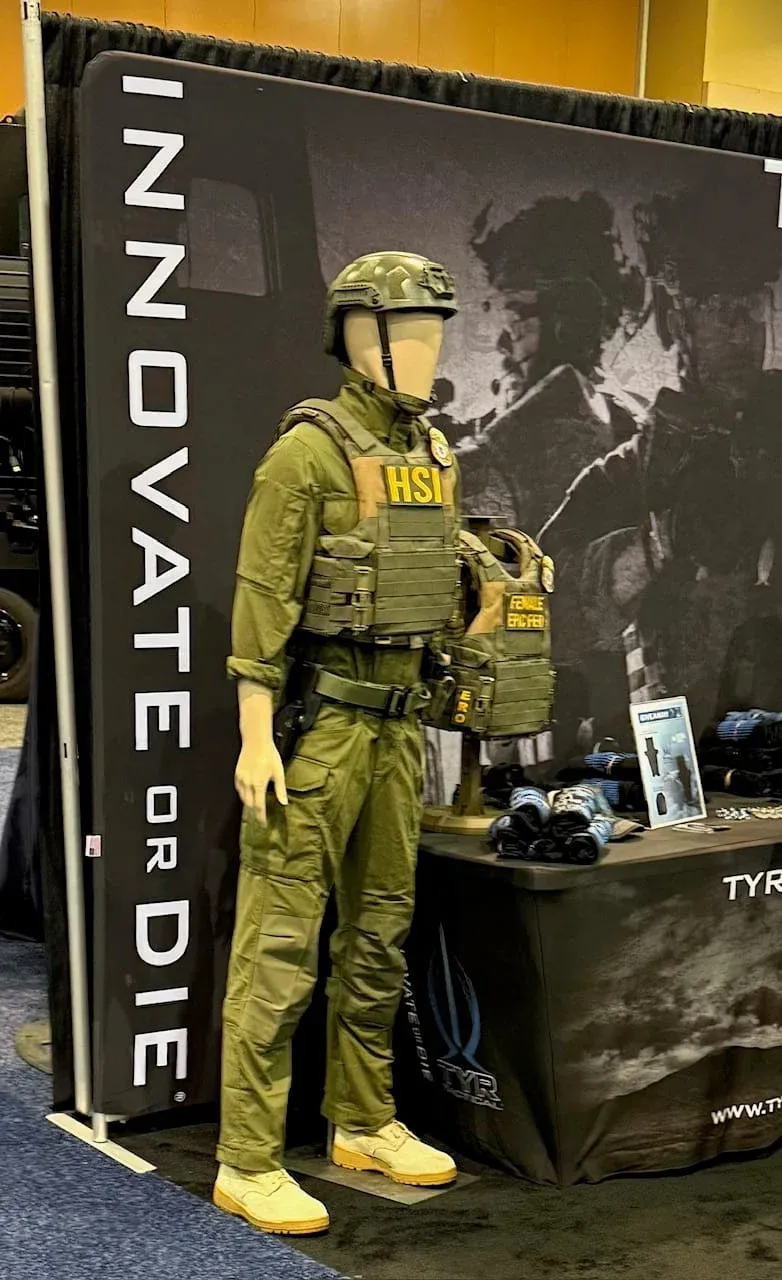
The Trump administration, which the Praxians practically control, is committing vast public resources to winning the fake civil and military technology race with China. Beneficiaries of all that public largess include both the Praxians and China’s functional oligarchy. Sequoia’s Unitree startup investment appears to be an example of Praxian neoreactionary accelerationists using creative destruction.
Husain added:
The more productive question is what the proliferation of cheap, precise, autonomous ground lethality means for how military operations will actually be planned and conducted. When any reasonably funded state actor can deploy hundreds of expendable missile-carrying platforms rather than a handful of crewed armored vehicles, the logic of force employment changes.
As we’ll discuss in Part 3, reasonably funded private sector “actors” can also afford to wage war thanks to these MCF-and-SEZ-accelerated “technological solutions.” The new “logic of force employment” doesn’t just apply to land-based warfare using armoured vehicles. The manner in which US forces have been deployed against Iran is now so illogical that it is virtually impossible to believe anything we are told about any part of the so-called “war” with Iran. It is perfectly reasonable to refer to it as a “not-war” SCAD.
The Israeli–US Not-War SCAD With Iran: Technology
Unwillingly, and perhaps even unwittingly, we have been dragged into an international hybrid war. The old adage, “The first casualty of war is truth,” is no longer adequate to describe how we are being attacked and misled by weaponised information. As hard as it may be to grasp, the goal in hybrid war is not necessarily to win any military confrontation. Strategically, kinetic warfare is just one domain in the “multidomain battlespace.” In hybrid warfare, wars may be fought, not for asserting dominance or gaining geopolitical advantage, but for economic, technological, monetary, or other social engineering objectives.
The manipulation of information is a hybrid weapon that goes beyond the usual wartime propaganda we are perhaps familiar with. This hybrid weapon is carefully crafted to achieve specific cognitive effects. This kind of propaganda is not limited to simply rallying support for national war efforts. It also includes seeding confusion, deliberately causing your own population fear and distress, selectively reporting or omitting information to achieve multidomain victories—even to the extent of deliberately losing or appearing to lose military conflicts. All of these propaganda tools have been incorporated into today’s “winning” hybrid war strategies. Only when we’re fully aware of and alert to hybrid warfare can we start to understand the propaganda narratives being foisted on us.
If anything we are told about the comparative military capabilities of nation-states around the world is true, then it is militarily impossible that the US is conducting a war against Iran in the manner described, despite the enormous number of media reports to the contrary. Current military technology should leave the US incapable of blockading the exit of the Strait of Hormuz—absent, that is, some degree of agreement.
Two possible explanations exist for why the reporting contradicts the reality. The first is that all governments in all countries are working together to hide the truth about current military technology, so the reports are simply a collective fairy tale. The second is that the so-called Israeli–US war with Iran is, to some extent, fake. As it seems extremely unlikely that all governments are “in it together,” the latter possibility appears most likely.
If so, this must logically require a degree of international collusion between purported combatant nations. That is not to say that they want the same thing or that there is no competition for resources or geopolitical advantage. Remember our corporate mission statement analogy above.
There are many elements of this war that suggest it is performative. As we’ll soon see, some of the proposed deployment plans, especially those suggested by the US, are ridiculous. Perhaps most notably, the likely eventual outcome has been planned for at least a generation.
Keep in mind, though, that raising the possibility of some theatrical war fakery is not meant to downplay the struggle of the people oppressed by their governments or the suffering of families who are losing loved ones as the stage production moves through its acts.
If we believe the official account presented by various state propagandists, then that means that, at the time of writing, there is a fragile ceasefire in place while Pakistan hosts tentative negotiations. There is little reason to believe any of it, but that is said to be the situation.
There has been a lot of talk about the relative hypersonic weapons capability of nation-states. A look at that reported history shows:
- The Russian military first demonstrated hypersonic boost-glide warhead capability in 2018.
- China first revealed its DF-17 hypersonic missile to the world in 2019.
- Iran first unveiled its hypersonic strike capability in the summer of 2023.
- India was next, in 2024.
- Supposedly, the US has yet to fully develop hypersonic missile technology or the ability to defend its assets against hypersonic attack.
While countries like India, having had an apparent technological head start, are at the stage of successfully test-firing hypersonic weapons at targets from both naval and land-based systems, the US is lagging behind. US hypersonic missile systems, such as Dark Eagle, are still “being developed.” The US managed to “successfully launch” only as recently as March 2026—though without hitting any targets. These systems are supposedly due to be operational “soon.”
Reports that Iran used hypersonic missiles to strike the Israel Dimona nuclear facilities seem credible. Iran says it also used its Fattah-2 hypersonic missiles to take out US Terminal High Altitude Area Defense (THAAD) installations. We’ll get to that in a moment.
The likely possession of hypersonic weapons by Iran means that the US carrier groups, currently stationed off the coast of Oman, could be sunk by Iranian forces. This assumes, of course, that anything we’re being told about hypersonic technology is true.
In the mire of war propaganda, it’s hard to ascertain the truth. But, if the technology exists, Iran probably does have hypersonic capability. Even staunchly anti-Iranian Deep State think tanks, such as the Foundation for Defense of Democracies (FDD), have begrudgingly acknowledged that the Iranian government has hypersonic weapons.
As noted above, the US is supposedly developing the same offensive hypersonic weapons technology. But protecting its military from them is a different matter. When China revealed its DF-17 hypersonic missile in 2019, US Air Force Lt. Gen. Samuel Greaves responded by saying that the US would “need birth-to-death tracking” to defend its assets, like aircraft carriers, from hypersonic missiles.
Birth-to-death tracking of hypersonic missiles relies on the deployment of space satellite systems like the proposed Hypersonic and Ballistic Tracking Space Sensor (HBTSS). Such space-based systems are central to the Trump administration’s concept of the “Golden Dome” defences against hypersonic threats. A little more than a year ago, Trump issued an Executive Order to impel US defence manufacturers to get on with constructing his Golden Dome, originally called the “Iron Dome.”
Yet again, the Praxians are the primary beneficiaries of another Trump defence spending commitment. On March 24th, The Wall Street Journal published an “exclusive” to inform the world that Anduril and Palantir are leading the push to develop the Golden Dome software at a cost to US taxpayers—and a boost to Praxian coffers—of $185 million. Though Musk’s SpaceX was awarded a $2 billion contract to fire Golden Dome hardware into space in October 2025, not a single Golden Dome satellite has been launched to date. With the cost to US taxpayers for the whole project estimated to be around $1.2 trillion, maintaining the threat narrative is essential for the Praxians and their oligarch partners to capitalise on this immense opportunity. That said, the Golden Dome does not currently exist.
This will be a big, beautiful 'Golden Dome', Joe Lonsdale says. (Palantir co-founder Joe Lonsdale discusses the development of the defense system on 'The Claman Countdown)
US aircraft carrier strike groups use a layered defensive network to detect and hopefully intercept missiles before they hit. In the age of hypersonic weaponry, the US military’s primary defence is the Aegis Ballistic Missile Defense System (BMD) and THAAD. Aegis is not currently linked to any birth-to-death Golden Dome tracking systems, such as the proposed HBTSS.
The US’s Middle East regional THAAD defences were reportedly knocked out either by Iranian drone swarms or Iran’s hypersonic missiles almost as soon as the alleged “war” began. US officials refused to deny that the AN/TPY-2 long-range X-band tracking systems, necessary for THAAD to work, were destroyed in Jordan, and probably in the UAE.
In November 2025, Air&Space Magazine (ASM) reported the current status of Golden Dome progress. It said the “threat picture” had changed due to “hypersonic missile threats, mass cruise missiles and UAV [Unmanned Aerial Vehicle—drone] volleys and UAV swarms that make creating an effective shield that much harder.” So hard, in fact, that US defence analysts admit that 2028 is a reasonable target just “to develop the basic infrastructure.”
ASM added:
The U.S. has no low-cost intercept capability to defend against large attack volleys/swarms in a small geographic area. There is no current operational LWIR [Long-Wave Infrared heat signature detection] discriminating midcourse surveillance system. The U.S. currently has no space-based interceptors for boost or early midcourse intercept [against hypersonic missiles], and no means to rapidly strike hardened targets immediately prior to launch.
As pointed out by the defence industry outlet Military Machine in January 2026:
Against hypersonic missiles, currently under development by several nations, the [defence] challenge intensifies significantly. [. . .] The US Navy is developing responses including upgraded sensors, new missile variants, and potentially directed-energy weapons that could engage at the speed of light.
“[I]s developing” and “could” are the key phrases here. As far as anyone knows, the US is unable to reliably defend huge floating airports—aircraft carriers—from hypersonic missiles.
At the moment, the US is supposedly blockading ships from entering and exiting Iranian ports by stationing its carrier strike groups in the Arabian Sea at the eastern end of the Strait of Hormuz. How is this feat militarily possible?
The touted range of the Iranian’s Fattah-2 hypersonic missile is 1,400km. Both the USS Abraham Lincoln and the USS Gerald R. Ford are well within Iran’s hypersonic range. Yet the Iranian government, allegedly fighting for its survival, has apparently allowed US bombings raids to proceed from those nuclear-powered aircraft carriers for weeks without firing a single hypersonic missile at either of them— though that’s disputed—and is apparently taking no hypersonic military action, or even threatening to take any, to stop the US blockading its ports.
On March 25th, the Iranian Army’s public relations office claimed that Iran had struck the USS Abraham Lincoln with cruise missiles—an allegation that was of course denied by US commanders. But this denial only further begs the question: Why hasn’t Iran used its apparent strike capabilities against these key US targets?
Despite all the public bravado from US politicians, there are significant military limitations to US projected power in the Middle East. For instance, Trump has “threatened” to seize Kharg Island, but the US hasn’t followed through. Kharg Island is situated in the northern Persian Gulf about 20 miles from the Iranian coast. It’s less than eight miles square, populated by about 20,000 oil workers, and defended by a fairly standard contingent of Iranian troops and defence systems.
Kharg Island serves as an oil processing facility for Iranian oil exporters. So, US “strategic” thinking supposedly goes, taking Kharg Island should seriously disrupt the Iranian economy and make the war prohibitively expensive from an Iranian perspective.
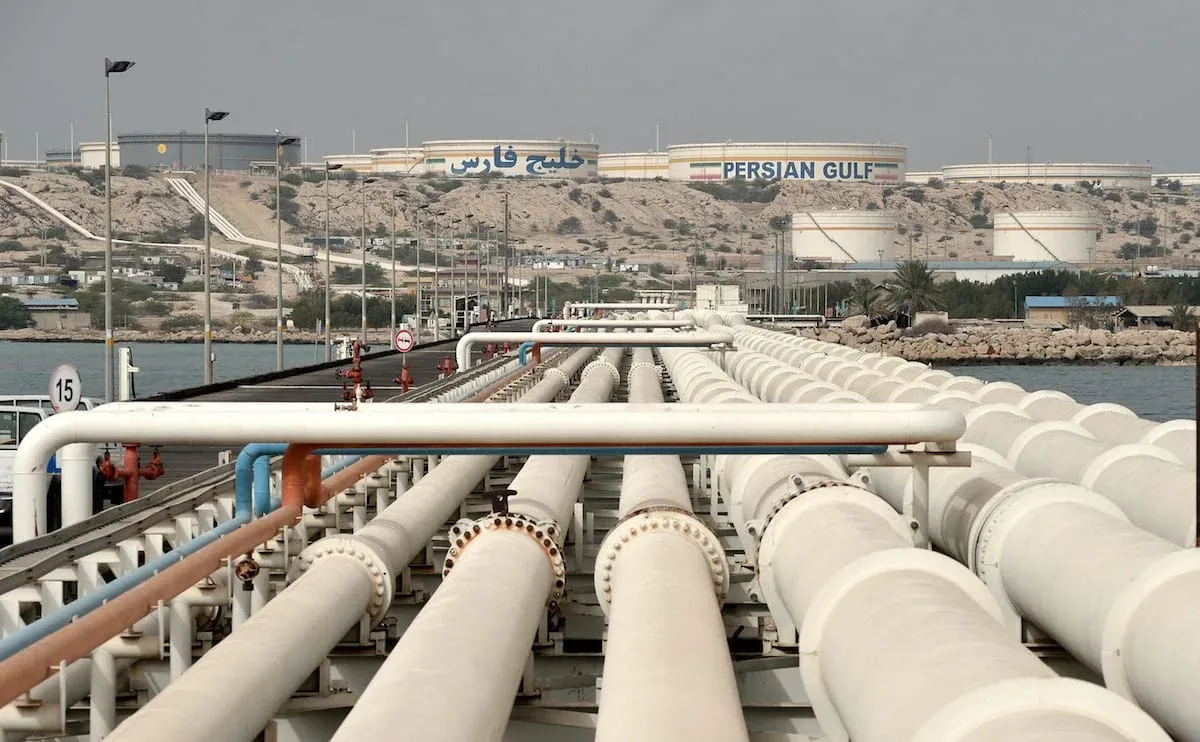
And yet taking Kharg is something the US is not presently able to achieve. Why not?
The Atlantic, a NATO-aligned magazine, said that, as of March 21st, it was “still too dangerous for U.S. warships to enter” the Persian Gulf because they would be exposed to Iran’s “cruise missiles” and its drone swarms. Invading Kharg Island was said to be militarily unfeasible, predominantly for this reason.
Oddly, just a couple of weeks later, it was presumably not “too dangerous” for the US Navy to hang around just off the Iranian coast, blockading the Strait of Hormuz from the touted “safety” of the Gulf of Oman. That can’t be true, given the Iranians’ possession of hypersonic missiles. Or, at least, it certainly doesn’t make sense from a military technology perspective.
But now, in late April, the alleged US plan to take Kharg Island appears to have been dropped, presumably it remains “too dangerous.” Meanwhile, satellite images show Iranian supertankers filling up at Kharg Island. The Western press claims that Iran is using its tankers as floating storage. Yet, contradicting this story, some Iranian tankers are being “allowed” through the US blockade—but only, it appears, if they are delivering millions of barrels to oil to China and are permitted to proceed by the multinational insurance companies.
Perhaps the whole hypersonic missile hype is just a myth told to justify immense defence spending on gargantuan military vanity projects like Trump’s Golden Dome. But if it isn’t, the purported “war” against Iran does not appear to be “war” as we commonly understand the meaning of the word. The distinct possibility exists that the blockade of the Strait of Hormuz is essentially nothing but an immense theatrical SCAD.
The Israeli–US Not-War SCAD With Iran: Troop Deployment
Speaking to the Arab Center in Washington (ACW)—a Qatar-funded policy think tank—on April 10th, Professor John J. Mearsheimer offered some incisive comments on US force deployment in what we might call the US “not-war” SCAD with Iran. We should of course consider the known bias of both Mearsheimer and his ACW audience against the Israeli government. Nonetheless, his comments on US force deployments were supported by evidence.
Mearsheimer told ACW:
We can’t put [the US] navy anywhere near Iran—certainly [not] anywhere near the Strait of Hormuz for fear that it’ll get sunk [. . .] by either Iranian cruise missiles or Iranian drones. [. . .] We had 13 bases in the region—13 major bases in the region. The New York Times has reported that, of those 13 bases, all of them are either badly damaged or destroyed.
We’ve just spoken of the supposed reality of hypersonic warfare, which would seem to make the proposition of sailing US carriers “anywhere near” the Iranian coastline ludicrous. Shortly, we’ll consider the additional warfare implications of Iranian drone swarms.
The New York Times, hardly an anti-American news outlet, did indeed report the extensive damage to US military bases by Iranian defences. This damage has been denied by the Trump administration, but reports of the scale of US tactical losses persist across US media.
The precise make-up of US forces deployed in the Middle East is, understandably, a military secret. Nevertheless, estimates suggest that, of the 40,000 to 50,000 US military personnel stationed in the Middle East prior to February 2026, a plausible central figurefor US ground force combat troops was somewhere in the 20,000–25,000 range, dispersed across the region.
Mearsheimer continued:
[To] wage combat, ground combat against Iran, President Trump has only recently moved 7,000 combat troops into the region. [. . .] You could do hardly anything with [an additional] 7,000 combat troops. And if I walked you all through all the scenarios, [you would see it is] not possible to win any kind of military victory with those small ground forces.
Reportedly, Trump has ordered the Pentagon to consider sending an additional 10,000 US troops to the Middle East to hammer home “Operation Epic Fury.” We heard him threaten to bomb Iran “back to the Stone Age,” rendering it defenceless. Western propaganda media suggests the possibility of follow-up US ground invasions of Iran and talks about troop surges and ground operations that will achieve US military objectives.
The Iranian military is almost entirely stationed inside Iranian territory, a country with very hostile terrain for any advancing army. Iranian forces are well-equipped and well-trained to defend Iran against any aggressors. Iran’s ground forces are comprised of the Islamic Republic of Iran Army (the Artesh), the Islamic Revolutionary Guard Corps (IRGC), and the Basij Resistance Force. Collectively, Iran can field 545,000 to 610,000 active regular troops plus an additional 350,000 in reserve (the Basij). This represents an Iranian ground force strength that dwarfs any possible US regional troop deployment.
Again, whatever motivations his critics may allege, Mearsheimer appears correct. The idea that 30,000-plus, or even 50,000-plus, US troops could conduct a successful military ground campaign in Iran seems so far-fetched it is barely worth giving it any credence at all. Unless the US government intends to send the entire US military to the Middle East, a ground invasion of Iran isn’t a remotely realistic prospect.
The real question this baseless US militaristic hubris poses is why other governments are going along with it. Maybe you can appreciate why the US’ traditional allies are staying silent. And certainly Israel’s motivation to maintain the narrative is clear enough. But why are the BRICS nations not highlighting the absurdity of it all? Why are they collectively allowing the Trump administration to engage in its grandiose delusions on the world’s stage without pointing out that the whole thing is flimflam? Why are they allowing the Strait of Hormuz blockade to continue? (We’ll consider a range of possible answers in Part 3.)
Again, we must reiterate: to highlight that the Iran war is almost certainly a State Crime Against Democracy is not to ignore the appalling death and destruction being wrought. Untold numbers of people suffer, losing homes, families, access to life-saving services and supplies, not to mention limbs and lives, as a result of SCADs.
So far, apart from killing many innocent people, the US military intervention against Iran has managed to expand a conflagration in the Middle East that is driving many of America’s regional allies away from it. Also, it has sparked a global energy crisis and all the knock-on effects such a crisis brings with it. Yet, in terms of defeating Iran militarily or politically, this SCAD doesn’t appear to have achieved anything. Quite the opposite, in fact (as we will make clear in Part 3).
The Carnegie Endowment for International Peace, a US oligarch-led war-strategy think tank, recently—and importantly—noted:
A substantial U.S. and Israeli air campaign was unable to eliminate Iran’s will or capability to exert power in the Gulf, with Iran turning historically secure neighbor states into war zones overnight.
There is another achievement we can attribute to the US attack on Iran. As we approach the MWO, where hybrid warfare is set to supersede large-scale international military conflicts, the apparent not-war SCAD in Iran, like the not-war SCAD in Ukraine before it, has changed the economics of kinetic war completely.
The End of Conventional War
The Israeli–US “not-war” with Iran, such as it is, is a hybrid war. Not only have economics, foreign policy, and energy access been weaponised, the ramifications of the military confrontation are multidimensional. As the ECB, IMF, UN, and many other representatives of the global functional oligarchy stress, this “war” will change everything from global supply chains and energy and food security to transnational capital flows and the geopolitical world order. It has also irrevocably transformed the nature of military confrontations.
In Part 1, we observed that Praxian Alex Karp was correct when he said that the Ukraine war has changed “how everyone fights wars.” Providing the high-tech, relatively low-cost war toys, such as killers drones and AI targetting systems, is precisely what the Praxians offer to the US military-industrial complex as warfare becomes increasingly reliant on technology and considerably cheaper. The Praxians’ defence companies are boomingmore than ever, thanks to the not-war SCAD with Iran.
Though the US defence industry is broadly capitalising on the Iran not-war, the marked increase in war-profiteering is not reaching the nation’s more traditional, heavy arms manufacturers to the same degree as it is the Praxian weapons firms. The Iran war is shifting the nature of conflict further in favour of the Praxians and their corporations and shareholders.
The media outlet for the Saudi government, House of Saud, highlights how the Iranian response has transformed the economics of kinetic war. When Iran’s “$20,000 Shahed drones” can only be shot down using “$4 million Patriot interceptors,” warfare using multibillion dollar aircraft carriers and hugely expensive missile defence systems starts to look like an overpriced lemon, not to mention the losing strategy.
House of Saud reports that the vaunted THAAD system is the “backbone” of US multibillion-dollar defensive capabilities in the Middle East. Counties across the regions used to rely on US defense systems and its military protection, but that reliance has now made them targets.
The Saudi media outlet adds that “Iran struck THAAD radar installations at bases in Jordan, the UAE, and Qatar” using squadrons of “$20,000” drones, rendering THAAD effectively useless. That report contradicts Iran’s claim that hypersonic missiles were used. Nonetheless, the salient point is that, with THAAD disabled, US aircraft carriers can’t possibly defend themselves. A blockade of the Strait of Hormuz by US carrier groups could easily be deterred, if that were desired by the US’ purported “enemies.”
If the hope is to carry on fighting wars, and it clearly is, then the Saudi Arabian government is looking toward China, not the US, for its current and future defence contracts and partnerships. For instance, China’s $5 billion investment in Saudi Arabia to build the Chengdu “Wing Loong-3 unmanned combat aerial vehicle” in Jeddah suddenly looks perfect and prescient. The Saudi government emphases:
The deal’s significance lies not in the drone itself but in its production model. By building an assembly line in Jeddah rather than shipping finished platforms from China, Saudi Arabia achieves three objectives simultaneously. It secures a domestic production capability that cannot be interrupted by foreign policy disputes or supply chain disruptions. It advances the kingdom’s Vision 2030 goal of localising 50 percent of military spending by 2030. And it signals to Washington that Riyadh’s patience with congressional restrictions on arms transfers has limits.
The Israeli–US not-war SCAD with Iran is delivering the transformation of the global defence industry first promised by the Praxians involvement in the Ukraine not-war SCAD. The new model of warfare certainly appears to benefit Saudi and Chinese long-term interests. Perhaps most notably, it benefits the transnational capitalist oligarchs.
To illustrate: Chengdu Aircraft Corporation (CAC) is a subsidiary of the Aviation Industry Corporation of China (AVIC), which is supposedly a “state-owned,” Beijing-based, publicly traded defence conglomerate. The leading “private” investment house backing AVIC is China Asset Management Co., Ltd. (ChinaAMC). Originally based in Hong Kong, ChinaAMC currently has $0.5 trillion of assets under management. ChinaAMC’s leading investors include the Canadian-based Mackenzie Investments, which is a subsidiary of the Canadian financial services company IGM Financial Inc. IGM is largely controlled by the Power Corporation of Canada, which is dominated by the Desmarais oligarch dynasty. Doubtless, many of the other leading oligarch shareholders of IGM are represented by BlackRock and Vanguard.
An international pivot to China’s MCF-based defence industry is fine by the Western branch of the transnational oligarch investment network. If this accelerates the high-tech transformation of the US defence industry, even better. Transnational capitalist investors have reason to be optimistic about the Chinese defence sectors’ prospects, because China has taken the idea of whole-of-society “unrestricted warfare” literally.
Having assisted the development of hybrid warfare in China, NATO-aligned governments are now using the Chinese fictitious bogeyman, that they and their propagandists have played a part in creating, to justify themselves rolling out every aspect of hybrid warfare. As we know, hybrid war is a war waged by governments against their civilian populations. Its multidomain battlespaces are both international and domestic.
Hybrid warriors are targetting their own populations. They’re able to get away with it, because most people don’t realize that systems of government are not—and never were—what they purport themselves to be: representative democracies, unitary communist republics, federal-democratic states, constitutional republics, or constitutional monarchies. Instead, nearly all governments are—and always have been—functional oligarchies. Hybrid warfare is designed to protect oligarchs and their influence. Governments are not in charge. Oligarchies are.
As I have outlined in The Technocratic Dark State, governments exist to advance oligarch-led policy platforms designed to achieve oligarchs’ objectives. The global oligarchy’s collective aim is to install a planet-wide lattice of smart city-states within a multipolar world order: a worldwide governance regime linked together by the Praxian Empire’s patchwork of network (Agentic State) realms.
Born from genocide, Gaza is destined to become the gleaming miracle city showcasing the “beautiful multipolar world order.”
Stay tuned. The concluding Part 3 of the Praxian Genocidal Kill Chain is imminent.
Correction: The original version of this article stated that the Ukrainian government hiked the transit fees for Gazprom by 400% in January 2025, prompting EU member state Slovenia to threaten to cut off Ukraine’s emergency electricity supply. However, the country in question was Slovakia, not Slovenia. The article has been updated and the error corrected.